Informing the ASN and the public A specific procedure was set up to inform the ASN about the conformity anomalies discovered by EDF. When there is any doubt as to the conformity of an item, EDF notifies the ASN and undertakes a process of "characterisation" which aims to determine whether there is a real deviation from the design safety requirements and if so, to specify the equipment affected and assess the consequences of the anomaly for safety. The ASN is informed of the characterisation results and a significant safety event declaration is sent out to it as necessary. The most significant conformity anomalies (INES scale level 1 and higher) are posted on the ASN's website. This procedure guarantees transparency both to the ASN but also to the public. The ASN's remediation requirements The ASN examines the remedial measures proposed by EDF, in particular the lead-times, taking account of the safety consequences of the anomaly. Any conformity deviation which significantly impairs safety must be corrected rapidly, even if the remedial measures entail a large volume of work. The facility may have to remain shut down until the repairs are made if the risk involved in operating it is considered to be unacceptable and if there are no possible palliative measures. Conversely, repair of a less serious anomaly may be spread over a longer period of time if particular constraints so warrant. For earthquake resistance anomalies, one factor in assessing the urgency of the repair is the seismic level for which the equipment in question is designed. In cases in which there is only a need to restore a safety margin for equipment items which can already withstand a large-scale earthquake, longer repair lead-times may be granted. Examples of anomalies currently being handled - The recirculation sump filters clogging risk In the event of a pipe break accident on the primary system inside the reactor building, the safety injection system (RIS) and containment spray system (EAS) are automatically triggered. These systems inject water which is first of all pumped from a tank. When this tank is empty, the water from the leak and the water already sprayed is collected in sumps at the bottom of the reactor building. This water is then reinjected into the primary system by the RIS LP pumps and dispersed into the containment via the EAS system pumps, thus reducing both pressure and temperature. |
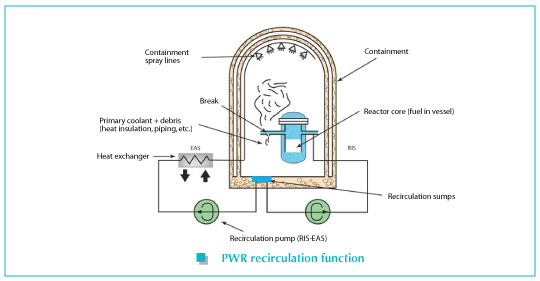 |
The main purpose of this reinjection of water into the primary system is to allow continued cooling of the reactor core, thus avoiding a serious core melt accident. This system is called the recirculation function and constitutes a fundamental "line of defence" in preventing a core melt accident in pressurised water reactors. Given the flow of water in the reactor building, the debris generated by the pipe break (particles of insulation material, concrete or paint) are likely to reach the sump filters. This results in a risk of sump clogging and of foreign bodies entering the systems, with possible malfunction of the recirculation function. These physical phenomena were indeed taken into account in nuclear reactor design. However, experience feedback and studies conducted at an international level for the past ten years or so have led the ASN to question the pertinence of the rules used for the design of the filtration systems. |
