| 3.5.2 The use of nickel-based alloys | |
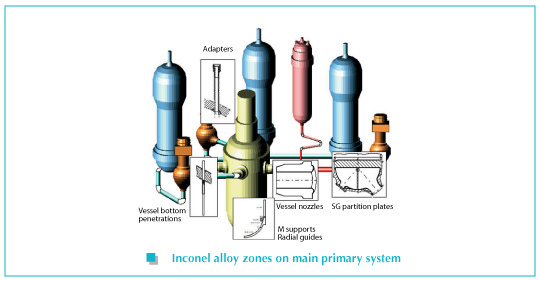
Several parts of PWR reactors are made of nickel-based alloys: in the steam generators, the tubes, the partition plate, the coating of the primary side of the tubesheet; in the vessel, the vessel head adapters, the vessel bottom head penetrations, the internals lower guide support welds, the repaired nozzle areas. The use of this type of alloy is justified by its resistance to generalised or pitting corrosion. However, in reactor operating conditions, one of the alloys adopted, Inconel 600, proved to be susceptible to stress corrosion. This particular corrosion phenomenon occurs when there are high levels of mechanical stress. It can lead to the appearance of cracking, sometimes rapidly as is the case on the steam generator tubes in the early 1980s, or on the 1300 MWe reactors pressuriser instrumentation taps at the end of the 1980s. The ASN asked the licensee to adopt an overall surveillance and maintenance approach for the zones concerned. Further to its decision 010067 of 5 March 2001 (available on the www.asn.gouv.fr website), a number of main primary system zones made of Inconel 600 alloy are now subject to particularly close inspection. For each one, the in-service surveillance programme, defined and updated annually by the licensee, has to meet requirements concerning the inspection objectives and frequencies. In addition, steam generators and vessel closure heads are covered by a major replacement programme (see § 3.5.3 and 3.5.4). In 2004, cracks attributable to stress corrosion were discovered on the partition plate in a steam generator which hitherto had not been considered by EDF to be susceptible to this type of damage. The ASN therefore asked EDF to adapt its maintenance strategy to take account of this unexpected damage. EDF made a number of commitments, in particular to develop automatic tools for inspecting and repairing these zones more easily. This was partially completed in 2005. A process for ultrasound characterisation of crack geometry was developed and deployed on several steam generators for a trial period. |
|
 |
|
