 |
4 | RADIATION PROTECTION AND ENVIRONMENTAL PROTECTION |
 |
4.1 | Radiation protection of persons working in nuclear power plants |
In a nuclear power plant, ionising radiation comes from a variety of sources, including:
About 80% of worker dosimetry is received during reactor outage maintenance work. EDF policy In 1999, EDF undertook to improve radiation protection and establish a level of requirements for it, comparable to that for safety, in particular by:
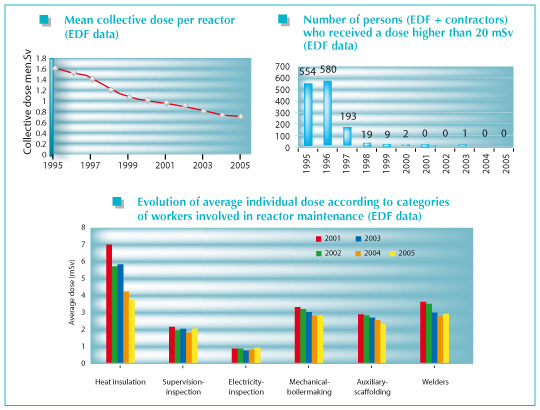
The ASN considers that this process, which has been in progress for 6 years, is now able to remedy the problems encountered by the plants. It has led to a significant reduction in worker dosimetry, in particular collective dosimetry, as illustrated by the following graphs. ASN assessment and actions taken In 2005, the ASN checked that EDF had correctly taken account of the requests made further to the assessments and inspections carried out between 2002 and 2004 on the pressurised water reactors. The results of these actions and the corresponding conclusions are presented in section 6.1 of this chapter. At the same time, the ASN has made changes to its supervision of worker radiation protection in nuclear power plants. The main efforts in this field chiefly concerned:
An example of this last point is the analysis in 2005 of a particular operation which showed that application of the optimisation approach was satisfactory. However, the ASN asked that the dosimetric model used to estimate the doses prior to the work be improved, along with EDF's ability to put to good use the lessons learned from previous worksites. |
||
 |
||
| Finally, the ASN initiated work in 2005 to compare radiation protection assessment methods in PWRs, through exchanges with the Spanish, American and Belgian nuclear regulators. Particular points The ASN supervised an experiment carried out by EDF and authorised in 2004, to inject zinc into the water of the primary system. This is part of an overall process to reduce collective dosimetry based on changes to the chemistry of the primary fluid in order to reduce the quantity of radioactive particles in the reactor systems. Incidents A specific analysis of significant radiation protection incidents declared is presented in point 5.1.2. A detailed analysis is given per origin and per subject. |
||
