| 4.2.3 Radioactive discharge values | |
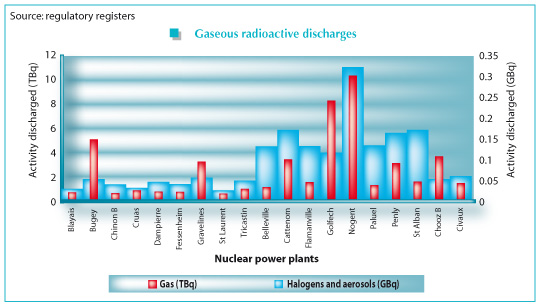
Discharges in 2005 Every month the licensee communicates its discharge results to the ASN. These data are regularly cross-checked against reactor operation during the period considered. Anomalies detected give rise to requests for complementary information from the licensee. The 2005 results concerning radioactive effluent discharges are presented in the following graphs. The "Liquid radioactive discharge" graph presents the 2005 discharges of liquid tritium and liquid non-tritium (carbon 14, iodine 131, nickel 63 and other beta and gamma emitting radionuclides) per pair of reactors. The "gaseous radioactive discharge" graph presents the 2005 discharge of gases (carbon 14, tritium and rare gases) as well as halogens and aerosols (iodines and other beta and gamma emitting radionuclides) per pair of reactors. The gas discharge activity of the Nogent-sur-Seine nuclear power plant in 2005 is higher than the average with respect to two parameters. For the "halogens and aerosols" parameter, this is due to higher iodine releases than in the first quarter of 2005, mainly as a result of high iodine activity in the primary system resulting from loss of tightness of the fuel cladding and the presence of a leak in a system carrying primary coolant. For the "gas" parameter, this is due to higher releases of rare gases, mainly as a result of loss of tightness of the fuel cladding and the leak as mentioned above. "Halogen and aerosol" gaseous discharges from the Golfech and Gravelines nuclear power plants in 2005 were also higher than the average for their respective plant series (1300 MWe and 900 MWe). This is explained by the higher releases of iodine, mainly due to the loss of tightness of the fuel cladding in reactor No. 1 at Golfech and reactor No. 6 at Gravelines |
|
 |
|
