| 1.1.3 Primary and secondary systems | |
The primary and secondary systems are used to transport the heat released in the core to the turbine, which produces electricity, without any of the water in contact with the core leaving the containment. The primary system extracts the heat released in the core by circulating pressurised water, known as the primary water, in the cooling loops (3 loops for a 900 MWe reactor, 4 loops for a 1300 MWe or 1450 MWe reactor). Each loop, connected to the reactor vessel containing the core, comprises a circulating, or primary pump, and a steam generator. The primary water, heated to more than 300 °C, is kept at a pressure of 155 bar by the pressuriser, to prevent it boiling. The entire primary system is located inside the containment. In each steam generator, the primary system water transfers the heat produced by the reactor core to the water in a secondary system, without coming into contact with it. The steam generators contain thousands of tubes through which the primary water circulates. These tubes are immersed in the water of the secondary system and boil it. Each secondary system primarily consists of a closed loop through which water runs in liquid form in one part and as steam in another part. The steam produced in the steam generators is partly expanded in a high-pressure turbine and then passes through superheater separators before final expansion in the low-pressure turbines, from which it is then routed to the condenser. The condensed water is sent back to the steam generators by the extraction pumps relayed by feed pumps through low and high pressure reheaters. |
|
| 1.1.4 Reactor containment building | |
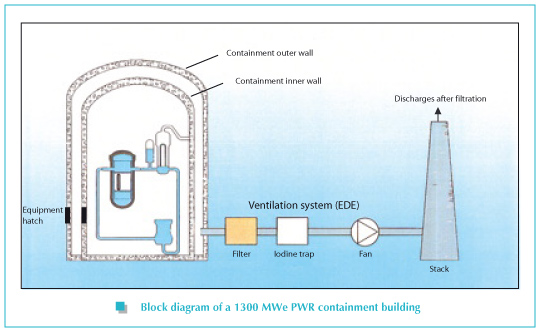
The PWR
containment building has two functions:
|
|
 |
|
