 |
1.4 | Protection of persons exposed to TENORM |
 |
1.4.1 Protection of persons exposed to radon | |
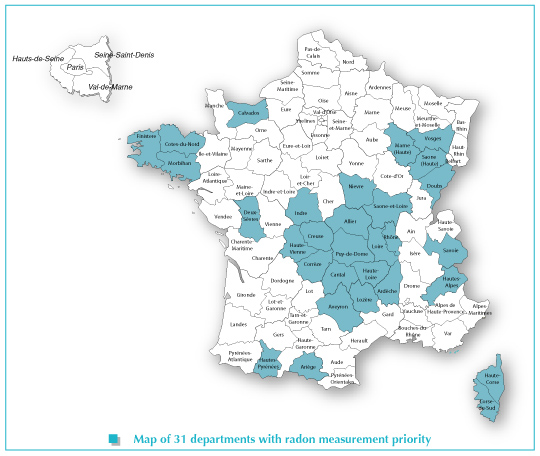
The regulatory framework applicable to management of the radon-related risk in premises open to the public (article R. 1333-15 of the Public Health Code) introduces the following clarifications: • the radon monitoring obligation applies in geographical areas in which radon of natural origin is likely to be measured in high concentrations and in premises in which the public is likely to stay for extended periods; • the measurements will be made by organisations approved by the Minister for Health, these measurements being repeated every 10 years and whenever work is carried out to modify the ventilation or the radon tightness of the building. In addition to introducing action trigger levels of 400 and 1000 Bq/m3, the implementing order of 22 July 2004 concerning management of the radon risk in premises open to the public defined geographical areas and premises open to the public for which radon measurements are now mandatory: the geographical areas correspond to the 31 departments classified as having priority for radon measurement (see map enclosed); the categories of premises open to the public cover teaching institutions, health and social institutions, spas and penitentiaries. The obligations of the owner of the facility are also specified when the action trigger levels are found to have been exceeded. The conditions for accreditation of the organisations authorised to carry out activity concentration measurements were defined in the order of 15 July 2003 concerning the accreditation of organisations responsible for measuring radon. The list of accredited organisations was updated by three orders published in 2005, on the opinion of the accreditation committee comprising representatives of the ministries concerned, of technical bodies (IRSN, Building industry's scientific and technical centre, French higher public health council), construction professionals and professionals concerned by radon measurement. The order of 22 July 2004 was accompanied by publication in the Official Gazette of a notice defining the applicable standards for radon measurement (Official Gazette of 12 August 2004) and another notice concerning definition of the actions and work to be carried out in the event of these 400 and 1000 Bq/m3 action trigger levels being exceeded (Official Gazette of 22 February 2005). In the residential field, the National health and environment plan
has defined a number of priorities which include regulatory action to
deal with the radon risk: Finally, in the working environment, the new article R. 231-115 of the Labour Code requires the head of the facility to take radon activity measurements and take the steps needed to reduce exposure when the measurement results reveal an average radon concentration of more than 400 Bq/m3. An order defining the workplaces in which these measurements are required should be published in 2006. |
||
 |
||
| |
||