Presentation and objectives
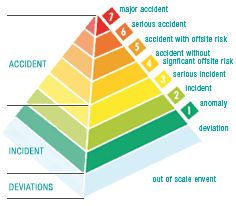
In the same way as for natural phenomena such as earthquakes, wind and avalanches, France in 1987 set up a scale of severity for nuclear events, which the IAEA used extensively as a basis for the INES scale (International Nuclear Event Scale). This scale, which was implemented internationally in 1991, is based partly on objective and partly on subjective criteria. It is used by about sixty countries and its purpose is to facilitate media and public perception of the scale of any nuclear incidents. It is not an assessment tool and cannot in any circumstances be used as a basis for international comparison. There is in particular no strict correlation between the number of non-serious incidents declared and the probability of a serious accident occurring in a facility.
Nature of the events rated on the INES scale
The INES scale is designed to cover events occurring in all civil nuclear installations, including those classified as secret, and during nuclear material transports. These events are rated by ASN on 8 levels from 0 to 7, depending on their severity. Application of the INES scale to nuclear installations is based on three rating criteria (columns 2, 3 and 4 of the following table):
- off-site impact, assessed in terms of radioactive releases that can affect the public and the environment;
- on-site impact, which can affect workers and the conditions of the installations;
- degradation of the lines of defence in depth of the installation, consisting of successive barriers (safety systems, procedures, technical or administrative checks, etc.) placed between the radioactive products and the environment. For transport of radioactive materials on the public highway, only the off-site impact and degradation of the defence in depth criteria are used for application of the INES scale.
Examples of events rated on the INES scale
Level 0. In France: several hundred events are rated level 0 every year. They concern deviations from the normal operation of the facilities or the normal transport of radioactive materials, but which have no impact in terms of safety.
Level 1. In France: about a hundred events are rated level 1 every year. These comprise anomalies, deviations from facility normal operating conditions or from normal transportation operations, owing to equipment failure, human error, or inadequate compliance with procedures.
Level 2. In France: •2006• Incorrect use of a MOX fuel fabrication scrap crusher in the Plutonium Technology Facility (ATPu) on the Cadarache site, following application of inappropriate and informal procedures and instructions. •2005• anomaly concerning certain safety pumps in EDF’s 900 MWe reactors which could, in certain accident situations, lead to loss of the cooling water recirculation function. |
|
•2004• generic anomaly affecting certain marshalling boxes in EDF nuclear power plants. This could have prevented various items (motors, valves) from operating in accident conditions involving the presence of water or steam in the reactor building. 2003: anomaly concerning the nuclear reactor cooling water recirculation system which could, in certain accident conditions, lead to clogging of the recirculation system sump filters for all the PWR reactors.
Level 3. In France: •2002• incident rated by the Swedish competent authority during transport by Federal Express (FedEx) between Sweden and the United States, via Roissy airport, of a package which at arrival registered a dose rate higher than the acceptable regulatory limit. •1981• fire in a storage silo at La Hague. Abroad: •2005• detection of a radioactive leak from a pipe between the dissolver and a tank in the Thorp fuel reprocessing plant in Sellafield (United Kingdom). •2002• on the Davis Besse power plant reactor (United States) discovery of a cavity in the reactor vessel closure head caused by boric acid corrosion of the metal. •1997• fire and explosion in a low-level effluent bituminization facility in Tokai-Mura, Japan, with acute irradiation of three workers, two of whom subsequently died.
Level 4. In France: •1980• damage to the core of the Saint- Laurent A1 reactor. Abroad: •1999• criticality accident in a fuel fabrication facility in Tokai-Mura, Japan, with acute irradiation of three workers, two of whom subsequently died. •1973• release of radioactive material following an exothermal reaction in a reprocessing tank in the Windscale plant (United Kingdom).
Level 5. In France: none. Abroad: •1979• partial meltdown of the Three Mile Island reactor core in the United States.
Level 6. In France: none. Abroad: •1957• explosion of a tank of radioactive products in the Kyshtym reprocessing plant in the USSR.
Level 7. In France: none. Abroad: •1986• explosion of reactor 4 in the Chernobyl nuclear power plant in Ukraine.
Use of the INES scale in France
All nuclear safety-significant events are reported by the licensees to ASN within 24 hours. This notification comprises a proposed rating on the INES scale, to be approved by ASN, which has full responsibility for the final rating decision. Using the INES scale enables ASN to select those events and incidents which are sufficiently important for it to issue a communication:
- all incidents rated level 1 and above are systematically published on the ASN’s asn.fr website. Journalists are informed of incidents rated level 2 and above by press releases and telephone calls;
- incidents rated level 0 are not necessarily made public by ASN. They may be published if of particular interest to the media.
|
Experimental classification of a radiation protection event on the INES scale
Following a proposal by ASN in 2003, the IAEA member states are experimenting with a new part of the INES scale applicable to radiation protection incidents, taking account of radioactive sources and radioactive material transport. This new part, which in France concerns only BNIs, includes the principle of the relationship between the radiological risk and the severity of the incident. Its experimental application to medical installations (excluding patients), industrial facilities or research establishments is in process. Publication of a new INES manual by IAEA in 2008 will mark the end of this trial period.
Together with the French Oncology Radiotherapy Society (SFRO), ASN also began a one year trial period in July 2007 for a radiotherapy incident rating scale based on the INES scale.
| EVENT |
NUMBER OF EXPOSED INDIVIDUALS AND FINAL RATING |
| Minimum rating |
Number of individuals |
Final rating* |
| Death or lethal dose received |
4 |
> 10 |
6 |
| > 1 |
5 |
| 1 |
4 |
| Deterministic effect or potential deterministic effect according to the dose received |
3 |
> 10 |
5 |
| > 1 |
4 |
| 1 |
3 |
Exposure higher
than 1 Sv or 1 Gy |
4 |
> 100 |
6 |
| > 10 |
5 |
| ≤ 10 |
4 |
Exposure higher
than 100 mSv |
3 |
> 100 |
5 |
| > 10 |
4 |
| ≤ 10 |
3 |
| Worker exposure to a dose higher than the regulation annual limit or exposure of a member of the public to a dose higher than 10 mSv |
2 |
> 100 |
4 |
| > 10 |
3 |
| ≤ 10 |
2 |
| Worker exposure to a dose higher than one quarter the regulation annual limit or exposure of a member of the public to a dose higher than the annual dose limit |
1** |
> 100 |
3 |
| > 10 |
2 |
| ≤ 10 |
1 |
* Select the higher rating
** When a dose limit is exceeded as a result of accumulated exposure over a given period of time, ASN systematically attributes a level 1 rating because of the lack of safety culture
[ top ]
|



 In the same way as for natural phenomena such as earthquakes, wind and avalanches, France in 1987 set up a scale of severity for nuclear events, which the IAEA used extensively as a basis for the INES scale (International Nuclear Event Scale)...