


 183 / 536

model to enable visitors to discover the principles and
effects of radioactivity, to learn hownuclear power plants
function and the way in which they are regulated and
overseen. During the year it was presented to the public
in schools and in themunicipalities located near nuclear
power plants.
1. DEVELOPING RELATIONS BETWEEN
ASN AND THE PUBLIC
1.1 Opening to the public at large
and development of a risk culture
among citizens
ASNwishes to develop a nuclear risk culture by fostering
the involvement of the citizens in the subjects relating
to nuclear safety and radiation protection. To this end,
ASNuses several means of communication and delivers
transparent information in these areas.
1.1.1 The ASN Information Centre
The role of the ASN Information Centre is to inform
the public on nuclear safety and radiation protection:
it coordinates the processing of the demands addressed
to ASN (technical questions, requests for administrative
documents, environmental information, dispatching of
publications, document searches). It responded to nearly
2,000 requests from varied audiences in 2015.
The centre also has more than 3,000 documents relating
to nuclear safety and radiation protection, particularly
administrative documents (public inquiry files, impact
studies and annual reports from the licensees), which
are available for consultation. The public has access to
all the ASN publications and can consult the French
and international publications produced by various
stakeholders (CLIs, nuclear licensees, IRSN – Institute
of Radiation Protection and Nuclear Safety – and other
technical experts, learned societies, professionals, non-
governmental organisations).
Information sheets provide syntheses and educational
information on the broad subjects of nuclear safety and
radiation protection for the general public:
“The French
nuclear fuel cycle”; “Transport of radioactive substances”,
“The taking of stable iodine in the event of a nuclear accident”;
“The principles of radiation protection”; “Nuclear emergency
situations”.
The InformationCentre also hosts temporary exhibitions
on nuclear safety and radiation protection which are
free of charge and open to everyone. In 2015 the centre
hosted an exhibition created by ASN and IRSN entitled
“Nuclear Safety? A key issue!”
1.1.2 The ASN/IRSN exhibition
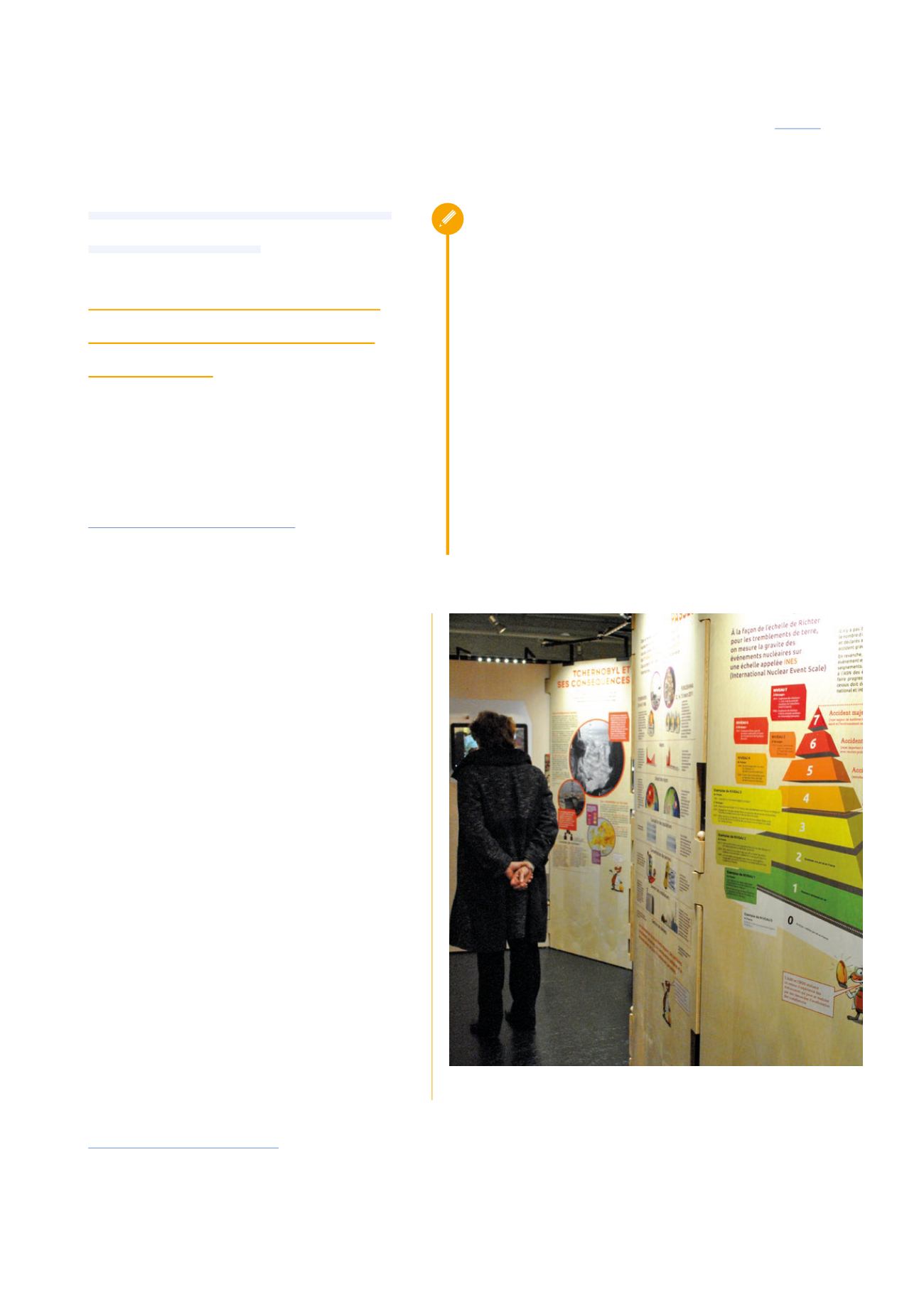
ASN and IRSN jointly created a road showwith the aim
of developing the nuclear risk culture of the citizens. The
exhibition comprises 10modules and features explanatory
display panels, documentary films and an animated reactor
“MORE risk culture in Dunkerque!”
ASN’s Lille division and IRSN deployed the exhibition
“Nuclear safety? A key issue!”
(see point 1.1.2) jointly
with their partners of the urban community of Dunkerque,
the Gravelines CLI and the National Association of Local
Information Committees (Anccli).
The exhibition was housed in the PLUS
(Palais de l’Univers
et des Sciences
– Palace of Science and the Universe) in
Cappelle-la-Grande from 17th September to 21st December
2015. It proposed an educational circuit comprising nearly
80 information boards, along with multimedia presentations
and personalised visits revolving around ten major themes.
A cycle of four conferences was also organised to discuss
with the public subjects such as the operating life of the
nuclear power plants, the lessons learned from Chernobyl and
Fukushima Daiichi, nuclear emergency situations and medical
uses of radiation.
TO BE NOTED
ASN/IRSN exhibition at the PLUS (Palace of Science and the Universe) in Cappelle-la-Grande,
near Dunkerque.
183
CHAPTER 06:
FROM INFORMATION TO TRANSPARENCY AND PUBLIC PARTICIPATION
ASN report on the state of nuclear safety and radiation protection in France in 2015