


 217 / 536

As inprevious years, several peer observations of inspections
were organisedwith ASN’s Belgian counterparts, whether
in the NPPs or in the field of small-scale nuclear activities.
Worth noting is the signature in March 2015 of a
convention on the rapid exchange of information between
ASN’s Châlons-en-Champagne, Lille and Strasbourg
divisions on the one hand, and AFCN on the other.
This convention concerns situations in sites holding
nuclear or radiological materials close to the Franco-
Belgian border. This convention came into effect on
1st March 2015.
The annual meeting of the Franco-Belgian steering
committee, co-chaired by Pierre-Franck Chevet and
Jan Bens, Director General of AFCN, was held on 28thMay
2015 at the AFCN headquarters in Belgium. On the
sidelines of this meeting, the ASN delegation visited
the Tihange NPP site and looked at the reinforcement
work currently in progress as part of the post-Fukushima
measures.
Since 2015, internal training has been organised by ASN
for AFCN and Bel V personnel. About ten staff members
from these entities were able to benefit from this training.
Conversely, two ASN staff members followed training
proposed by AFCN concerning the Belgian guides
published on the safety levels of the new reactors.
China
ASNand its Chinese counterpart, NNSA (National Nuclear
Safety Administration), renewed their overall nuclear
safety and radiation protection cooperation agreement in
2014, expanding the scope of this agreement to include
radioactive waste management and fuel cycle facilities.
The specific cooperation agreement on the EPRwas also
extended by five years.
A steering committee combining the French and Chinese
safety regulators thus met in Beijing on 20th and 21st July
2015. The ASNChairman, Pierre-Franck Chevet, and the
Deputy Minister in charge of environmental protection
and nuclear safety, Li Ganjie, the Administrator of the
NNSA, presented the activity of the two safety regulators
and the corresponding issues and challenges. To conclude
the exchanges between the two delegations, a cooperation
action plan between ASN and NNSA was drafted. It
comprises six topics, including greater cooperation
on the EPR, the safety of existing reactors, personnel
exchanges between the two regulators and information
of the public.
Following this meeting, the delegation headed by Pierre-
Franck Chevet went to the Taishan site where two EPR
reactors are being built. Somemembers of the delegation
also visited the Daya Bay NPP in Shenzhen, north of
Hong Kong.
The ASN Lyon division has also enjoyed close relations
with the NNSA’s Guangdong division for several years.
In January 2015, three inspectors from the Lyon division
thus took part in an in-depth inspection of the NNSA
concerning preparations for the first outage of reactor 1
on the Yang Jiang nuclear site. In return, in November
2015, three NNSA inspectors observed an ASNworksite
inspection on reactor 2 in the Cruas NPP. They also visited
the Areva nuclear fuels fabrication site in Romans-sur-
Isère (see chapter 8).
Within the framework of the Instrument for Nuclear
Safety Cooperation (INSC), the consortium set up by
ASN, comprising the nuclear safety regulators from
Spain (CSN, Consejo de SeguridadNuclear) and Finland
(STUK, Säteilyturvakeskus), along with the technical
support organisations from France (IRSN), Germany
(GRS, Gesellschaft für Anlagen und Reaktorsicherheit)
and Belgium (Bel V), in response to the call for proposals
from the European Commission, assisted China with its
process to improve the regulatory framework applicable
to nuclear safety. This assistance project, which began
in December 2013, will end in 2016.
This programme comprises six areas for work: firstly,
the aim is to support NNSA and its technical support
organisation the NSC (Nuclear Safety Center) in their
NPP reactor authorisation assessment procedures. The
second goal is to help them perform these assessments
in complete independence from the operator. The other
areas for work are: improving the evaluation procedures
for new technologies (of particular importance because
China is currently building new reactors), flood protection
in theNPPs and the development of operating experience
feedback analysis. Finally, the aim is to reinforce the
safety culture of our counterparts.
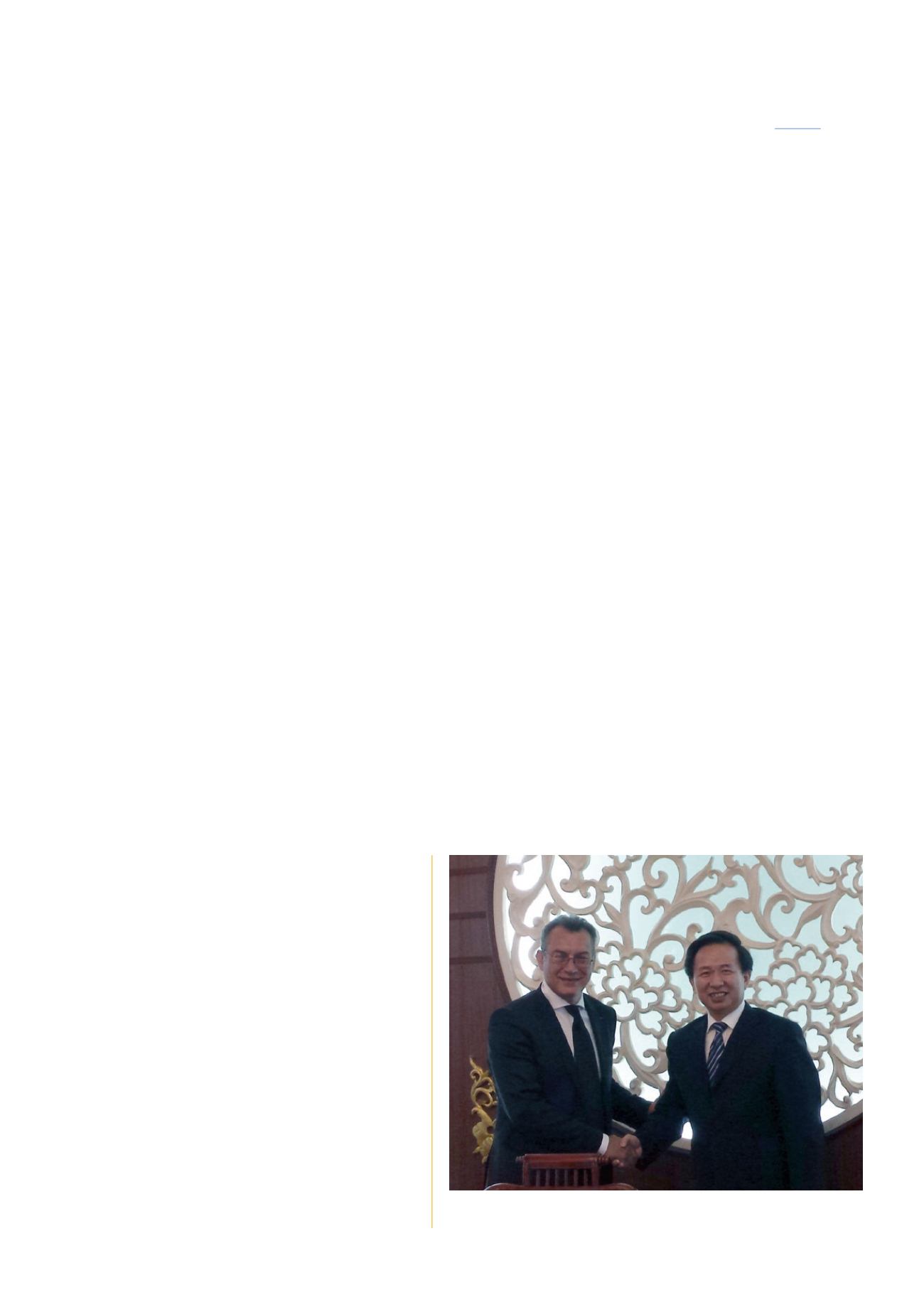
ASN-NNSA bilateral meeting In Beijing (China), 19th-23rd July 2015. Pierre-Franck Chevet and Ganjie Li,
Deputy Minister responsible for environmental protection and nuclear safety, Administrator of the NNSA.
217
CHAPTER 07:
INTERNATIONAL RELATIONS
ASN report on the state of nuclear safety and radiation protection in France in 2015