


 384 / 536

2.9 NPP operating life extension
Although the regulations governing the operation of
the NPPs in France set no time limit for their operating
authorisation, Article L.593-18 of the Environment
Code states that the licensee must carry out a periodic
safety review of each reactor every ten years.
2.9.1 The age of NPPs
The NPPs currently in operation in France were built
over a relatively short period of time: forty-five reactors,
representing 50,000 MWe, or three quarters of the
power output by the French fleet, were commissioned
between 1980 and 1990 and seven reactors, representing
a further 10,000 MWe, between 1991 and 2000. In
December 2015, the average ages of the reactors,
calculated from the date of initial reactor criticality,
were as follows:
•
34 years for the thirty-four 900 MWe reactors;
•
28 years for the twenty 1,300 MWe reactors;
•
18 years for the four 1,450 MWe reactors.
2.9.2 The main challenges in managing ageing
Like all industrial installations, NPPs are subject to ageing.
ASN ensures that, in line with its general operating and
maintenance strategy, EDF takes account of ageing-related
phenomena in order to maintain a satisfactory level of
safety throughout the operating life of the facilities.
To understand the ageing of anNPP, apart from the time
elapsed since its commissioning, other factors must be
taken into account, in particular physical phenomena
that can modify the characteristics of the equipment,
depending on its function or conditions of use.
Deterioration of replaceable items
Equipment ageing is the result of phenomena such as the
hardening of certain steels under the effect of irradiation
or temperature, the swelling of certain concretes, the
hardening of polymers, corrosion of metals and so on.
These degradations are generally considered at the design
andmanufacturing stages and then in a monitoring and
preventive maintenance programme, or even a repair or
replacement programme as necessary.
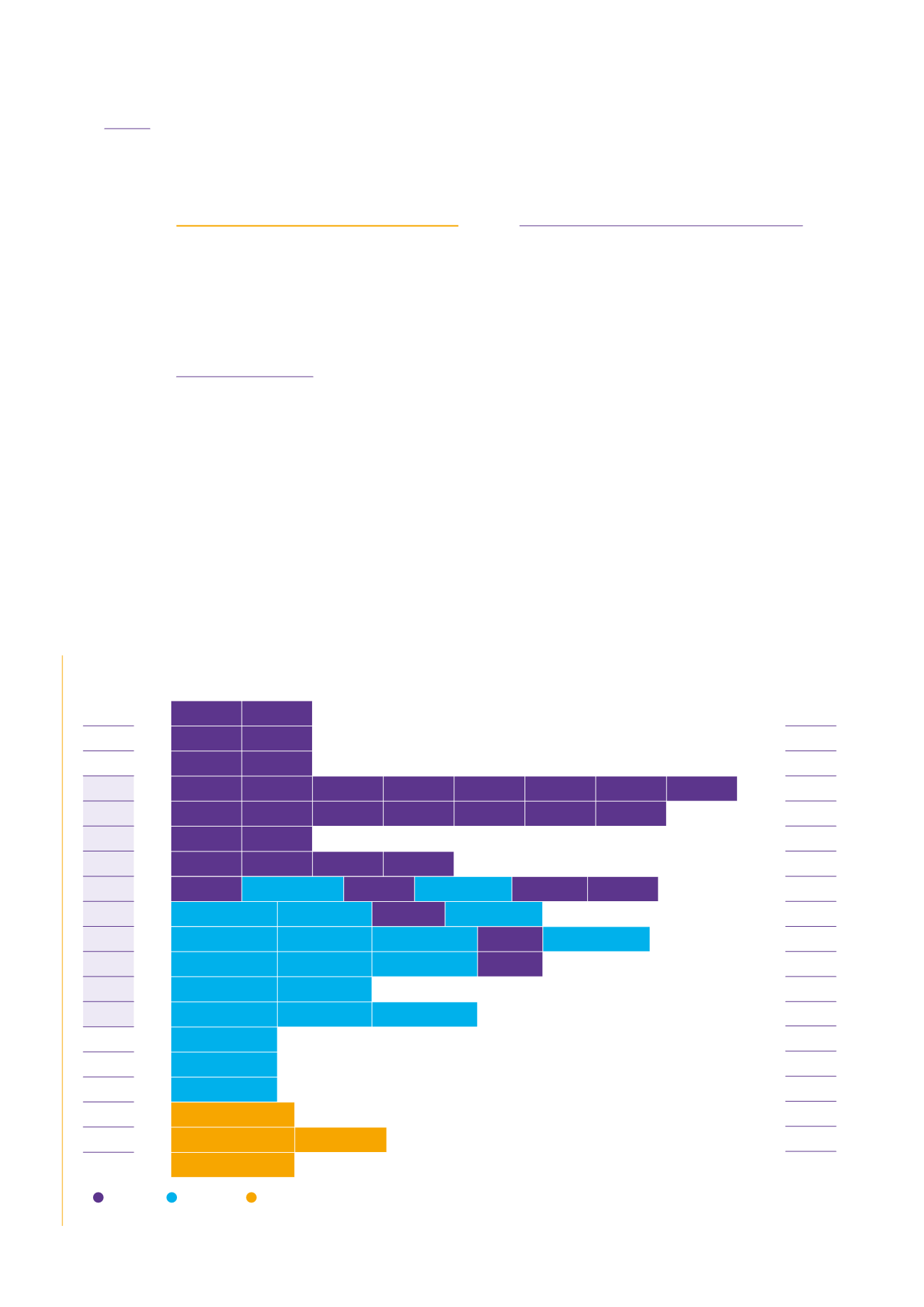
AGE PYRAMID
of the French nuclear power generating reactors (NPP fleet in France as at end of 2015; by date of 1st criticality; power per reactor)
Fessenheim 1 Fessenheim 2
Bugey 2
Bugey 3
Bugey 4
Bugey 5
Tricastin 1
Gravelines 1
Tricastin 2
Tricastin 3
Gravelines 2
Dampierre 1
Gravelines 3 Saint-Laurent B1
Dampierre 2 Saint-Laurent B2
Blayais 1
Dampierre 3
Tricastin 4
Gravelines 4
Dampierre 4
Blayais 2
Chinon B1
Cruas 1
Blayais 4
Blayais 3
Chinon B2
Cruas 3
Paluel 1
Cruas 2
Paluel 2
Gravelines 5
Cruas 4
Saint-Alban 1
Paluel 3
Gravelines 6
Flamanville 1
Paluel 4
Saint-Alban 2
Flamanville 2
Chinon B3
Cattenom 1
Cattenom 2
Nogent 1
Belleville 1
Chinon B4
Belleville 2
Nogent 2
Cattenom 3
Penly 1
Golfech 1
Cattenom 4
Penly 2
Golfech 2
Chooz B1
Chooz B2
Civaux 1
Civaux 2
1977
1978
1979
1980
1981
1982
1983
1984
1985
1986
1987
1988
1990
1991
1992
1993
1996
1997
1999
1,800 MWe
1,800 MWe
1,800 MWe
7,200 MWe
6,300 MWe
1,800 MWe
3,600 MWe
6,200 MWe
4,800 MWe
6,100 MWe
4,800 MWe
2,600 MWe
3,900 MWe
1,300 MWe
1,300 MWe
1,300 MWe
1,450 MWe
2,900 MWe
1,450 MWe
Global power
Date of
1st criticality
Source: ASN.
1,300 MWe
1,450 MWe
900 MWe
384
CHAPTER 12:
EDF NUCLEAR POWER PLANTS (NPPs)
ASN report on the state of nuclear safety and radiation protection in France in 2015