


 319 / 536

Moreover, the still incomplete use of dosimetry and the
lack of appropriate dosimetricmonitoring, in particular of
the extremities for certain fluoroscopy-guided procedures,
and the absence ofmedical monitoring of the practitioners,
make it difficult to assess the status of worker radiation
protection in this sector. ASNdoes nevertheless observe
improvements in the inspected departments and greater
awareness of the professionals as a result of the information
feedback from notified events.
For the PCRs, there are still methodological and
organisational difficulties and they do not always have
the means enabling them to perform their duties in full.
Moreover, in the private sector, the analyses of private
practitioners’ working practices and conditions, their
dosimetric monitoring, their medical monitoring and,
where applicable, that of their employees, represent a
recurrent difficulty.
5.7.2 Radiation protection of patients
in interventional radiology
The findings established on completion of the inspections
in 2014 with regard to patient radiation protection also
confirm the observations made over the last few years.
This holds true for the shortcomings observed in the
application of the principle of dose optimisation, be it
in the setting of the machines and the protocols used or
in the practices. They result from insufficient operator
training in patient radiation protection and sub-optimal
use of the radiology devices, as the dose optimisation
functions of the devices are insufficiently well known.
A significant improvement is however observed in
the dedicated facilities, particularly in cardiology and
neuroradiology, where dosimetric reviews are becoming
more widespreadwith a view to optimising procedures;
reference levels for the most common examinations are
increasingly set at local level. This approach also enables
appropriate medical monitoring of the patient to be
organised according to the dose levels received.
Assessments of professional practices are rare in the
areas of interventional radiology and fluoroscopy-guided
procedures. The specialities inwhich in the assessment of
practices ismost widespread are neuroradiology, vascular
surgery and coronarography, for which between 20 and
30% of the departments inspected had conducted an
assessment. These assessments of practices are virtually
inexistent in the other specialities, although it must be said
that the number of departments inspectedwas very low.
The low level of use of medical physicists in departments
practicing interventional radiology hinders implementation
of the principle of optimisation: greater involvement of
medical physicists would more specifically allow better
use of the equipment and the application of protocols
adapted to the procedures performed. When medical
centres call upon outside medical physics service
providers, it is observed that the centres rarely adopt
the procedures and documentation used by these service
providers. The analysis of the notified events, detailed
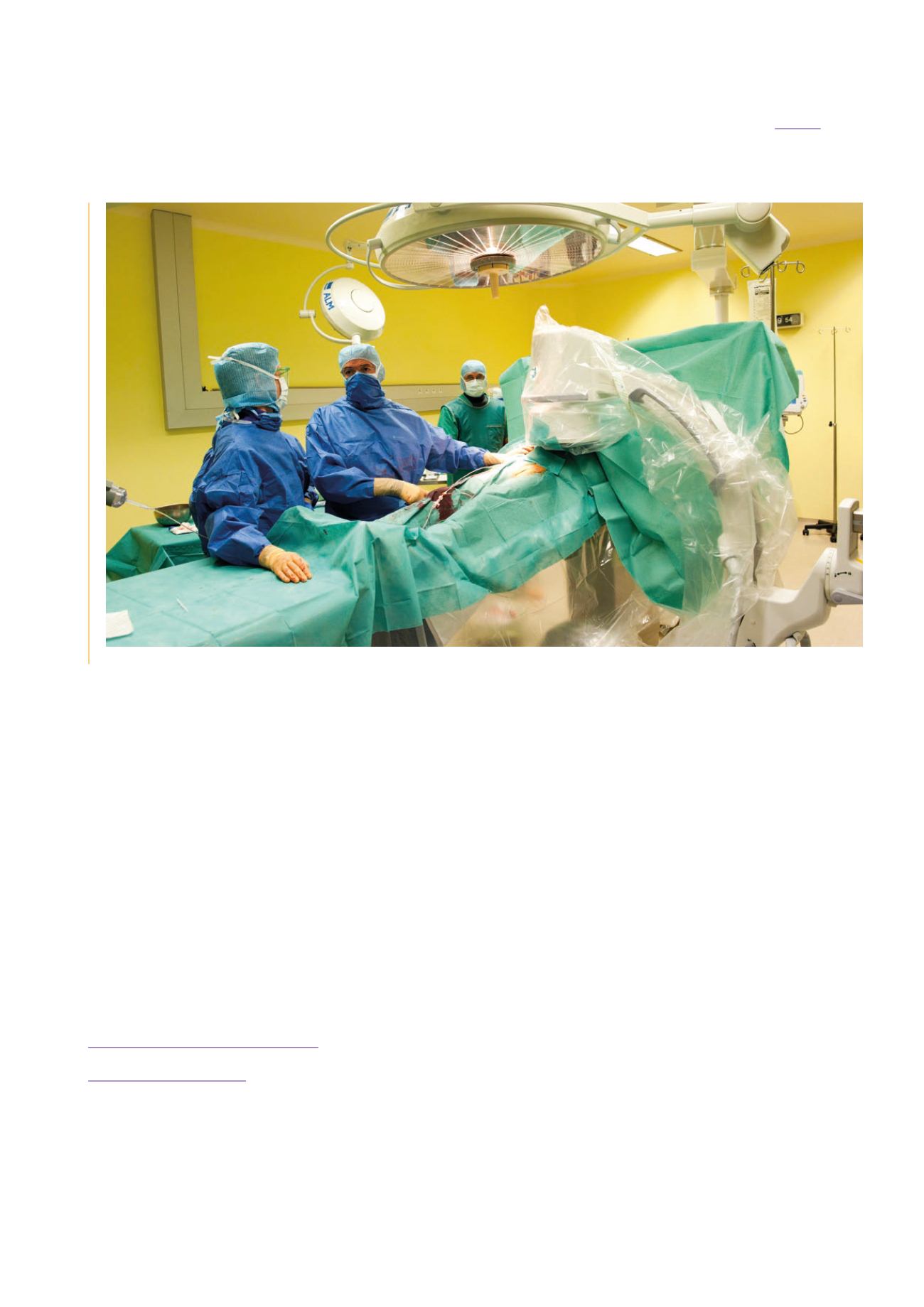
ASN inspection on the theme of interventional radiology, Villefranche-de-Rouergue hospital, December 2010.
319
CHAPTER 09:
MEDICAL USES OF IONISING RADIATION
ASN report on the state of nuclear safety and radiation protection in France in 2015