



 325 / 536

•
density measurement and weighing: the principle is the
same as for the above two measurements. The sources
usedare generally americium241 (activity level: 2GBq),
caesium-137, barium-137m(activity level: 100MBq) or
cobalt-60 (30 GBq);
•
soildensityandhumiditymeasurement(gammadensimetry)
inparticularinagricultureandpublicworks.Thesedevices
operate with a pair of americium-beryllium sources and
a caesium-137 source;
•
diagraphy (logging), which enables the geological
properties of the subsoil to be examined by inserting a
measurement probe comprising a source of cobalt-60,
caesium-137, americium-241 or californium-252.
1.1.3 Verification of physical parameters
The operating principle of these physical parameter
verificationdevices is the attenuationof the signal emitted:
the difference between the emitted signal and the received
signal can be used to assess the information looked for.
The radionuclides most frequently used are carbon-14,
krypton-85, caesium-137, americium-241, cobalt-60 and
promethium-147. The source activity levels are between a
fewkilobecquerels (kBq) and a fewgigabecquerels (GBq).
These sources are used for the following purposes:
•
atmospheric dust measurement; the air is permanently
filtered through a tape running at a controlled speed,
placed between source and detector. The intensity of
radiation receivedby the detector depends on the amount
of dust on the filter, which enables this amount to be
determined. The most commonly used sources are
carbon-14 (activity level: 3.5MBq) or promethium-147
(activity level: 9 MBq). These measurements are
particularly used for air qualitymonitoring by verifying
the dust content of discharges from plants;
•
paper weight (grammage)measurement: a beta radiation
beampasses through the paper and is then received by
a detector. The signal attenuation on this detector gives
the paper density and thus the grammage. The sources
used are generally krypton-85, promethium-147 and
americium-241with activity levels not exceeding 3GBq;
•
liquidlevelmeasurement:agammaradiationbeampasses
through the container holding the liquid. It is receivedby
adetectorpositionedopposite. The signal attenuationon
thisdetector indicates the filling level of the container and
automatically triggers certain operations (stop/continue
filling, alarm, etc.). The radionuclides used depend on
the characteristics of the container and the content. As
applicable, americium-241 (activity level: 1.7 GBq),
caesium-137 – barium-137m (activity level: 37 MBq)
are generally used;
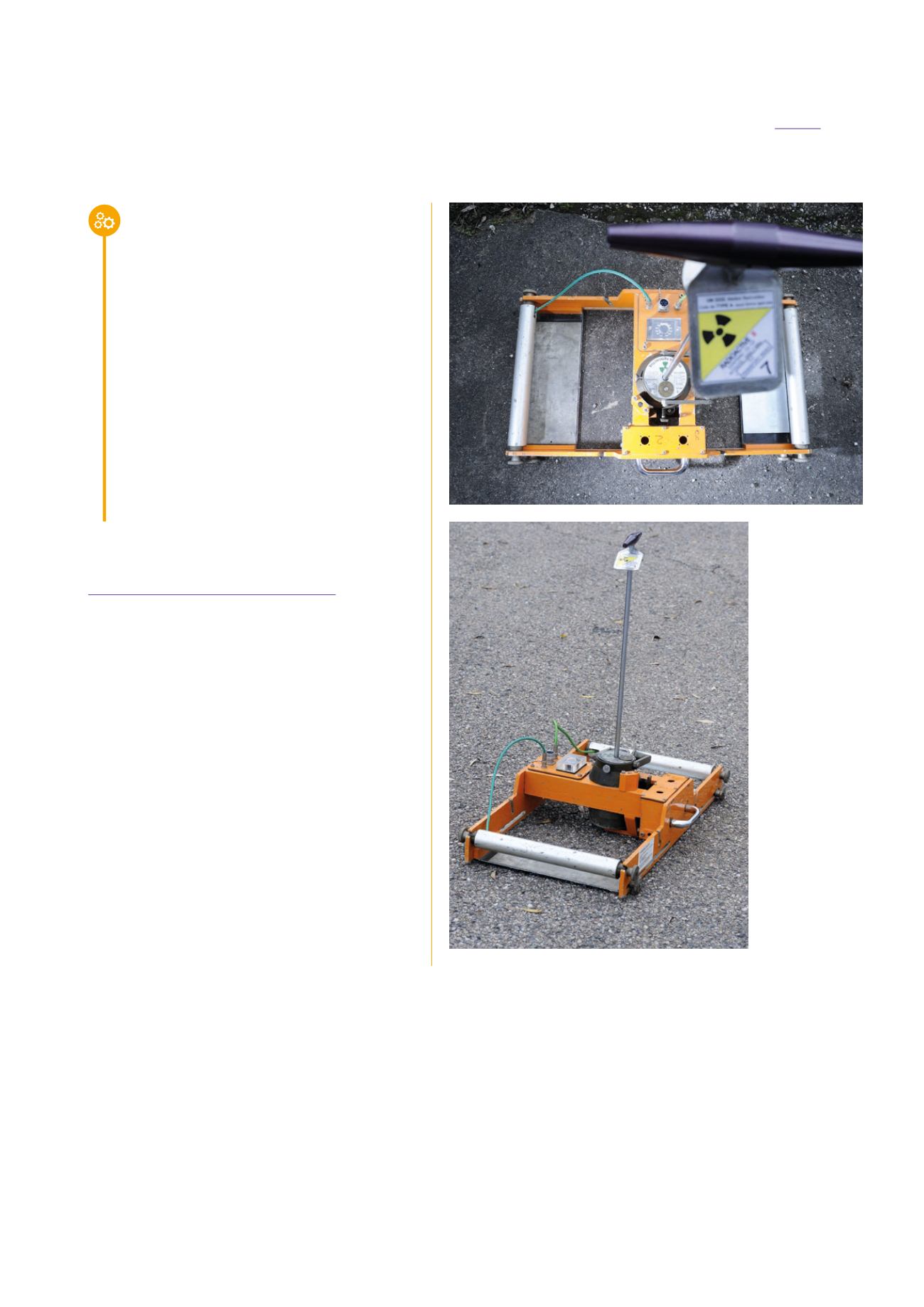
Mobile gamma ray densitometer.
Selenium-75 gamma radiography
The use of selenium in gamma radiography has been
authorised in France since 2006. Implemented in the same
devices as those functioning with iridium-192, selenium-75
offers significant radiation protection advantages in
gamma radiography. The equivalent dose rates are about
55 millisieverts (mSv) per hour and per TBq one metre from
the source, as opposed to 130 for iridium-192. In France
about 10% of gamma radiography devices are equipped with
selenium-75, and although its utilisation has been increasing
for a few years, ASN considers that it is still too little used
in industry. Yet it can be used in place of iridium-192 in
numerous industrial fields, especially the petrochemical
industry, and allows a significant reduction in the safety
perimeters required and facilitates intervention in the event of
an incident (see point 5).
UNDERSTAND
325
CHAPTER 10:
INDUSTRIAL, RESEARCH AND VETERINARY USES AND SOURCE SECURITY
ASN report on the state of nuclear safety and radiation protection in France in 2015