


 352 / 536

2. ROLES AND RESPONSIBILITIES
IN REGULATING THE TRANSPORT
OF RADIOACTIVE SUBSTANCES
2.1 Regulation of nuclear safety
and radiation protection
The objective of ensuring the safety of shipments of
radioactive substances is to prevent nuclear accidents
and their radiological consequences for people by
implementing organisational and technical measures.
In France, ASN has been responsible since 1997 for
regulating the safety of transport of shipments for civil
uses, while ASND (the Defence Nuclear Safety Authority)
fulfils this role for the shipments relating to national
defence. ASN’s action in the field of transport comprises:
•
checking, from the safety standpoint, all the stages
in the life of a package, from design and manufacture
through to maintenance;
•
checking compliance with the safety regulations during
the shipment and transportation of the packages.
Section 4 of this chapter gives more details on these
inspections.
2.2 Protection against malicious acts
The prevention of malicious acts consists in
preventing sabotage, losses, disappearances, theft and
misappropriation of nuclear materials that could be used
to manufacture weapons. The Defence and Security
High Officials (HFDS), under the Ministers responsible
for Energy and Defence, are the regulatory authority
responsible for preventingmalicious acts targeting nuclear
materials. In practice, it is the HFDS of the ministry in
charge of ecology that is delegated this role by the two
abovementioned HFDS.
2.3 Regulation of the transport
of dangerous goods
Regulation of the transport of dangerous goods is
monitored by theMTMD (Hazardous Materials Transport
Mission) of the Ministry of Ecology. This entity is tasked
with ensuring the measures relative to the safe transport
of dangerous goods other than class 7 (radioactive) by
road, rail and inland waterways. It has a consultative
body (CITMD – Interministerial Hazardous Materials
Transport Committee) that is consulted for its opinion
on any draft regulations relative to the transport of
dangerous goods by rail, road or inland waterway.
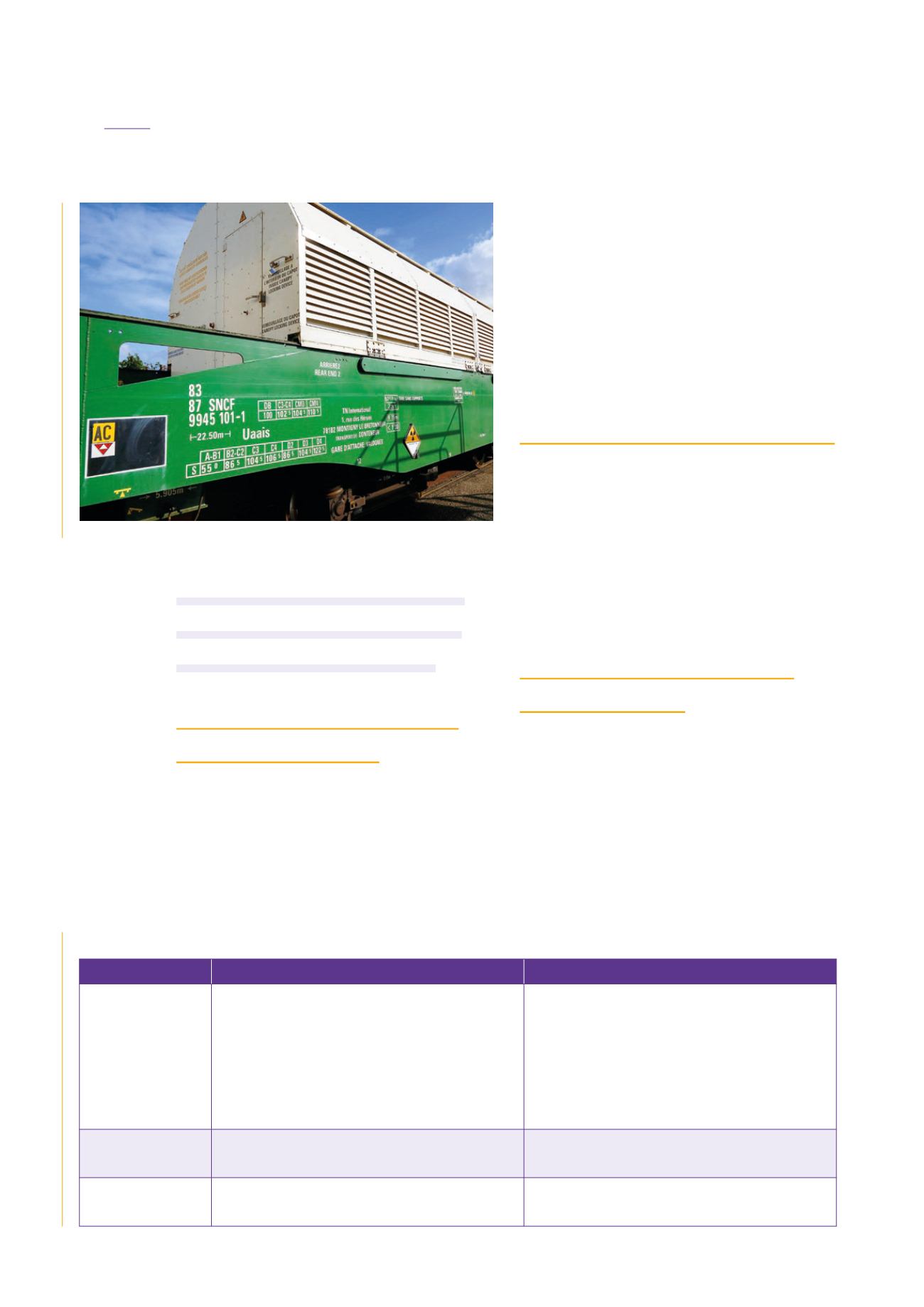
Wagon used to transport vitrified waste packages.
TABLE 2:
Administrations responsible for regulating the mode of transport and the package
MODE OF TRANSPORT
REGULATION OF MODE OF TRANSPORT
PACKAGE REGULATION
Sea
General Directorate for Infrastructures, Transports and the Sea (DGITM)
at the Ministry for the Environment, Energy and the Sea (MEEM).
ASN provides its assistance in regulating compliance with the prescriptions
contained in the International Code for the Safe Carriage of Irradiated Nuclear Fuel,
Plutonium and High-level Radioactive Wastes on Board Ships
(”Irradiated Nuclear Fuel” Code).
General Directorate for Energy and Climate (DGEC) of the Ministry of Ecology,
Energy and the Sea (”Irradiated Nuclear Fuel” Code).
The DGITM has competence for regulation of dangerous goods packages in general.
ASN is tasked with the regulation of packages of radioactive substances
Road, rail, inland waterways
General Directorate for Energy and Climate (DGEC)
of the Ministry of Ecology, Energy and the Sea (MEEM).
The General Directorate for the Prevention of Risks (DGPR) is responsible
for regulating packages of dangerous goods in general.
ASN is tasked with the regulation of radioactive substances
Air
General Directorate of Civil Aviation (DGAC) of the MEEM
The DGAC has competence for regulation of dangerous goods packages in general.
ASN is tasked with the regulation of packages of radioactive substances
352
CHAPTER 11:
TRANSPORT OF RADIOACTIVE SUBSTANCES
ASN report on the state of nuclear safety and radiation protection in France in 2015