


 347 / 536

protection issues on these facilities must be considered
as of the design stage. Application of the standards, in
particular standard NFM62-105
“Industrial accelerators:
installations”,
ISO 10648-2
“Containment enclosures”
and
ISO 17873
“Nuclear facilities – Criteria for the design and
operation of ventilation systems for nuclear installations
other than nuclear reactors”
, guarantees safe use of the
equipment and a significant reduction in risks.
The establishments that hold a cyclotron and use it
to produce radionuclides and products containing
radionuclides are subject to gaseous effluent discharge
limits specified in their license. The discharge levels
depend on the frequency and types of production
involved.
In order to minimise the activity discharged at the stack
outlet, systems for filtering and trapping the gaseous
effluents are installed in the production enclosures and
in the facilities’ extraction systems. Consequently, the
very low activities discharged and the short half-life of
the radionuclides discharged in gaseous form means
there is no impact on the public or the environment.
Some licensees have also installed, beside the shielded
enclosures, systems for recovering the gases to
allow their decay before their discharge, allowing a
substantial reduction in the activities discharged into
the environment.
ASNperforms about a dozen inspections on these facilities
every year. Aspects related to radiation protection, user
safety and the correct operation of cyclotrons and
production platforms receive particular attention during
the inspections. The scope of the inspections performed
includes – apart from the aspects relating to radiation
protection – the monitoring and maintenance of the
production equipment, the inspection of the surveillance
and control systems and the gaseous discharge results.
The radiation protection organisation of these facilities is
satisfactory and they are fully familiar with the regulations.
National action plans have been put in place by the
licensees and are monitored by ASN in order to ensure
continuous improvement of radiation protection and
safety in these facilities.
There are disparities in the technical and organisational
means implemented by the licensees according to the
age of the facilities and the type of activities performed
(research or industrial production). Experience feedback
in this area has led ASN to ask IRSN to establish
recommendations and requirements necessary for
the control of the radiological risks applicable to
establishments using a cyclotron and producing
radionuclides and products containing radionuclides.
A draft resolution on the minimum technical design,
operating andmaintenance rules for this type of facility is
currently being prepared by ASN and should be subject
to consultations in 2016.
Monitoring the protection of radioactive sources against
malicious acts
In 2014 and 2015, ASNbrought the subject of monitoring
the protection of radioactive sources against malicious
acts to the attention of Parliament through the review
of the Energy Transition for Green Growth Bill. The
legislative process started in 2008 by the Government
with the assistance of ASNwas recently concludedwith the
publication of Ordinance 2016-128 of 10thFebruary 2016
which includes the protection of radioactive sources
against malicious acts.
At the same time, in 2015ASN– alongwith its institutional
partners – continued the preparation of the implementing
texts necessary for the effective implementation of
monitoring and the steps undertaken since 2011 toproduce
an inventory of the existing facilities and anticipate staff
training and the development of appropriate tools for
rapid and effective implementation of this new duty.
In 2016 ASN will endeavour, with these same partners,
to continue the preparation of regulatory texts enabling:
•
the safety of the sources to be taken into account when
examining licensing applications;
•
the technical and organisational requirements for
protecting themost hazardous sources againstmalicious
acts to be defined;
•
the verification of the safety of sources to be organised.
These texts should come into effect as of July 2017.
To this end, ASN will adapt the tools it already uses
to monitor radiation protection, continue to train its
inspectors accordingly and communicate widely to the
entities concerned.
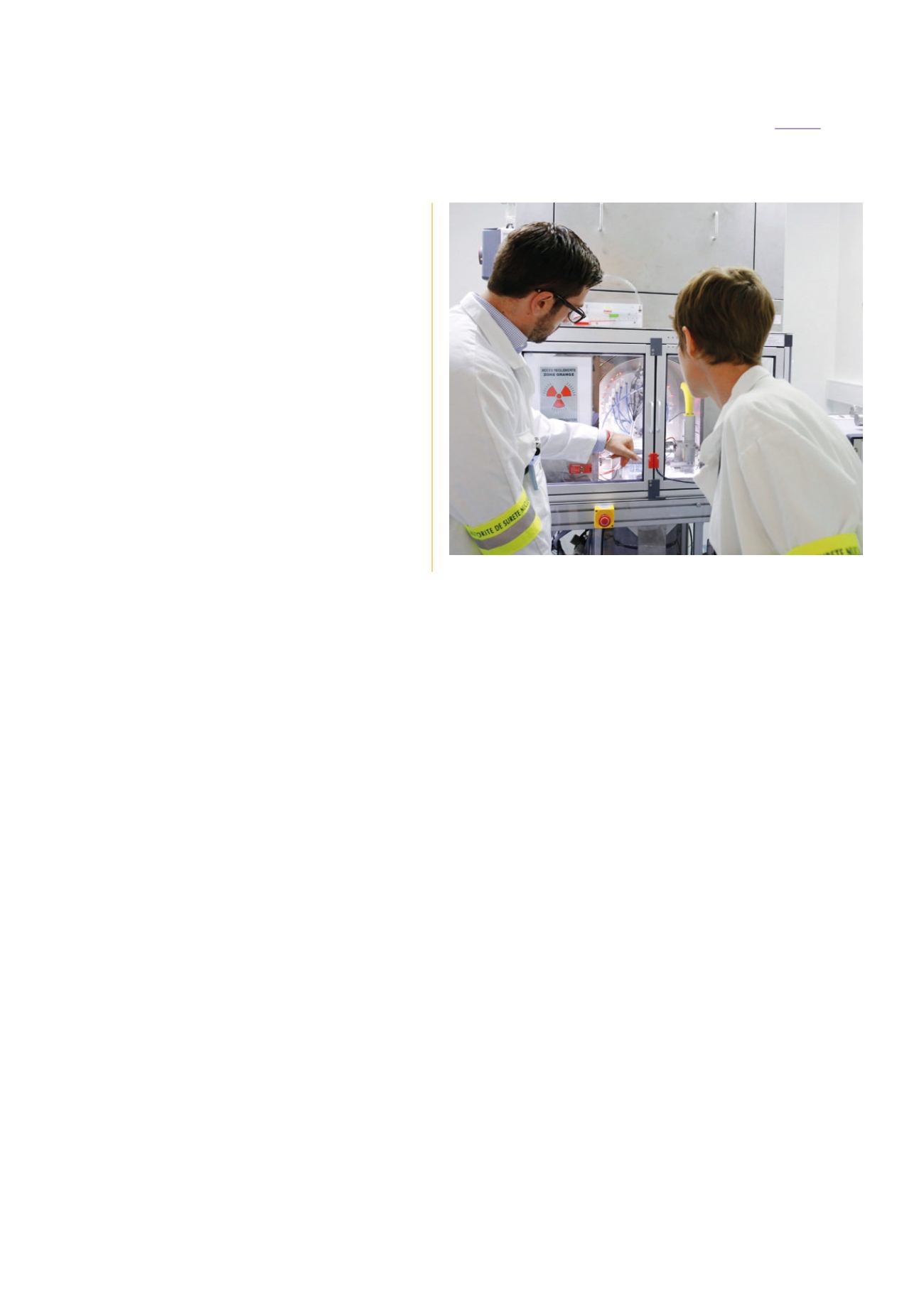
ASN inspection of the Arronax cyclotron, July 2015. Irradiated capsule receiving station.
347
CHAPTER 10:
INDUSTRIAL, RESEARCH AND VETERINARY USES AND SOURCE SECURITY
ASN report on the state of nuclear safety and radiation protection in France in 2015