


 354 / 536

3.2 Requirements applicable
to each type of package
The regulations define safety requirements for each type
of package, including tests to assess their robustness.
The regulations thus require that type A packages that
contain no fissile substances (such as enriched uranium),
be designed towithstand incidents that can occur during
handling or storage operations. They must therefore be
subjected to the following tests:
•
exposure to a severe storm (rainfall reaching 5 cm/
hour for at least 1 hour);
•
drop test onto an unyielding surface from a height
varying according to themass of the package (maximum
1.20 m);
•
compression equivalent to 5 times the weight of the
package;
•
penetration by dropping a standard bar onto the package
from a height of 1 m.
Additional tests are required if the content of the package
is in liquid or gaseous form.
Type A packages are not subject to ASN approval: the
design of the package and performance of the tests are
the responsibility of the manufacturer. These packages
and their safety demonstration files are inspected by the
ASN inspectors.
Type B packages, which are used to transport the most
dangerous substances, must be designed such that safety is
guaranteed, including in the event of a transport accident.
These accidents are represented by the following tests:
•
three consecutive tests:
-- a 9 m drop test onto an unyielding surface;
-- a 1 m drop onto a spike;
-- encircling fire of at least 800°C for 30 minutes;
•
immersion in 15 m deep water (200 m water depth
for spent fuel) for 8 h.
These tests, which are similar to the automotive industry’s
crash-tests, were recommended by IAEA. They have
been designed, firstly to cover 95% of the most severe
accidents, and secondly with the aim of being readily
reproducible from one country to another. These tests
are thus recognised and applied very widely by the IAEA
member countries. Their performance is obligatorywithin
the European Union.
3.3 Defining responsibilities
in the transport of radioactive
substances
The main participants in transport arrangements are
the consignor and the carrier.
The consignor is responsible for package safety and
accepts its responsibility by way of the dispatch note
accompanying the package remitted to the carrier. The
carrier is responsible for carriage of the shipment to its
destination. Other participants are also involved: the
package designer, manufacturer and owner and the
carriage commission agent (authorised by the consignor
to organise the transport operation).
For a radioactive substance shipment to be carried out
in satisfactory conditions of safety, a rigorous chain of
responsibility has to be set up. Therefore:
•
The corresponding packaging must be designed and
sized in accordance with the conditions of use and the
current regulations. The designermust have submitted
an application for ASN approval and obtained it.
•
Themanufacturermust producepackaging inaccordance
with the description given in the approval.
•
The consignormust check that thematerial is authorised
for transport andonlyuse approved, correctlymaintained
packagings that are suitable for the goods in question
and complywith requirements concerning themode of
transport and the shipment restrictions. The consignor
mustmore particularly carry out the leaktightness, dose
rate, temperature and contamination inspections and
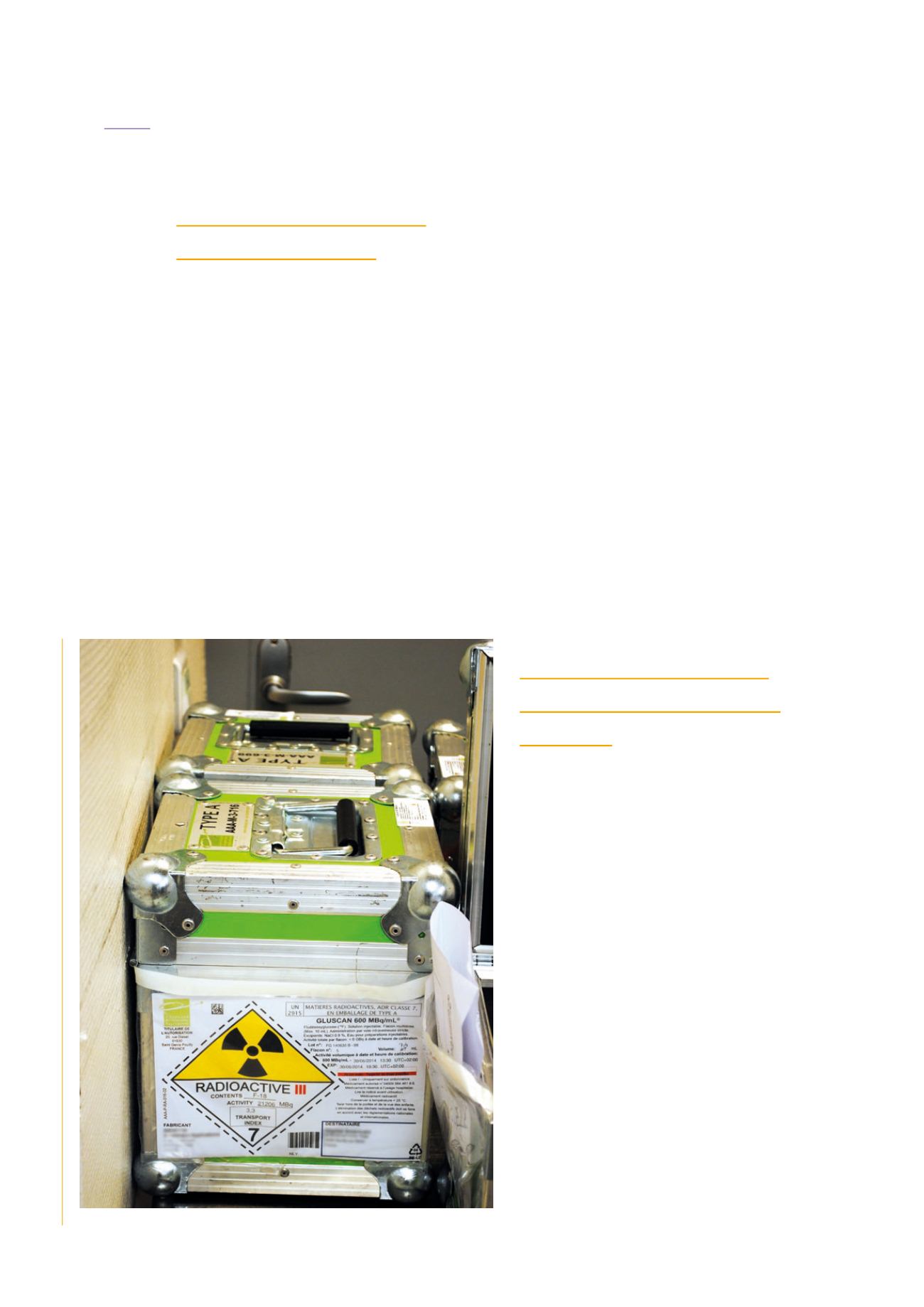
Type A transport package.
354
CHAPTER 11:
TRANSPORT OF RADIOACTIVE SUBSTANCES
ASN report on the state of nuclear safety and radiation protection in France in 2015