


 492 / 536

ASN nevertheless considered that some of the technical
and economic hypotheses adopted by Andra were
too optimistic and consequently did not satisfy the
requirement for caution imposed by such an evaluation.
Moreover, at this stage of project development,
uncertainties are inevitable. ASN therefore considered
that it was essential to provide a mechanism for regularly
updating the reference cost, particularly during key
stages of project development.
ASN pointed out that this evaluation is one of the bases
for calculating the funds required by the licensees to
cover the expenses associated withmanagement of their
radioactive waste. The purpose of these funds is to ensure
that these costs will not be borne by future generations.
In accordance with the procedure stipulated in
Article L. 542-12 of the Environment Code, after
consideration of ASN’s opinion and the comments of
the radioactive waste producers, the Minister responsible
for Energy issued an Order on the reference cost of the
Cigéo disposal project on 15th January 2016: a
“cost is
set at €25 Bn under the economic conditions prevailing on
31st December 2011, the year in which the cost evaluation
work began”.
This Order also specifies that the cost must
be updated regularly and
“at least at the key stages of
project development (creation authorisation, commissioning,
end of the “industrial pilot phase”, periodic safety reviews),
in accordance with the opinion of ASN.”
ASN’s position on reversibility
The reversibility of deep geological disposal is a requirement
contained in the Environment Code. This requirement is to
be detailed in a future Act. In 2016, Andra will submit a file
to ASN presenting the main technical options to ensure the
retrievability of the emplaced waste packages. ASN informed
Andra of its expectations on this subject.
ASN considers that the notion of reversibility must not only
guarantee retrievability, in other words the possibility of
retrieving the waste packages already emplaced for a given
period of time, but also that the facility is adaptable in order
to guarantee the possibility of modifying the previously
adopted provisions during construction and operation of the
disposal facility. As such, ASN considers that Andra must
demonstrate that a change in the waste inventory intended
for deep geological disposal further to – for example – a
political decision in terms of energy policy leading to the
direct disposal of spent fuel, does not call into question the
safety of disposal.
To ensure that these safety issues are integrated as of the
design phase, ASN considers it essential that the technical
requirements associated with reversibility be defined by
Parliament prior to submission of the creation authorisation
application for such a disposal facility. ASN will publish its
position on reversibility in 2016.
TO BE NOTED
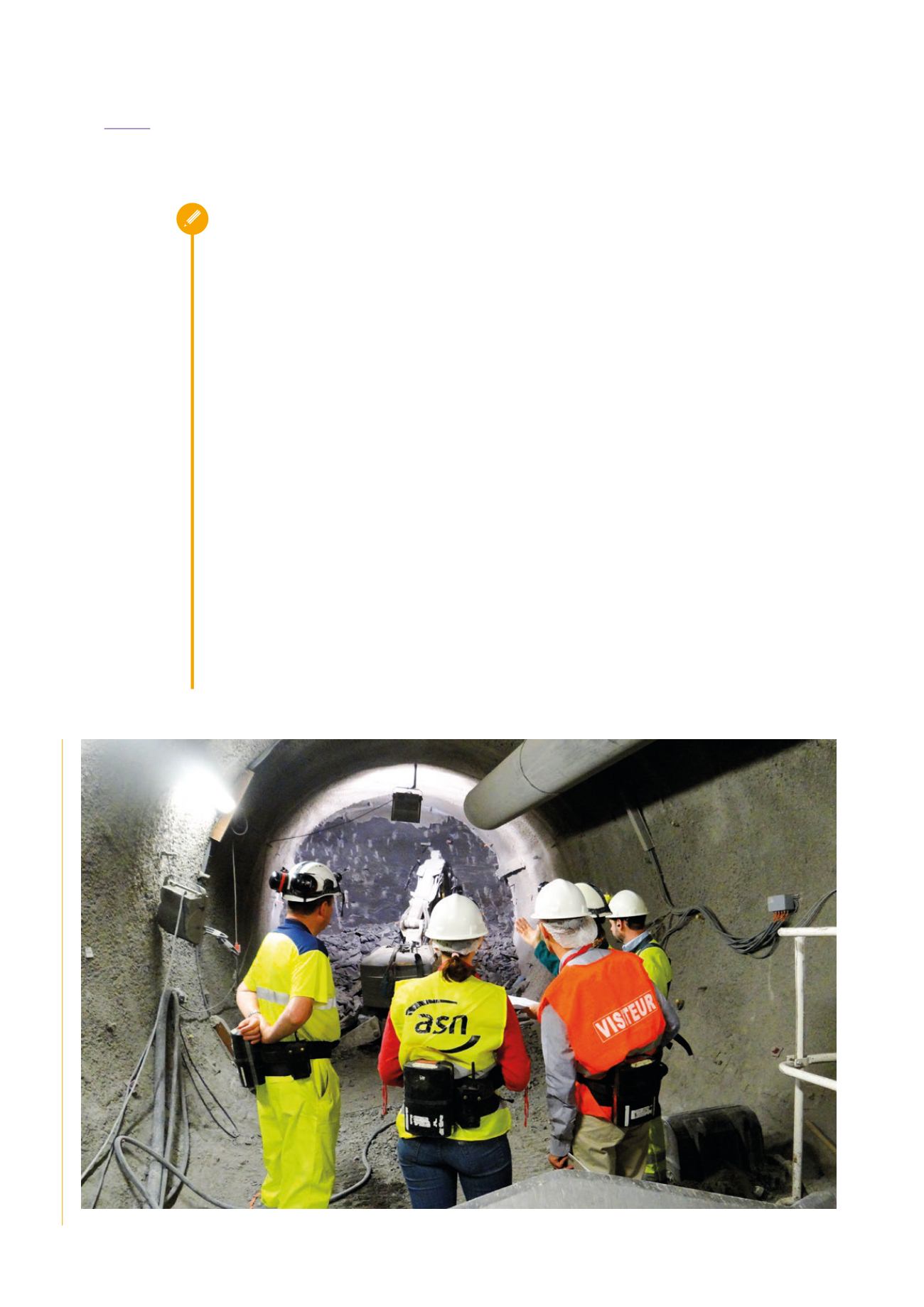
ASN visit to the Bure underground laboratory, July 2015.
492
CHAPTER 16:
RADIOACTIVE WASTE AND CONTAMINATED SITES AND SOILS
ASN report on the state of nuclear safety and radiation protection in France in 2015