


 497 / 536

Although significant improvements have been made,
ASN still notes a lack of follow-up of deviations detected
during the verifications, periodic tests and regulatory
checks and remains extremely vigilant regarding the
interfaces with the general services of the centre and
the monitoring of outside contractors in particular.
The current monitoring of outside contractors must be
rapidly consolidated.
•
Solid waste Treatment Station (STD) – BNI 37-A
At present, the STD is CEA’s only civil BNI licensed
for packaging LL/ILW-LL radioactive waste before it is
stored in the Cedra facility (BNI 164) pending transfer
to a deep geological repository (Cigéo project).
In this respect the STD holds a strategic position in the
management of CEA’s ILW-LL waste, and in particular for
the outcome of some of its projects (decommissioning
of facilities on the Fontenay-aux-Roses site, removal of
waste from BNI 72 on the Saclay site).
The main nuclear risks associated with the operations
carried out on radioactive waste in the STD are exposure
to ionising radiation, dissemination of radioactive
substances, criticality and explosion resulting from the
materials present in the treated drums or containers
(production of hydrogen by radioloysis, compacting
of drums containing explosive gases or a reaction of
a metal [aluminium, zinc] with the injected mortar).
The first periodic safety review of the STD was held in
1998 (at the same time as that of the STE). It revealed
significant shortcomings, notably in static containment,
control of the fire risk and earthquake resistance. Since
then CEA has been examining reinforcement scenarios
for the STD with the aim of continuing the activity in
BNI 37-A over the long term. It is noteworthy that the
Decree for BNI 164 provides for a treatment building
which will therefore not be used. In the context of
the second periodic safety review of the STD (file
submitted in March 2012) conducted by CEA with a
view to continuing operation of the solid IL-LL waste
treatment functions for a period of at least ten years,
CEA presented the safety options for the renovated
facility. The file indicates that CEA plans completing
the STD renovation work in 2020.
An ASN resolution will govern the implementation
of protective measures in the short term and the
facility renovation work. Furthermore, in compliance
with the BNI Order, CEA transmitted a production
authorisation request for each family of packages
(CEA-050 and CEA-060) produced in BNI 37-A
since 2012 to ASN.
ASN will be particularly attentive to the meeting of
the commitments made further to the periodic safety
review of the facility concerning containment, fire and
the seismic risk.
•
Effluent Treatment Station (STE) – BNI 37-B
The STE facility stopped receiving radioactive effluents on
1st January 2012 in accordance with an ASN resolution
of 27th January 2011. The use of the STE’s treatment
units also stopped on 31st December 2013. The facility is
therefore definitively shut down and has been functionally
replaced by the Agate facility, commissioned in 2014. The
civil engineering and processes (capacities) investigation
programme is continuing. CEA plans transmitting the
periodic safety review guidelines file to ASN in January
2016. CEA plans submitting the STE decommissioning
file in 2017, at the same time as the periodic safety
review file.
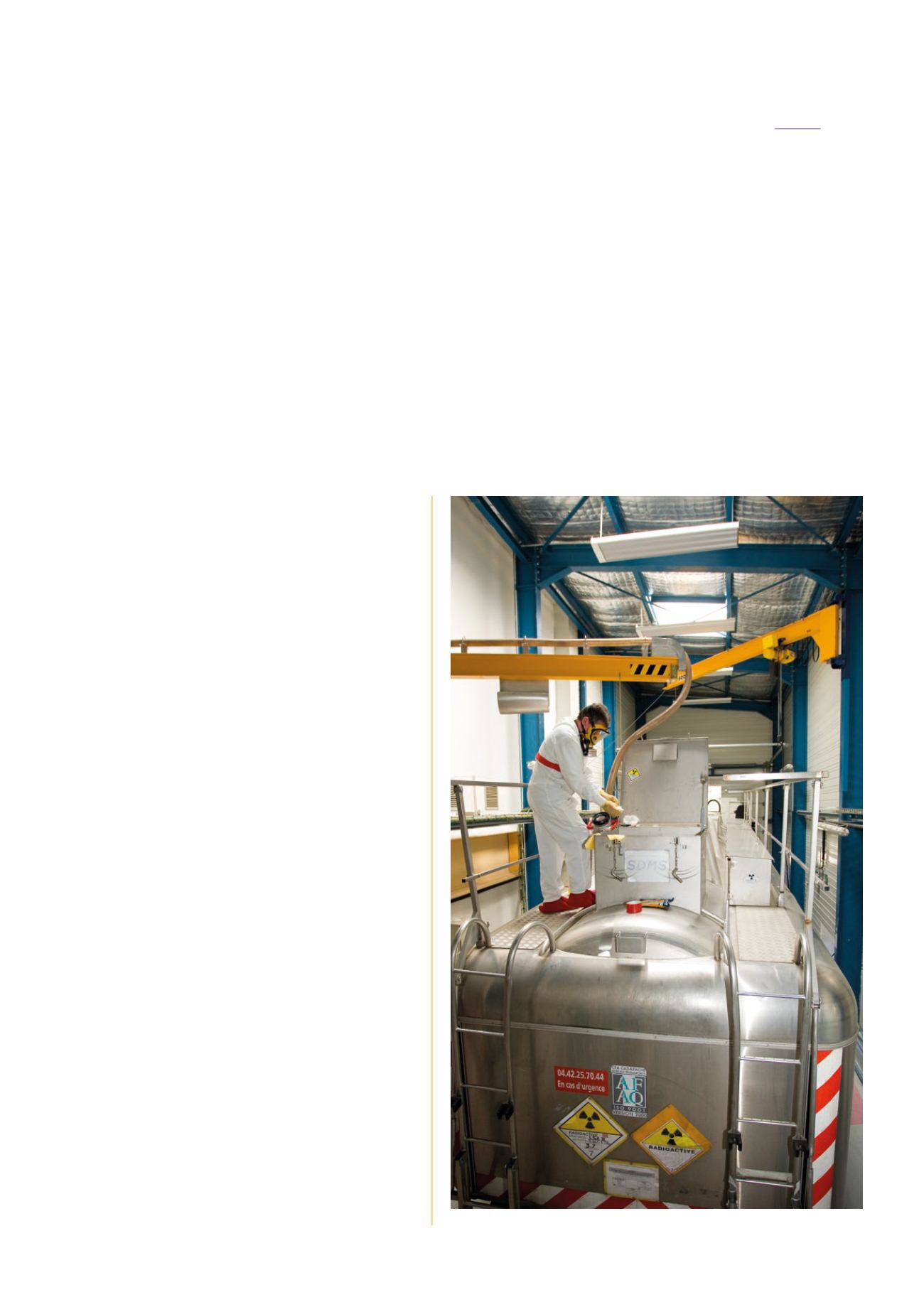
Effluent Treatment Station (STE) – BNI 37-B, CEA Cadarache.
497
CHAPTER 16:
RADIOACTIVE WASTE AND CONTAMINATED SITES AND SOILS
ASN report on the state of nuclear safety and radiation protection in France in 2015