


 149 / 536

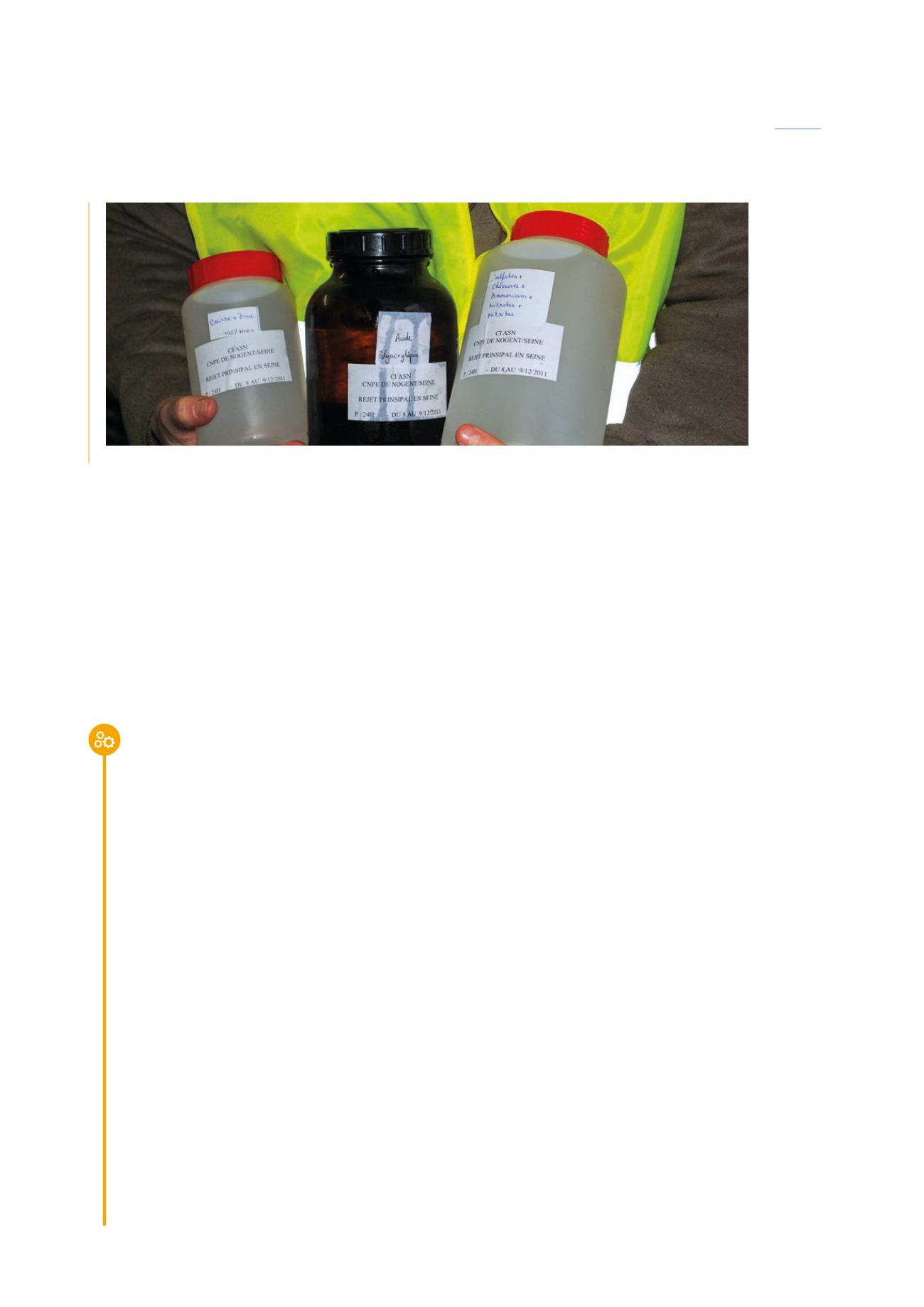
ASN environment inspection at the Nogent-sur-Seine NPP, December 2011
With regard to the measurements
• The Decision Threshold (SD) is the value above which it is
possible with a high degree of confidence to conclude
that a radionuclide is present in the sample.
• The Detection Limit (LD) is the value as of which the
measurement technique is able to quantify a radionuclide
with a reasonable degree of uncertainty (the uncertainty
is about 50% at the LD).
In general LD ≈ 2 x SD.
For the measurement results on chemical substances,
the Quantification Limit (LQ) is equivalent to the LQ used
to measure radioactivity.
Reference spectra
For the NPPs, the reference spectra of discharges comprise
the following radionuclides:
• Liquid discharges: tritium, carbon-14, iodine-131, other
fission and activation products (manganese-54, cobalt-58,
cobalt-60, Ag-110m, Tellurium-123m, antimony-124,
antimony-125, caesium-134, caesium-137);
• Gaseous discharges: tritium, carbon-14, iodines (iodine-131,
iodine-133), other fission and activation products (cobalt-58,
cobalt-60, caesium-134, caesium-137), noble gases:
xenon-133, xenon-135 (permanent discharges from
ventilation networks, krypton-85, Xenon-131m, xenon-133
(when draining “RS” tanks), argon-41, xenon-133,
xenon-135 (at decompression of reactor buildings).
UNDERSTAND
spectrum”, listing the radionuclides specific to the type
of discharge in question.
The principles underlying the accounting rules are as
follows:
•
radionuclides for which the measured activity exceeds
the decision threshold for the measurement technique
are all counted;
•
the radionuclides of the «reference spectrum” forwhich
themeasured activity is belowthe decision threshold (see
box) are considered to be at the decision threshold level.
For discharges of chemical substances with an emission
limit value set by an ASN prescription, when the
concentration valuesmeasured are below the quantification
limit, the licensee is required by convention to declare
a value equal to half the quantification limit concerned.
Monitoring discharges in the medical sector
Pursuant to ASN resolution 2008-DC-0095 of
29th January 2008, radioactivitymeasurements are taken
on the effluents coming from the places that produce them.
In hospitals that have a nuclear medicine department,
these measurements chiefly concern iodine-131 and
technetium-99m. In view of the difficulties encountered
in putting in place the permits to discharge radionuclides
into the public sewage networks, as provided for by
the Public Health Code, ASN has created a working
group involving administrations, “producers” (nuclear
physicians, researchers) and sanitation professionals.
The report from this working group will propose
recommendations for making the regulations more
efficient.
In the small-scale industrial nuclear sector, few plants
discharge effluents apart fromcyclotrons (see chapter 10).
The discharge permits stipulate requirements for the
discharges and their monitoring, which are subject to
particular scrutiny during inspections.
149
CHAPTER 04:
REGULATION OF NUCLEAR ACTIVITIES AND EXPOSURE TO IONISING RADIATION
ASN report on the state of nuclear safety and radiation protection in France in 2015