


 360 / 536

4.2.5 Management of transport safety
At the end of 2012, ASN conducted three technical visits
to the major players in radioactive substance transport
for the fuel cycle, namely Areva, EDF and CEA, in order
to assess the management of safety in this area. Analysis
of these visits led to the follow-up letters published on
www.asn.frin 2013. ASN continued its efforts on this
topic, by carrying out a specific inspection at Areva TN
in 2015. Among the main recommendations, ASN asks
that the general transport organisation take account
of subcontracting, that the individual and collective
expertise of the participants in the transport of radioactive
substances be put to best use and that operations that are
important for safety be clearly identified. Finally, ASN
considers that in certain cases, consideration should be
given to a method for recording and analysing experience
feedback from all transport activities, involving the
packaging users.
Inspection of the transport
of Swiss vitrified waste
A consignment of vitrified nuclear waste was shipped from
the Sellafield plant in England to Switzerland, passing
through France, which it entered via the port of Cherbourg on
14th September 2015. This consignment was taken by road
to the rail terminal in Valognes where the packages were
loaded onto rail wagons. The consignment left the country
on 18th September. It comprised three TN 81 packages,
each containing 28 CSD-V containers of vitrified waste.
These containers contain fission products in a glass matrix,
inside a metal container. The fission products are the
chemical bodies resulting from the fission of uranium in
nuclear reactors. They are extracted during reprocessing
of the spent nuclear fuel and constitute the ultimate waste
from the production of electricity using nuclear energy.
These wastes are high level, long-lived. The total activity
of the consignment is about 1.15x10
18
Bq, or an average
of 3.83x10
17
Bq per TN 81 package. These activity levels are
comparable to those of the packages containing spent fuels
taken from the French NPPs for shipment to the reprocessing
plant at La Hague. The TN 81 package model, designed by
the Areva TN company, has been approved by ASN.
ASN carried out an inspection on the safety of the
consignment on 15th September, at package transhipment in
the Valognes rail terminal. The inspectors were accompanied
by an inspector from the Swiss safety regulator, as well
as a team from IRSN, which took measurements on the
packages and then on the loaded wagons, in order to verify
compliance with the regulation limits for dose equivalent rate
and contamination. Two members of associations represented
on the High Committee for Transparency and Information on
Nuclear Security (HCTISN) attended a part of the inspection
They were able to observe the handling operations on the
TO BE NOTED
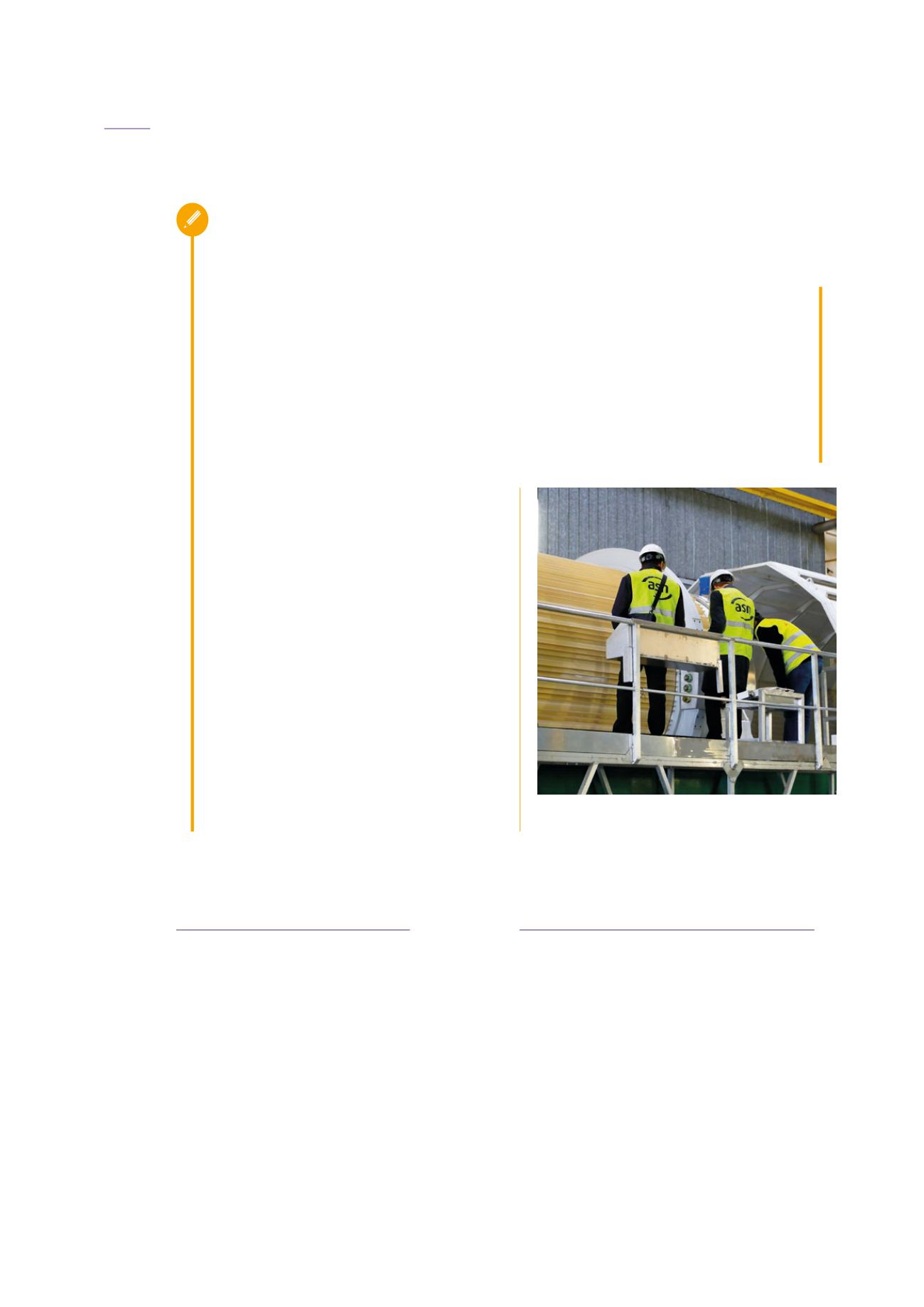
ASN transport inspection in Valognes - TN 81 type B fissile package,
used to transport vitrified waste, September 2015.
third package, as well as the radioactivity and contamination
measurements taken on this package and on the wagon
containing it.
The ASN inspection gave rise to a follow-up letter, which is
available on the ASN website. The inspectors considered that
the safety level of the transport operation was satisfactory,
but they nonetheless made three requests for corrective measures.
The measurements taken by IRSN produced values below
the regulation limits for the contamination levels and dose
equivalent rates.
4.2.6 Preparedness for emergency management
Emergency management is the final barrier in the
defence in depth system. In the event of an accident
involving transport, it should be able to minimise the
consequences for the public and the environment. In
order to reinforce the preparedness of the industry
(consignors and carriers) for emergency management,
ASN published a guide in December 2014 on the
content of accident and incident management plans
concerning the transport of radioactive substances. This
guide recommends the drafting of plans to prepare for
emergency management and stipulates the minimum
content of these plans.
In order to check correct application of this guide, ASN
carried out two inspections in 2015 on the topic of
preparedness for emergency situations. The inspectors
in particular looked at the organisation in place, the
360
CHAPTER 11:
TRANSPORT OF RADIOACTIVE SUBSTANCES
ASN report on the state of nuclear safety and radiation protection in France in 2015