


 378 / 536

or periodic safety review of the installations. In order to
define this exceptional level earthquake, ASNasked EDF
to supplement the deterministic approach to defining the
seismic hazardwith a probabilistic approach, whichwould
be more closely in line with international best practices
(see point 3.1).
2.6.2 Drafting of flooding protection rules
The partial flooding of the Le Blayais NPP in December
1999 led the licensees, under the supervision of ASN,
to reassess the safety of the existing BNIs with respect
to this risk in more severe conditions than previously
and to make a number of safety improvements, with a
schedule proportionate to the potential consequences. In
accordance with the ASNprescriptions, EDF completed
the required work on the entire NPP fleet by the end
of 2014.
At the same time, to ensure more exhaustive and more
robust integration of the flooding risk, as of the facilities
design stage, ASN published Guide No. 13 in 2013
concerning BNI protection against external flooding.
For the existing facilities, ASN asked EDF in 2014 to
take account of the recommendations of the guide on
all its reactors during the course of the coming ten years
and no later than the last periodic safety review of the
reactors on a given site.
Following the stress tests performed in the wake of the
Fukushima Daiichi accident, ASN considered that, with
regard to protection against flooding, the requirements
arising from the complete reassessment performed after
the flooding of the Le Blayais NPP in 1999 provided the
nuclear power plantswith a high level of protection against
the risk of external flooding. However, in June 2012, ASN
issued several resolutions to ask the licensees:
•
to reinforceNPPprotectionagainst certainhazards, such
as intense rainfall and earthquake-induced flooding;
•
todefineandimplementa“hardenedsafetycore”ofmaterial
and organisational measures to control the fundamental
safety functions in extreme situations and in particular
in the case of flooding beyond the design-basis safety
requirements (see point 3.1).
2.6.3 Prevention of heat wave and drought risks
During the heat waves in recent decades, some of the rivers
used to cool NPPs experienced a reduction in their flow
rate and significant warming.
Significant temperature riseswere also observed in certain
NPP premises housing heat-sensitive equipment.
EDF took account of this experience feedback and initiated
reassessments of the operationof its facilities inair andwater
temperature conditionsmore extreme than those initially
included in the design. In parallel with development of
these “extreme heat” baseline safety requirements, EDF
initiated the deployment of priority modifications (such
as an increase in the capacity of certain heat exchangers)
and adopted operating practices optimising the cooling
capacity of the equipment and improving the resistance
of equipment susceptible to high temperatures.
In 2012, ASN approved the application of these
baseline requirements to the 900 MWe reactors as well
as implementation of the resulting modifications. ASN
also asked EDF to take account of the comments it made
during this examination process with a view to drafting
and implementing baseline requirements applicable to
the other plant series.
For the periodic safety reviewof the 1,300 MWe reactors,
EDFhas initiatedamodifications programme on its facilities
designed toprovideprotectionagainst heatwave situations.
The capacity of certain cooling systems for equipment
required for the nuclear safety case will in particular be
improved.
EDF has also initiated a monitoring programme in order
to anticipate climate changes, which could compromise
the hypotheses adopted in the “extreme heat” baseline
safety standards.
The impact on thermal discharges from the NPPs
NPPs discharge hot effluents into rivers or the sea,
either directly, from those NPPs operating with direct
or “once-through” cooling, or after cooling of these
effluents in cooling towers, enabling some of the heat
to be dissipated to the atmosphere. Thermal discharges
fromNPPs lead to a temperature rise between the points
upstream and downstream of the discharge which,
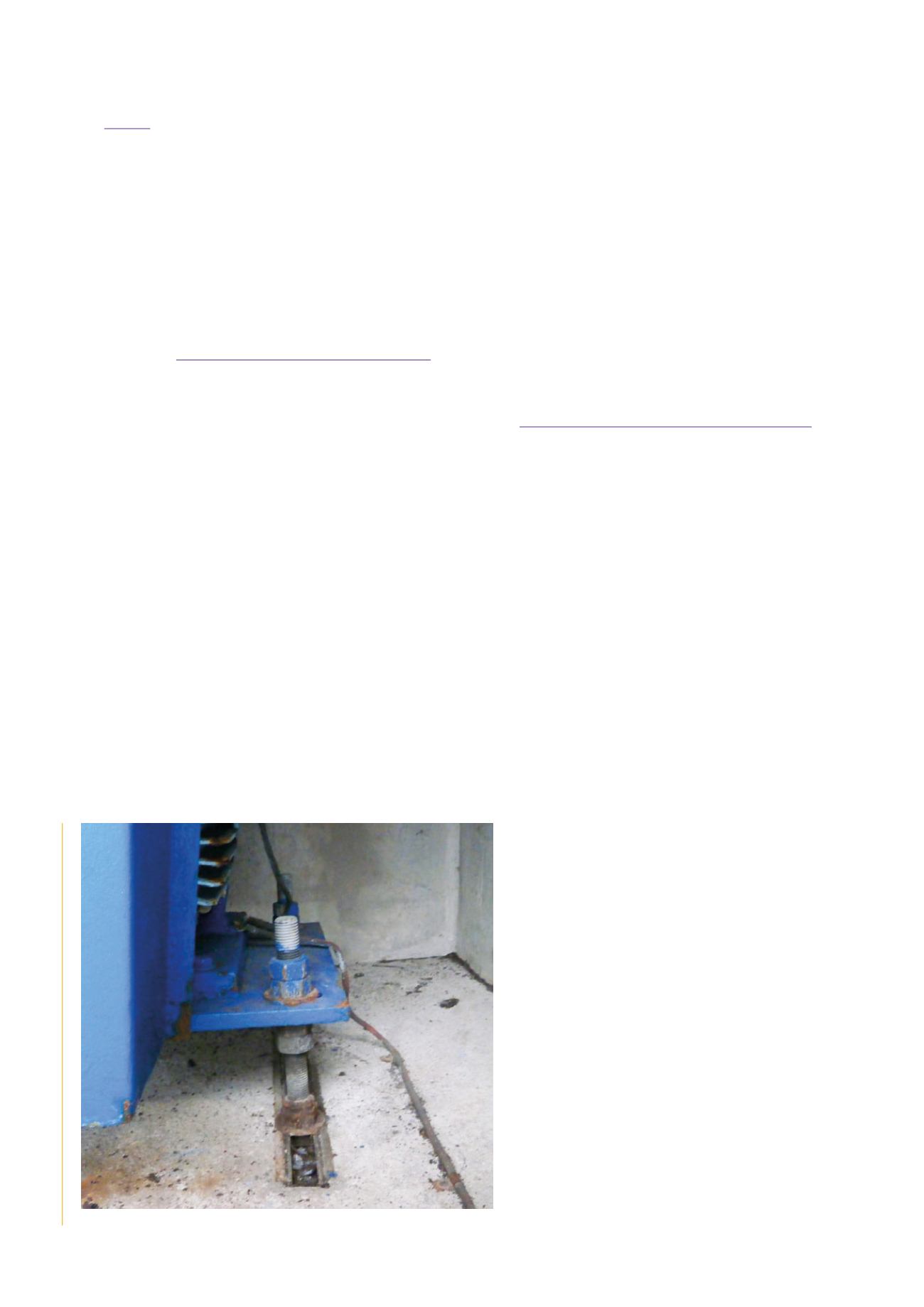
Floor anchoring of a pump.
378
CHAPTER 12:
EDF NUCLEAR POWER PLANTS (NPPs)
ASN report on the state of nuclear safety and radiation protection in France in 2015