


 407 / 536

attention by EDF. Finally, waste management is on
the whole better, but could often be improved, with
deviations from the operational baseline requirements
being observed.
ASN considers that the quality of the documentation
on conventional risks and on the operation of the
installations could be improved, in particular with
regard to the display of certain instructions inside the
installations and the labelling of hazardous substances.
ASN notes that progress has been made in applying and
assimilating the prescriptions regulating discharges set
out in the waste and the detrimental effects prevention
and mitigation provisions of the Order of 7th February
2012 and in resolution 2013-DC-0360 of 16th July 2013.
Finally, ASN considers that EDF’s approach for integrating
the items and activities concerning the control of
detrimental effects and environmental impact, from
among the equipment important for protection of the
interests defined by the Order of 7th February 2012,
is insufficient and must be significantly reinforced.
4.1.6 Analysis of operating experience
The operating experience feedback process
Operating Experience Feedback (OEF) relies mainly
on the process to identify and handle deviations (“OEF
loop”). This process mobilises all the players involved
in reactor operations, including outside contractors.
The steps taken by EDF since 2012, in particular as
part of its “corrective measures programme”, mean that
it is better able to detect deviations from the specified
requirements, with greater involvement in this process
by its contractors and subcontractors. The result is a
significant rise in notifications, requiring adaptation
of the licensee’s organisation. However, in 2015, ASN
noted that the OEF loop is still not effective enough
and considers that improved subsequent assessment
of the remedial, corrective and preventive measures
taken is required.
There are also differences in the way in which the NPPs
take account of operating experience feedback. Some
plants focus on their local OEF while others extensively
integrate the national OEF sent out by the head office
departments.
Greater EDF vigilance in disseminating OEF to its
contractors and subcontractors is also required, because
these latter generally work on several NPPs.
With regard to reactive operating experience feedback – in
other words following a significant event (see chapter 4,
point 3.3) – the NPPs are using a new significant events
analysis method proposed by the EDF head office
departments. ASN notes differences between the sites
in the quality of the significant event reports: the analyses
made by some sites go beyond the apparent causes and
highlight organisational malfunctions, while the analyses
performed on others simply focus on the apparent causes,
despite the presence of “human factors” consultants.
Reactive operating experience feedback, which mainly
comprises an analysis of the often organisational
root causes and the identification, implementation
and follow-up of corrective measures, all too often
remains superficial. A frequent ASN observation is that
the corrective measures adopted by the sites are not
always able to address the organisational malfunctions
highlighted in the analyses.
The deviations leading to significant events are analysed
by the EDF head office departments in order to assess
to what extent they are generic. 2015 was marked by
an increase in the number of generic events. Although
the cause of this increase could be the completion of the
complex characterisation work done on the deviations
behind these events, thepotentially serious nature of certain
generic significant events confirms the importance of the
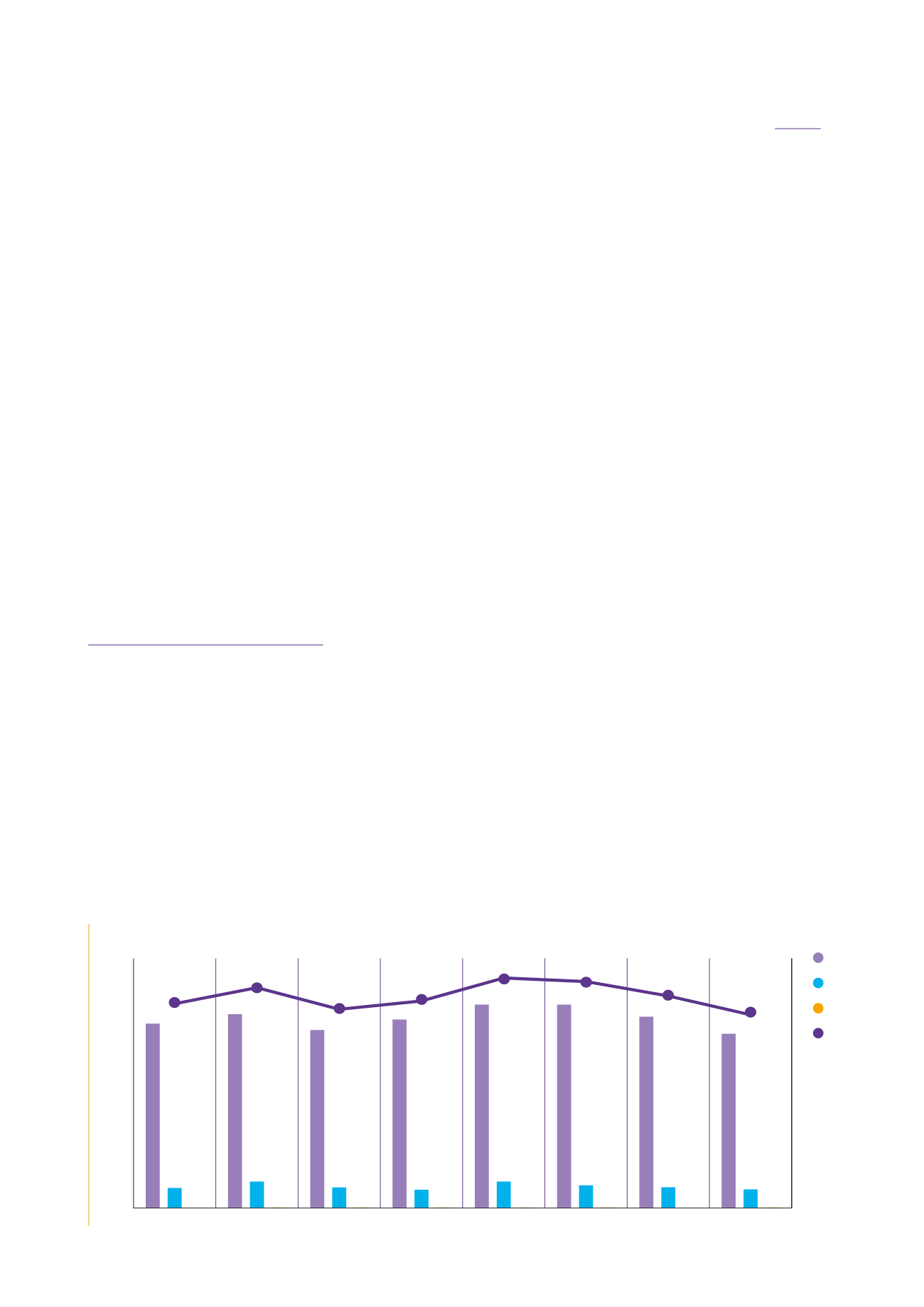
GRAPH 4:
Trend in the number of significant events rated on the INES scale in EDF nuclear power plants from 2008 to 2015
2013
2014
2015
2009
2008
2012
2011
2010
737
665
72
95
74
95
82
75
66
699
642
680
734
690
629
0
0
1
1
1
1
1
734
795
717
830
817
765
67
1
697
747
0
100
200
300
400
500
600
700
800
900
Total
Level 0
Level 1
Level 2
407
CHAPTER 12:
EDF NUCLEAR POWER PLANTS (NPPs)
ASN report on the state of nuclear safety and radiation protection in France in 2015