


 76 / 536

ASN regional divisions
For many years, ASN has benefited from a regional
organisation built around its eleven regional divisions.
These regional divisions operate under the authority of
the regional representatives. The director of the Regional
Directorate for the Environment, Planning and Housing
(DREAL) or of the Regional and inter-departmental
Directorate for the Environment and Energy (DRIEE) in
which the regional division in question is located, takes
on this responsibility as regional representative. He or she
is placed at the disposal of ASN to fulfil this role which
is not exercised under the authority of the Prefect. This
person is delegated with power of signature by the ASN
Chairman for decisions at the local level.
Theregionaldivisionscarryoutmostofthedirectinspections
on the BNIs, on radioactive substance transport operations
andon small-scalenuclear activities, and reviewmost of the
authorisation applications filed with ASN by the nuclear
activity licensees within their regions. They are organised
into two to four hubs, depending on the activities to be
regulated in their territory.
In emergency situations, the regional divisions assist the
Prefect,who is inchargeof protecting the general public, and
supervise the operations carriedout to safeguard the facility
on the site. To ensure preparedness for these situations,
they take part in drawing up the emergency plans drafted
by the Prefects and in periodic emergency exercises.
TheregionaldivisionscontributetoASN’spublicinformation
duty. They for example take part in the meetings of the
Local InformationCommittees (CLIs) andmaintain regular
relationswith the localmedia, electedofficials, associations,
licensees and local administrations.
ASN’s regional divisions are presented in chapter 8 of
this report.
2.3.3 Operation
Human resources
As at 31st December 2015, the total ASNworkforce stood
at 483, divided between the central services (263 staff
members), the regional divisions (216 staff members)
and various international organisations (4 staffmembers).
This workforce can be further broken down as follows:
•
388 tenured or contract staff members;
•
95 staff members seconded by public establishments
(Andra,
Assistance publique – Hôpitaux de Paris,
CEA,
IRSN, Departmental Fire and Emergency Response
Service – SDIS).
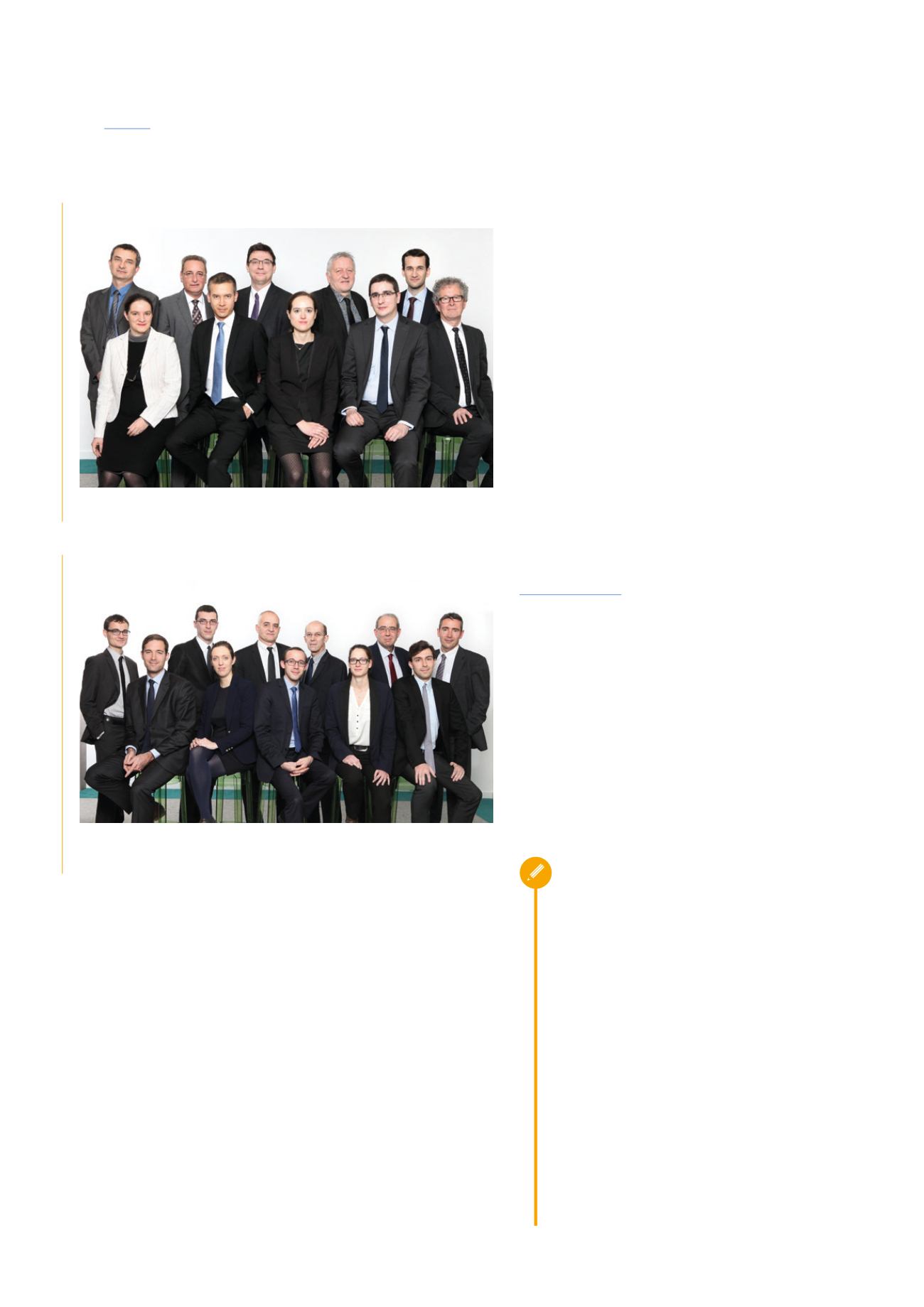
From left to right: Bastien Poubeau, Paul Bougon, Pierre Boquel, Sophie Letournel, Pierre
Siefridt, Guillaume Bouyt, Jean-Michel Férat, Marie Thomines, François Godin, Laurent Deproit
and Marc Champion.
THE REGIONAL DIVISION HEADS
From left to right: Luc Chanial, Anne-Cécile Rigail, Alain Rivière, Vivien Tran-Thien, Stéphane
Pailler, Bénédicte Genthon, Jean-Luc Godet, Remy Catteau, Fabien Schilz and Alain Delmestre.
THE DIRECTORS
The State’s regional reforms and ASN
Following the adoption by Parliament of the Act constituting
the regional reorganisation of the Republic and then
the Prime Minister’s presentation to the Cabinet of Ministers
on 31st July 2015 of the provisional list of the capitals
of the new regions and the reorganisation of the local
government administrations, ASN analysed the impact
of these reforms on its regional organisation.
The ASN Commission and Director General’s office, in close
liaison with the regional divisions, thus initiated a review
to take account of the new locations of the DREAL and
the offices of the Prefects and the geographical situation
of the new regional capitals.
ASN also asked the General Economic Council (CGE)
to support this review process. The report submitted to
it by the CGE at the beginning of 2016 will assist ASN in
its own review and will help it reach a decision concerning
its target organisation for the regions.
TO BE NOTED
76
CHAPTER 02:
PRINCIPLES AND STAKEHOLDERS IN THE REGULATION OF NUCLEAR SAFETY AND RADIATION PROTECTION
ASN report on the state of nuclear safety and radiation protection in France in 2015