


 77 / 536

ASN maintains a diversified hiring policy in terms of
profiles and experience, with the aim of ensuring that it
has enoughqualified and complementary human resources
to perform its duties. In its opinion of 6th May 2014
concerning preparations for the Budget Bill for the period
2015-2017, it considered that 125 positions would need
to be created by the end of 2017 in order to address the
unprecedented safety challenges with which it is faced.
Following budget discussions and decisions, it noted the
30 additional positions (10 per year) which had been
granted to it for this same period.
In order to obtain the required experience and level
of expertise, ASN sets up training programmes and
procedures for integrating new arrivals and handing
down specific know-how. It also aims to offer a variety
of career paths, commensurate with its needs, based in
particular on the experience of its staff.
Skills management
Competence is one of the four key values of ASN. The tutor
system, initial and continuing training, whether general,
linked to nuclear techniques, the field of communication,
or legalmatters, aswell as day-to-day practices, are essential
aspects of the professionalism of ASN staff.
Management of the skills of ASN personnel is based
primarily on a technical training programme tailored
to each staff member, based on training requirements
that include minimum experience conditions.
Pursuant to the provisions of Articles L. 592-22 and L.
592-23 of the Environment Code, whichmore specifically
state that
“ASN shall appoint nuclear safety inspectors […]
and radiation protection inspectors […] from among its
staff”
and Decree 2007-831 of 11th May 2007 setting
the procedures for appointing and qualifying nuclear
safety inspectors, which states that the
“nuclear safety
inspectors and the staff responsible for checking nuclear
pressure equipment […] are chosen for their professional
experience and their legal and technical knowledge”,
ASN
set up an official process for accrediting certain of its staff
members to perform its inspections and, as necessary,
carry out judicial policing roles. ASN also carries out
labour Inspectorate duties in the nuclear power plants,
pursuant to Article R. 8111-11 of the Labour Code.
For each of the inspectors it qualifies, the accreditation
decision taken by ASN is based on the adequacy of the
skills acquired, both within and outside ASN, with those
specified in the professional baseline requirements.
Furthermore, and in order to recognise the expertise and
experience of its inspectors, ASN has set up a process
enabling it to select senior inspectors from among its
staff, to whom it can entrust inspections that are more
complex or with more significant implications. As at
31st December 2015, 43 ASNnuclear safety and radiation
protection inspectors were senior inspectors, or nearly
17% of the 273 ASN staff members holding at least one
accreditation.
In 2015, nearly 3,700 days of training were provided
to ASN staff through 204 sessions forming part of
119 different courses. The financial cost of the courses
provided by organisations other than ASN, amounted
to €430 k.
Social dialogue
ASN comprises various entities enabling it to maintain
and develop high-quality social dialogue.
During the course of 2015, the ASN Social Dialogue
Committee (SDC) met on four occasions, including one
extraordinary session to address the possible impacts for
ASN of the State’s regional reforms. On other matters,
numerous discussions were held with the personnel
representatives: hiring and employment of contract
staff at ASN, reorganisation or relocation of entities,
discussions concerning tele-working, organisation of
in-depth inspections, etc.
Complementing the action of the ASN SDC, the Joint
Consultative Commission (CCP) – which has competence
for contract staff – met three times, including one
extraordinary session. Apart from examining how the
tenure process defined in the 12th March 2012 Act is
applied to ASN contract staff, the discussions primarily
concerned hiring and employment at ASN for this
personnel category.
Finally, the ASN Committee for Health, Safety and
Working Conditions (CHSCT) met four times in 2015,
including one extraordinary session in the presence of
representatives fromall the regional divisions, to discuss
the possible impacts for ASNof the State’s regional reforms.
The discussions with the personnel representatives also
covered a variety of subjects: methodology for drafting
the ASNoccupational risk assessment document (DU or
DUER), in particular on the occasion of the launch of the
questionnaire sent out to the staff to identify occupational
hazards, the conditions for entering controlled-access
areas by ASN inspectors, the radiation protection results
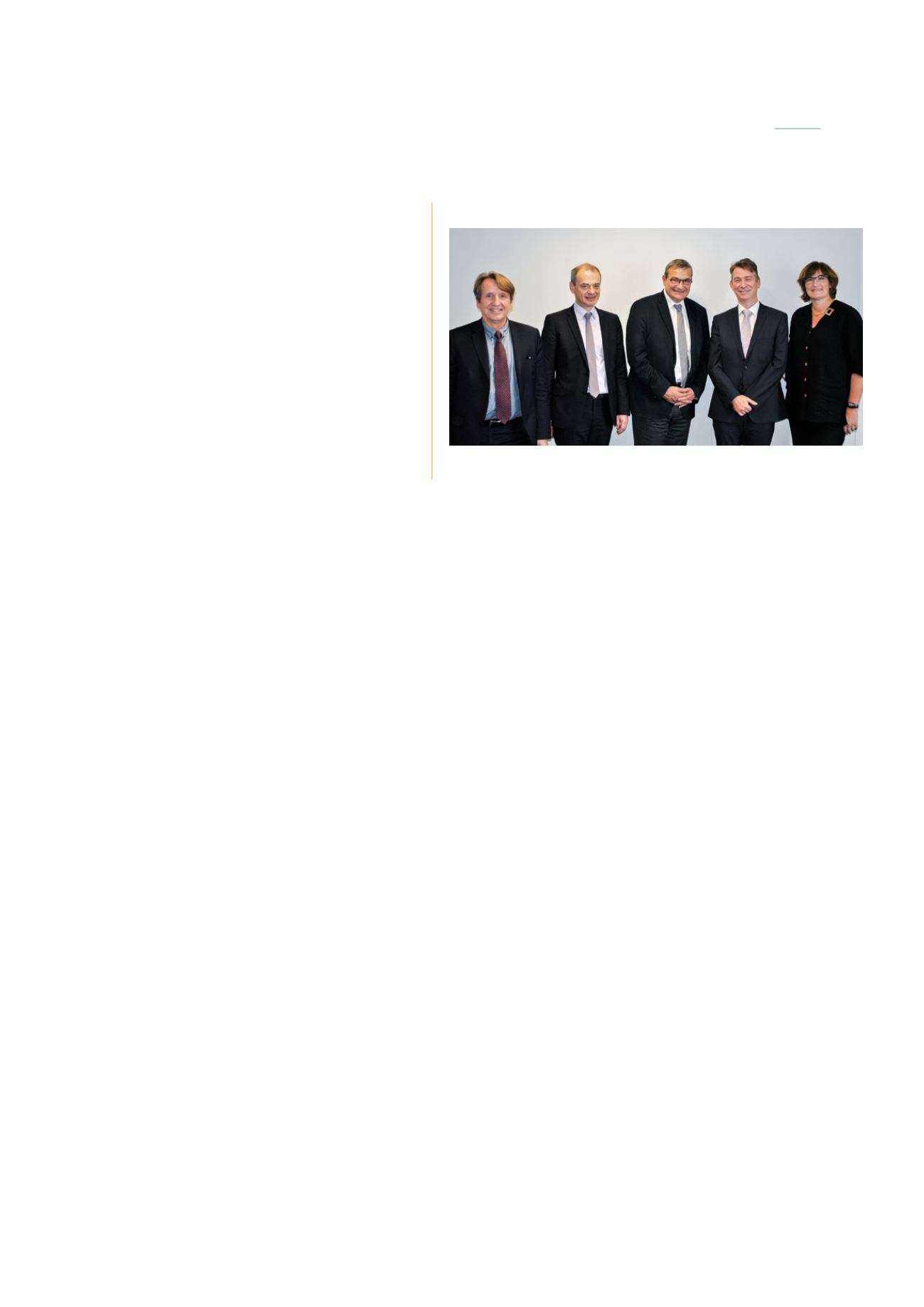
From left to right: Thierry Vatin, Christophe Chassande, Alain Vallet, Vincent Motyka
and Françoise Noars (not in photo: Annick Bonneville).
THE REGIONAL REPRESENTATIVES
77
CHAPTER 02:
PRINCIPLES AND STAKEHOLDERS IN THE REGULATION OF NUCLEAR SAFETY AND RADIATION PROTECTION
ASN report on the state of nuclear safety and radiation protection in France in 2015