



 303 / 536

It is more and more frequently used to treat cerebral
metastases, but also for extra-cranial tumours.
This therapeutic technique essentially uses three types
of equipment:
•
specific systems such as Gamma Knife®which directs
the emissions from more than 200 cobalt-60 sources
towards a single focal spot (4units are currently in service
in three establishments in France), and CyberKnife®
which consists of a miniaturised linear accelerator
mounted on a robotic arm;
•
“conventional” linear accelerators equipped with
additional collimation means (mini-collimators,
localisers) that can produce mini-beams.
3.1.2 Specific external-beam radiotherapy
techniques
Helical radiotherapy
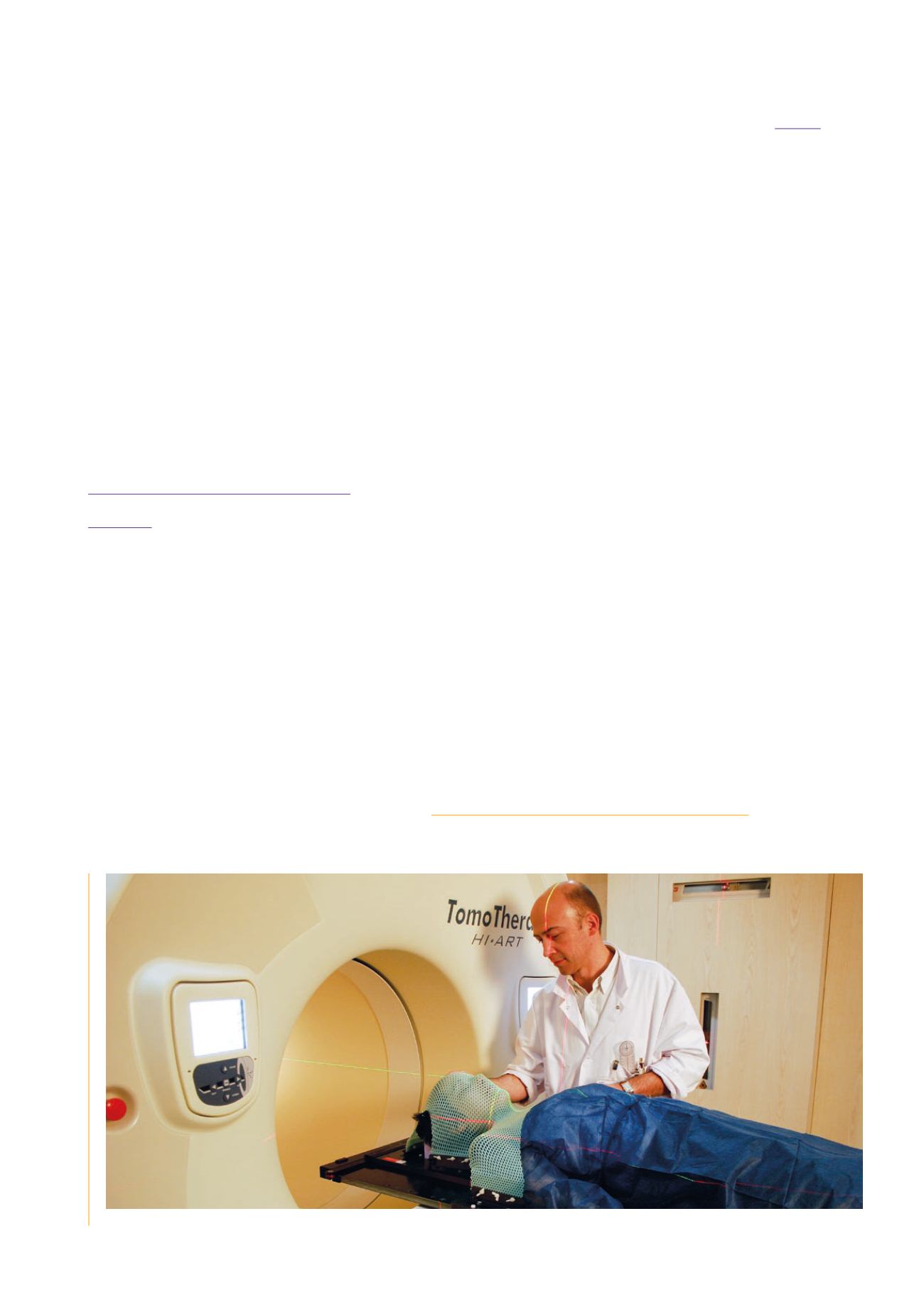
Helical radiotherapy, marketed under the name
TomoTherapy®, enables radiation treatment to be
delivered by combining the continuous rotation of an
accelerator with the longitudinal movement of the patient
during the treatment. The technique employed is similar
to the principle of helical image acquisitions obtained
with computed tomography. A photon beam, emitted at
a voltage of 6 MV and a dose-rate of 8 Gy/min, shaped
by a multileaf collimator enabling the intensity of the
radiation to bemodulated, allows the irradiation of large
volumes of complex shape as well as extremely localised
lesions, which may be in anatomically independent
regions. It is also possible to acquire images in treatment
conditions and compare themwith reference computed
tomography images, in order to improve the quality of
patient positioning.
At the end of 2014, France totalled 19 sites equipped
with facilities of this type.
Intensity modulated arc therapy
An extension of IntensityModulated Radiation Therapy
4
(IMRT), Intensity Modulated Arc Therapy is now used
in France. This technique consists in irradiating a target
volume by continuous irradiation rotating around the
patient. Several parameters canvaryduring the irradiation,
including the shape of themultileaf collimator aperture, the
dose-rate, the rotation speed of the armor the orientation
of the multileaf collimator.
This technique, designatedunder different terms (VMAT®,
RapidArc®) depending on themanufacturer, is achieved
using isocentric linear accelerators equipped with this
technological option.
Robotic stereotactic radiotherapy
Stereotactic radiotherapy with a robotic arm consists in
using a small particle accelerator producing 6MVphotons,
placed on an industrial type robotic armwith 6 degrees
of freedom, marketed under the name CyberKnife®.
Furthermore, the treatment table is also positioned on
a robot of the same type. By combining the movement
possibilities of the two robots, it is possible to usemultiple,
non-coplanar beams to irradiate small tumours that
are difficult to access using surgery and conventional
radiotherapy. This technique enables irradiation to be
carried out under stereotactic conditions, and with
respiratory tracking.
4. The collimator leaves move during irradiation, which modulates
the delivered dose in a complex manner.
Patient set-up for a tomotherapy session.
303
CHAPTER 09:
MEDICAL USES OF IONISING RADIATION
ASN report on the state of nuclear safety and radiation protection in France in 2015