


 304 / 536

Given the movement capabilities of the robot and its
arm, the usual standards do not apply to the radiation
protection of the treatment room and a specific study is
therefore required.
At the end of 2014, France totalled 9 sites equippedwith
facilities of this type.
Intraoperative radiotherapy
Intraoperative radiotherapy combines surgery and
radiotherapy, performed concomitantly in the operating
theatre environment. The dose of radiation is delivered
to the tumour bed during surgical intervention.
In March 2011, the French National Cancer Institute
(INCa) launched a call for proposals to support the
installation of intraoperative radiotherapy equipment
for the treatment of breast cancer patients. One of the
objectives of this call for proposals is to carry out amedico-
economic evaluation of radiotherapy treatments involving
a small number of sessions compared with standard
breast cancer treatments. Seven projects deploying an
INTRABEAM®accelerator producingX-rayswith a voltage
of 50 kVwere selected and launched between 2011 and
2012. The HAS (French National Authority for Health)
is currently finalising a synthesis of the clinical results.
Hadron therapy
Hadron therapy is a treatment technique based on the
use of beams of charged particles – protons and carbon
nuclei – whose particular physical properties ensure
highly localised dose distribution during treatment
(Bragg’s peak). Compared with existing techniques,
the dose delivered around the tumour to be irradiated is
lower, therefore the volume of healthy tissue irradiated is
drastically reduced. Hadron therapy allows the specific
treatment of tumours.
Hadron therapy with protons is currently practised in
two centres in France – the Curie Institute in Orsay
(equipment renewed in 2010) and the Antoine Lacassagne
Centre in Nice (equipment currently being renewed).
According to its advocates, hadron therapy with carbon
nuclei is more appropriate for the treatment of the most
radiation-resistant tumours and could bring several
hundred additional cured cancer cases per year. The
claimed biological advantage is reportedly due to the
very high ionisation of these particles at the end of their
path, combined with a reduced effect on the tissues
they pass through before reaching the target volume.
3.1.3 Brachytherapy
Brachytherapy allows specific or complementary
treatment of cancerous tumours, particularly in the
head and neck, the skin, the breast, the genitals and
the bronchial tubes.
This technique consists in implanting radionuclides,
exclusively in the form of sealed sources (with the
exception of iridium-192 wires, considered to be
unsealed sources), either in contact with or inside the
solid tumours to be treated.
The main radionuclides used in brachytherapy are
caesium-137, iridium-192 and iodine-125.
Brachytherapy techniques involve three types of
applications:
a - Low Dose-Rate (LDR) brachytherapy:
•
delivering dose-rates of between 0.4 and 2 Gy/h;
•
using iodine-125 sources in the formof seeds implanted
permanently.
For the treatment of prostate cancers, iodine-125
sources are used. These sources (seeds), 4.5 mm long
and 0.8 mm in diameter, are positioned permanently
inside the patient’s prostate gland. Their unit activity is
between 10 and 30 MBq and treatment requires about
a hundred seeds representing a total activity of 1 to
2 gigabecquerels (GBq).
Low Dose-Rate brachytherapy using sources of
iridium-192 and caesium-137 is in the process of being
phased out. Conversely, the technique using iodine-125
sources (prostate and ophthalmic brachytherapy) has
developed over the last few years. The use of iridiumwires
stopped in 2014, as they are no longer manufactured.
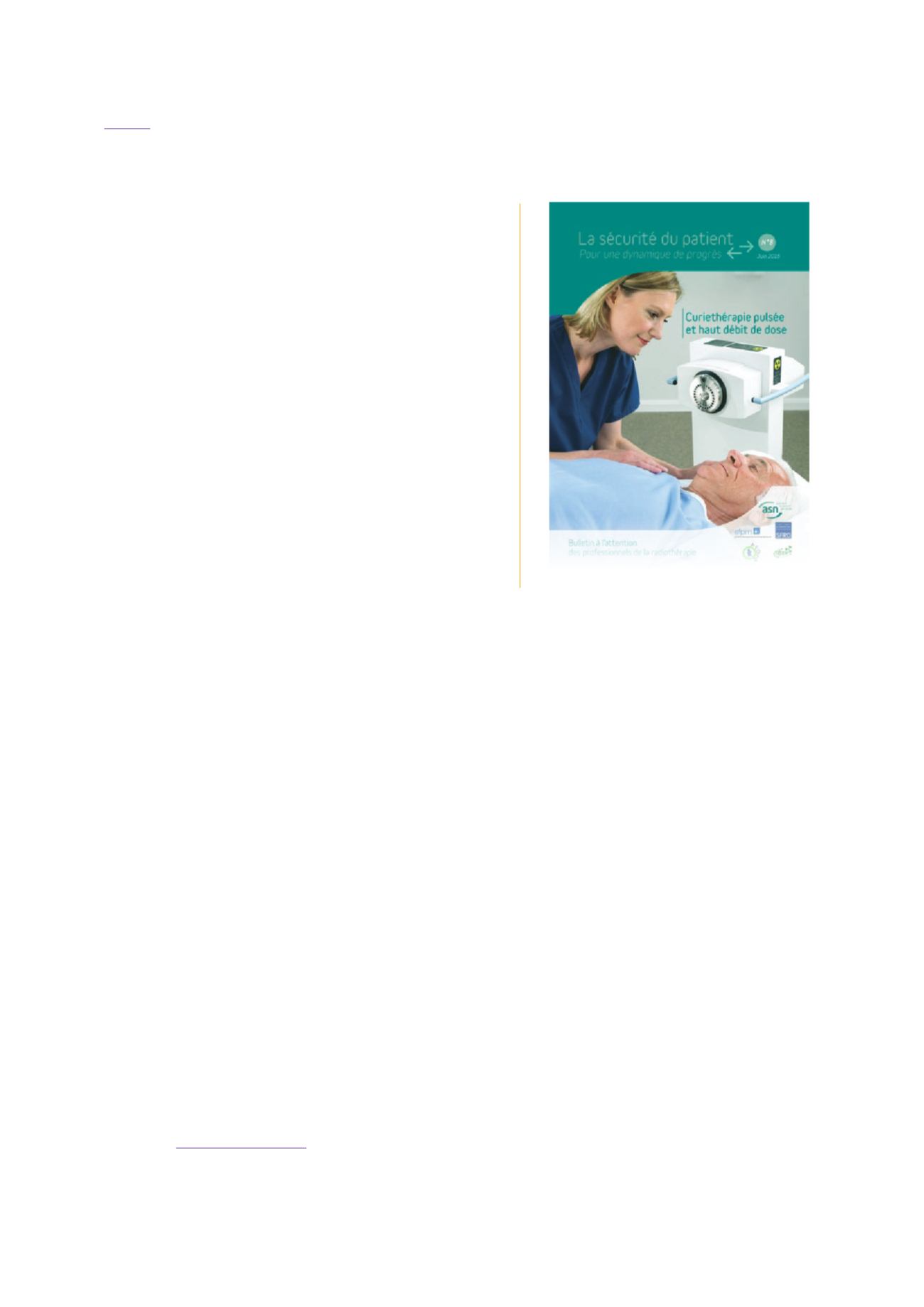
Cover of Bulletin No. 8,
Patient safety
.
304
CHAPTER 09:
MEDICAL USES OF IONISING RADIATION
ASN report on the state of nuclear safety and radiation protection in France in 2015