


 369 / 536

cycle, as the fissile nuclei disappear. The chain reaction,
and hence reactor power, is controlled by:
•
inserting control rod cluster assemblies, which contain
elements that absorb neutrons, to varying depths in the
core. These enable the reactor to be started and stopped
and its power level to be adjusted to the electrical power
to be produced. Dropping the control rod assemblies
under the effects of gravity enables the reactor to be
shut down in an emergency;
•
adjusting the level of boron (which absorbs neutrons)
in the primary system water during the cycle as the
fissilematerial in the fuel gradually becomes depleted.
At the end of the cycle, the reactor core is unloaded for
renewal of part of the fuel.
EDFuses two types of fuels in its pressurisedwater reactors:
•
uranium oxide based fuels (UO
2
) with uranium-235
enrichment to a maximum of 4.5%. These fuels are
fabricated in several plants in France and abroad,
which belong to the fuel manufacturers Areva NP and
Westinghouse;
•
fuels consisting of amixture of depleteduraniumoxides
andplutonium(MOX). TheMOX fuel is producedby the
ArevaNCMelox plant. The initial plutoniumcontent is
currently limited to 8.65% (average per fuel assembly)
andprovides an energy performance equivalent toUO
2
this equipment contribute to reactor safety. The secondary
systems belong partly to the nuclear island and partly
to the conventional island.
The PWR reactor safety case is based on the application
of the principle of defence in depth (see chapter 2,
point 1.2.2).
1.2 Core, fuel and fuel management
The reactor’s core consists of fuel assemblies in the
form of “rods” comprising “pellets” of uranium oxide or
oxides of depleted uranium and plutonium (known as
MOX fuel) contained in closed metal tubes, referred to
as the “cladding”. As a result of fission, the uranium or
plutoniumnuclei, referred to as «fissile», emit neutrons
which, in turn, produce further fissions: this is known
as the chain reaction. These nuclear fissions release a
large amount of energy in the form of heat. The primary
systemwater enters the core frombelow at a temperature
of about 285°C, heats up as it flows up along the fuel
rods and exits through the top at a temperature close
to 320°C.
At the beginning of the operating cycle, the core has a
considerable energy reserve. This gradually falls during the
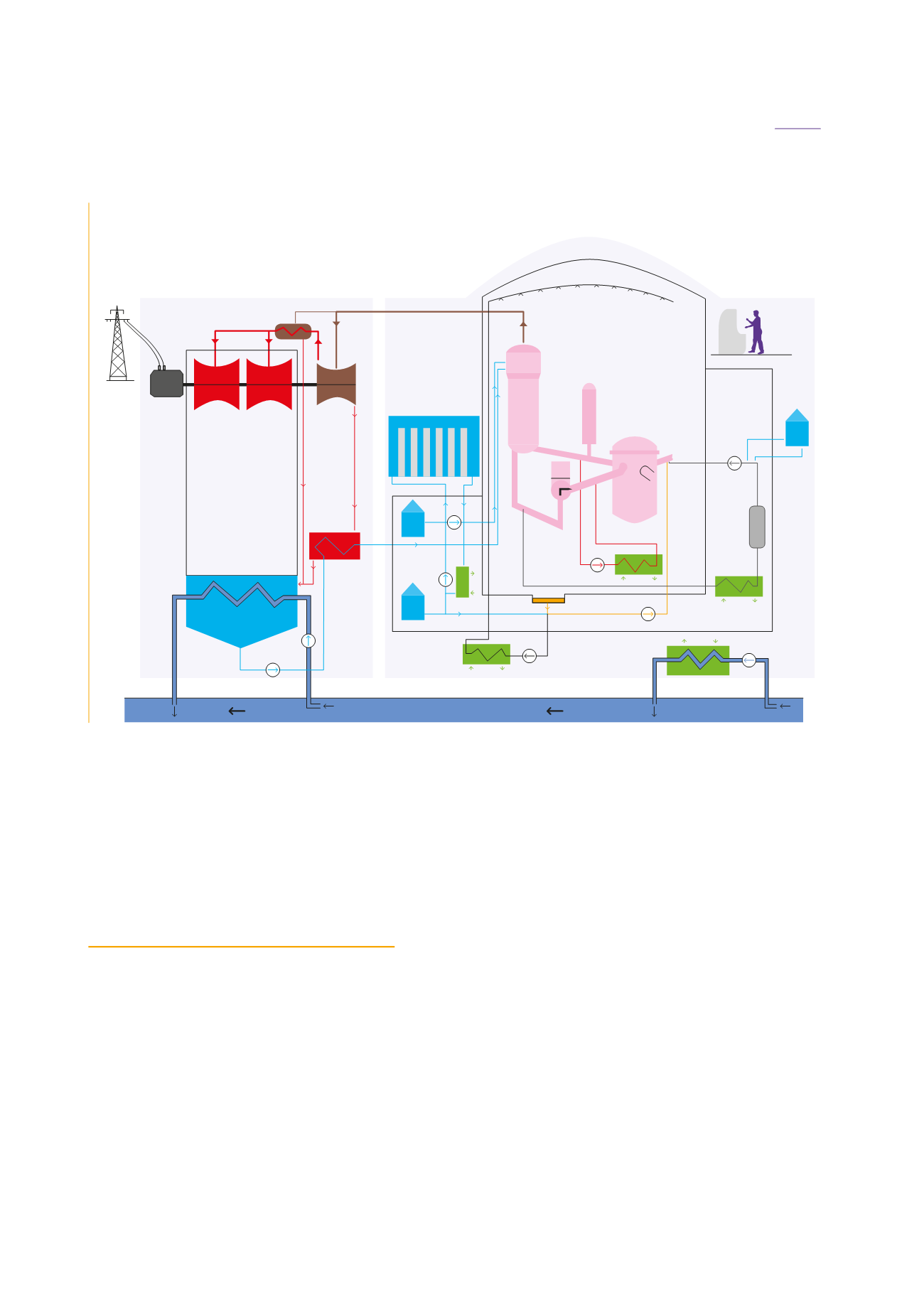
THE PRINCIPLE
of pressurised water reactor operation
CONVENTIONAL ISLAND
NUCLEAR ISLAND
Moisture separator-
Superheater
Alternateur
Condenser
Secondary
system
Steam
generator
Pressurizer
Control room
Primary
pump
Vessel
Primary
system
Fuel pool
Heater
LP Turbine
LP Turbine
HP Turbine
VVP
EAS
ASG
ARE
TEP
RIS
RRI
RRA
RCV
PTR
RIVER
SEC
369
CHAPTER 12:
EDF NUCLEAR POWER PLANTS (NPPs)
ASN report on the state of nuclear safety and radiation protection in France in 2015