


 370 / 536

fuel enriched to 3.7%with uranium-235. This fuel can
be used in the twenty-eight 900 MWe reactors forwhich
the Creation Authorisation Decrees (DAC) provide for
the use of MOX fuel.
The way in which the fuel is used in the reactors, known
as “fuel management”, is specific to each reactor plant
series. It is, in particular, characterised by:
•
the nature of the fuel used and its initial fissile content;
•
the maximumdegree of fuel depletion at removal from
the reactor, characterising thequantityof energy extracted
per ton of material (expressed in GWd/t);
•
the duration of a reactor operating cycle;
•
the number of new fuel assemblies loaded at each reactor
refuelling outage (generally1/3or 1/4of the total number
of assemblies);
•
the reactor operating mode (at constant power or by
varying the power tomatchdemand), whichdetermines
the loads to which the fuel is subjected.
1.3 Primary system
and secondary systems
The primary systemand the secondary systems transport
the energy given off by the core in the form of heat to a
turbo-generator set which produces electricity.
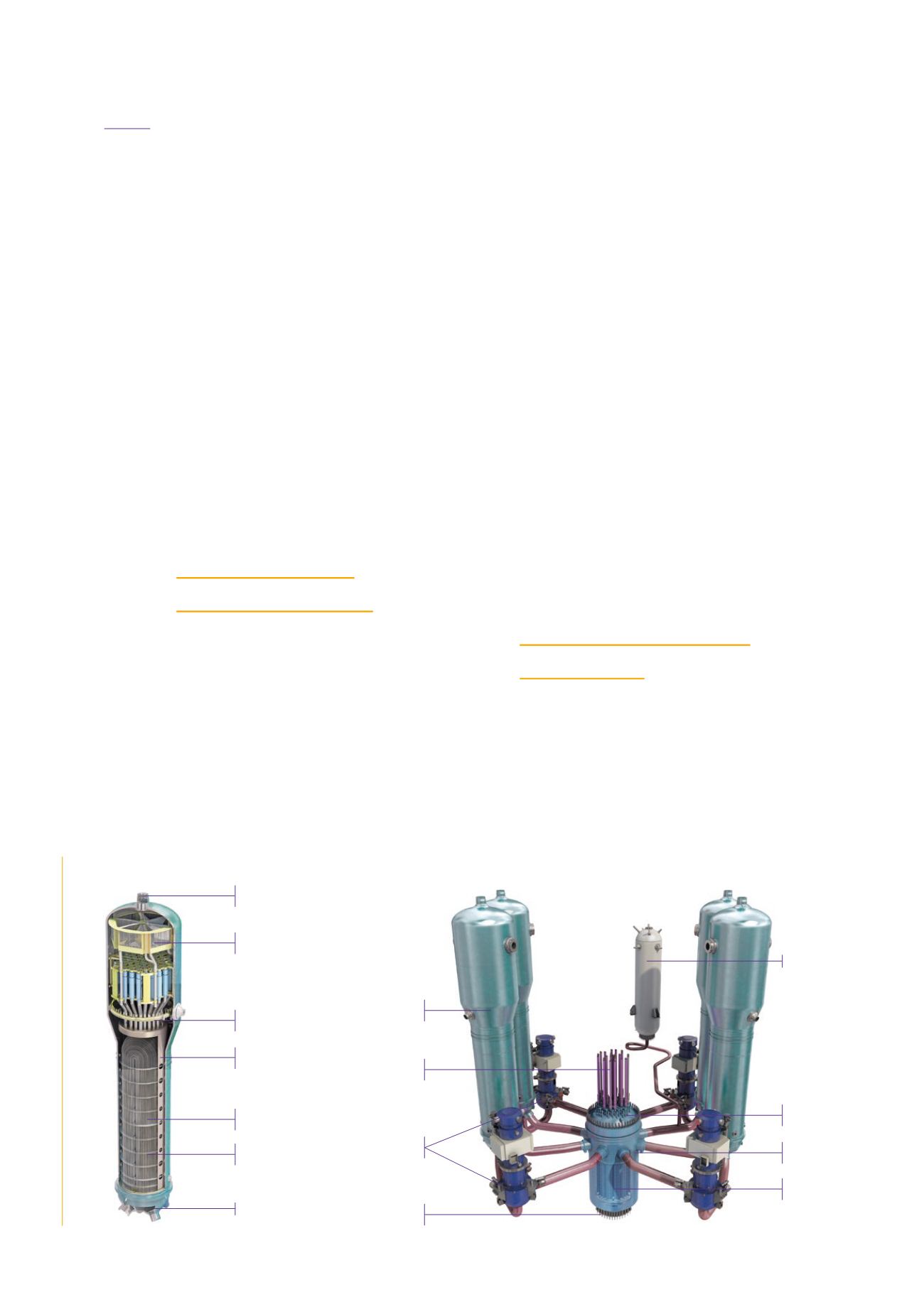
The primary system consists of cooling loops (three
loops for a 900 MWe reactor and four for a 1,300 MWe,
1,450 MWe or 1,650 MWe type EPR reactor). The role of
the primary system is to extract the heat given off in the
core by circulating pressurised water, referred to as the
primary or reactor coolant water. Each loop, connected to
the reactor vessel containing the core, comprises a circulating
pump (known as the primary or reactor coolant pump)
and a Steam Generator (SG). The primary water, heated
tomore than 300°C, is kept at a pressure of 155 bar by the
pressuriser, to prevent it fromboiling. The entire primary
system is located inside the containment.
Theprimary systemwater transfers theheat to the secondary
systemwater via the steamgenerators. The steamgenerators
are exchangers that contain3,500 to5,600 tubes, depending
on themodel, throughwhich the primary reactor coolant
water circulates. These tubes are immersed in the water
of the secondary system and boil it, without ever coming
into contact with the primary water.
Each secondary system principally consists of a closed
loop throughwhichwater runs in liquid form in one part
and as steam in the other part. The steamproduced in the
steam generators is partly expanded in a high-pressure
turbine and thenpasses throughmoisture separators before
final expansion in the low-pressure turbines, fromwhich
it is then routed to the condenser. The condensed water
is then heated by reheaters and sent back to the steam
generators by the condensate extraction pumps and the
feedwater pumps.
1.4 The secondary system
cooling system
The function of the secondary systemcooling system is to
condense the steam exiting the turbine. This is achieved
by a condenser comprising a heat exchanger containing
thousands of tubes throughwhich coldwater fromoutside
(sea or river) circulates. When the steam comes into
contact with the tubes it condenses and can be returned
in liquid form to the steam generators (see point 1.3).
The cooling systemwater that is heated in the condenser
A STEAM GENERATOR
and a main primary system of a 1,300 MWe reactor
Steam
exhaust
Moisture
separators
Feedwater
ring
Bundle
wrapper
Tube
bundle
Tube
support plate
Channel head
Primary
pumps
Core
instrumentation
Control rod drive
mechanisms
Steam
generator
Reactor
core
Reactor
vessel
Vessel
head
Pressurizer
370
CHAPTER 12:
EDF NUCLEAR POWER PLANTS (NPPs)
ASN report on the state of nuclear safety and radiation protection in France in 2015