


 371 / 536

is then discharged to the natural environment (open
circuit) or, when the river flow is too low or heating too
great in relation to the sensitivity of the environment, it is
cooled in a cooling tower (closed or semi-closed circuit).
The cooling systems are environments favourable to the
development of pathogenicmicro-organisms. Replacing
brass by titaniumor stainless steel in the construction of
riverside reactor condensers, in order to reduce metal
discharges into the natural environment, requires the use
of disinfectants, mainly bymeans of biocidal treatment.
Cooling towers can contribute to the atmospheric
dispersal of legionella bacteria, whose proliferation can
be prevented by reinforced treatment of the structures
(descaling, implementation of biocidal treatment, etc.)
and monitoring.
1.5 Reactor containment building
The PWR containment building has two functions:
•
confine radioactive products likely to be dispersed in
the event of an accident. The containments are therefore
designed to withstand the pressures and temperatures
that could result from the most severe reactor loss of
coolant accident and offer sufficient leaktightness in
such conditions.
•
protect the reactor against external hazards.
Two different containment models have been designed:
•
the 900 MWe reactor containments, consisting of a single
wall of pre-stressed concrete (concrete containing steel
cables tensioned to ensure compressionof the structure).
Thiswall offersmechanical resistance topressure, aswell
as structural integritywith regard to an external hazard.
Leaktightness is provided by a metal liner covering the
entire inner face of the concrete wall;
•
the 1,300 MWe and 1,450 MWe reactor containments
consisting of two walls: an inner wall made of pre-
stressed concrete and an outer wall made of reinforced
concrete. Leaktightness is provided by the inner wall
and the ventilation system which collects and filters
residual leaks from the inner wall before discharge.
Resistance to external hazards is mainly ensured by
the outer wall.
1.6 The main auxiliary
and safeguard systems
In normal operating conditions, at power, or in reactor
outage states, the auxiliary systems control nuclear reactions,
removeheat fromtheprimary systemand residual heat from
the fuel andprovide containment of radioactive substances.
This chiefly involves the Chemical and Volume Control
System(RCV) and theResidualHeat Removal System(RRA).
Thepurpose of the safeguard systems is to control incidents
andaccidents andmitigate their consequences. This chiefly
concerns the following systems:
•
the Safety Injection System (RIS), the role of which is
to inject water into the primary system in the event of
its leaking;
•
the reactor buildingContainment SpraySystem(EAS), the
role of which is to reduce the pressure and temperature
in the containment in the event of a primary system
leak accident;
•
the SteamGenerators Auxiliary feedwater system(ASG),
which supplieswater to the SGs if the normal feedwater
system is lost, thus enabling heat to be removed from
the primary system.
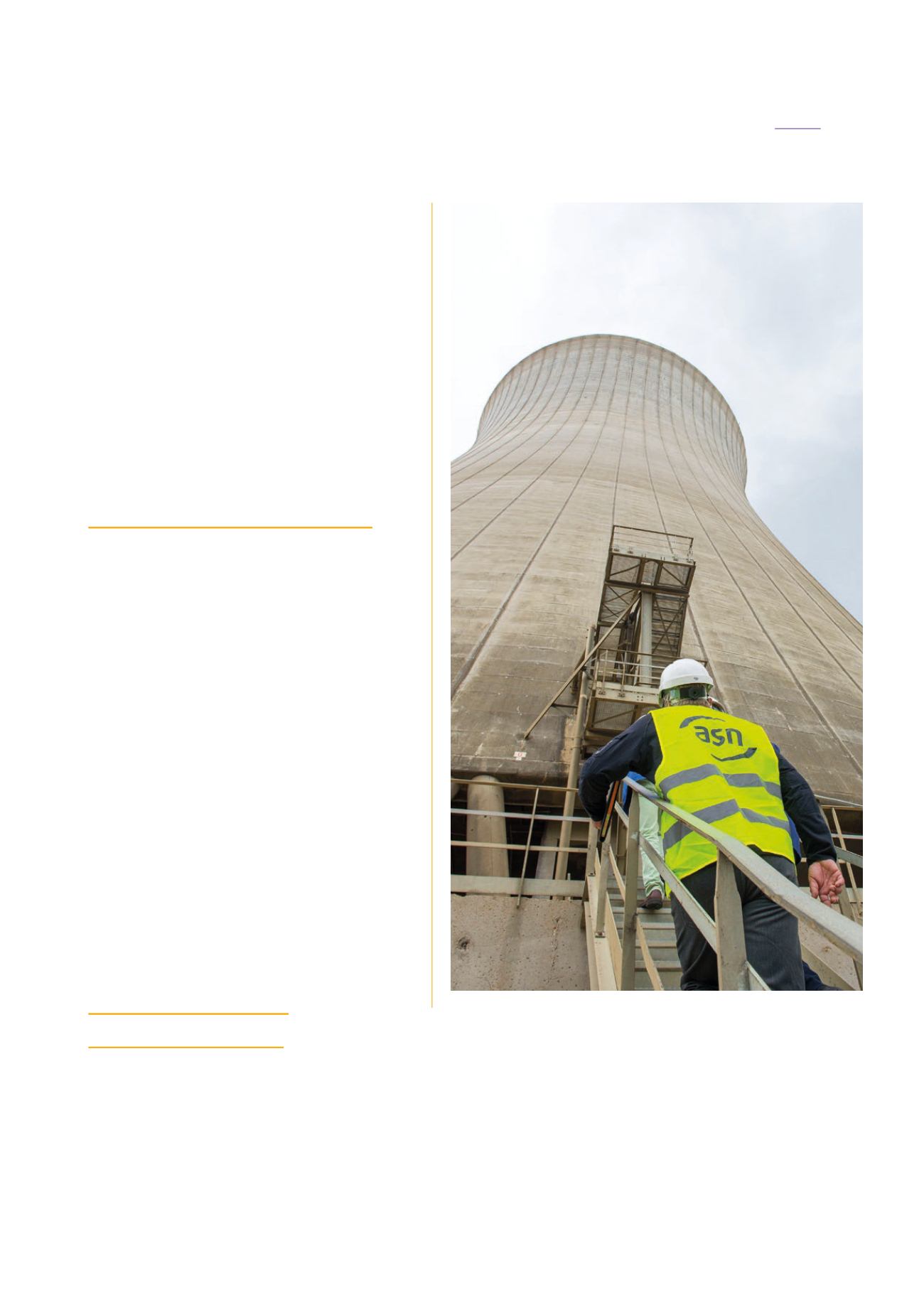
ASN inspection in Dampierre-en-Burly NPP, July 2015.
371
CHAPTER 12:
EDF NUCLEAR POWER PLANTS (NPPs)
ASN report on the state of nuclear safety and radiation protection in France in 2015