


 391 / 536

will be presented to theHigher Council for the Prevention
of Technological Risks (CSPRT) in 2016 (see chapter 2,
point 2.4.3) and submitted for ministerial approval.
Finally, the steps taken by EDF to enable chillers to operate
with coolants with a lower overall heating potential are
well advanced. Chiller management does not however
at present make it possible to eliminate the unwanted
discharge of these fluids into the atmosphere.
3. NUCLEAR SAFETY AND RADIATION
PROTECTION NEWS
3.1 Experience feedback from
the Fukushima Daiichi accident
After the Fukushima Daiichi accident, ASN issued a set
of resolutions dated 5th May 2011 asking the licensees
of major nuclear facilities to perform stress tests in the
light of this accident.
The results of these stress tests were presented to the
AdvisoryCommittees for Reactors and for Laboratories and
Plants whichmet on 8th, 9th and 10thNovember 2011,
and ASN issued a position statement on them on 3rd
January 2012. This position was itself examined within
the framework of the European stress tests, which were
completed in April 2012.
On the basis of the options of the AdvisoryCommittee and
the conclusions of the European stress tests, ASN issued
a series of resolutions dated 26th June 2012 requiring
EDF to implement:
•
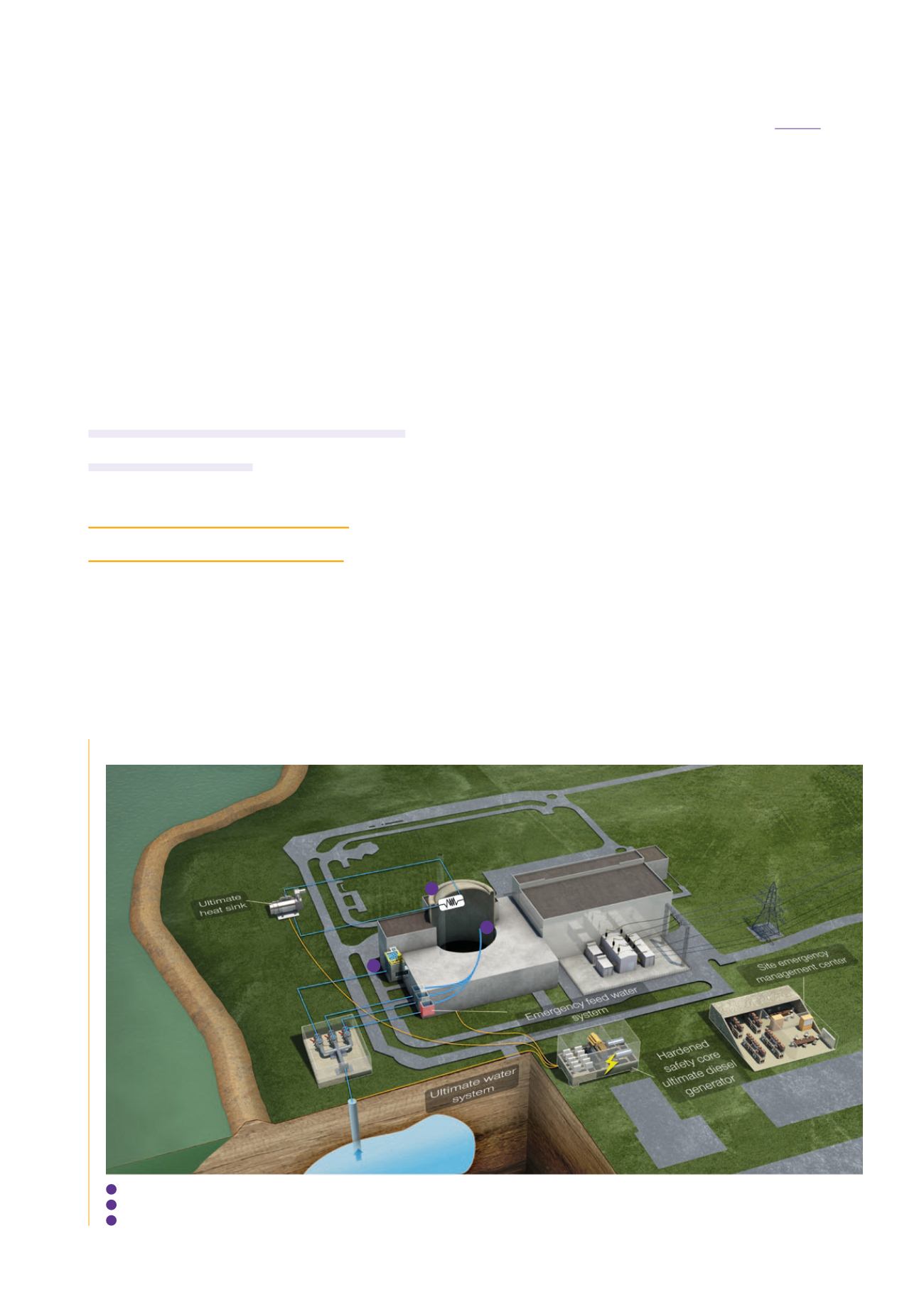
•a “hardened safety core” of material and organisational
measures which, in the event of an extreme external
hazard, are designed to:
-- prevent an accident with fuel melt, or limit its
progression,
-- limit large-scale radioactive releases,
-- enable the licensee to carry out its emergencymana-
gement duties;
•
a local emergency centre allowing emergency
management of the nuclear site as a whole in the event
of an extreme external hazard;
•
a Nuclear Rapid Intervention Force (FARN) which,
usingmobile means external to the site, can intervene
on a nuclear site in a pre-accident or accident situation;
•
a range of corrective measures or improvements,
notably the acquisition of additional communication
and radiological protectionmeans, the implementation
of additional instrumentation, extensive consideration
of internal and external hazard risks, improvement
of the way in which emergency situations are taken
into account.
1
reactor cooling
2
pool cooling
3
reactor building cooling
3
2
1
THE PRINCIPLE
of the hardened safety core
391
CHAPTER 12:
EDF NUCLEAR POWER PLANTS (NPPs)
ASN report on the state of nuclear safety and radiation protection in France in 2015