


 329 / 536

Thedeviceswith the largest inspection tunnel cross-section
are used in airports for screening air freight, large baggage
items and hold baggage in airports. This range of devices
is supplemented by tomographs, which give a series of
cross-sectional images of the object being examined.
The irradiation zone inside these appliances is sometime
delimited by doors, butmost often simply by one ormore
lead curtains.
X-ray body scanners
Thisparticularapplicationisgivenforinformationonly,since
the use of X-ray scanners onpeople during security checks
is prohibited inFrance (in applicationof Article L. 1333-11
of the Public Health Code). The experiments carried out
inFrance are basedonnon-ionising imaging technologies
(millimetre wave scanners).
Inspection of consumer goods
The use of devices for detecting foreign bodies in certain
consumer products has developed over the last fewyears,
such as for detecting unwanted items in food products
or cosmetics.
X-ray diffraction analysis
Research laboratories are making increasing use of small
devices of this type, which are self-shielded. Experimental
devices used for X-ray diffraction analysis can however
be built by experimenters themselveswithparts obtained
fromvarious suppliers (goniometer, sample holder, tube,
detector, high-voltage generator, control console, etc.).
X-ray fluorescence analysis
Portable X-ray fluorescence devices are intended for the
analysis of metals and alloys.
Measuring parameters
These appliances, which operate on the principle of X-ray
attenuation, are used as industrial gauges for measuring
fluid levels in cylinders or drums, for detecting leaks, for
measuring thicknesses or density, etc.
Irradiation treatment
More generally used for performing irradiations, the
self-shielded appliances exist in several models that
sometimes differ only in the size of the self-shielded
chamber, while the characteristics of the X-ray generator
remain the same.
2.2 Veterinary diagnostic radiology
The profession counts approximately 16,000 veterinary
surgeons and 14,000 non-veterinarian employees.
Veterinary surgeons use diagnostic radiology devices
in a context similar to that of the devices used in human
medicine. Veterinary diagnostic radiology activities
essentially concern pets:
•
90% of the 5,793 veterinary structures in France have
at least one diagnostic radiology device;
•
about thirty computed tomography scanners are used
in veterinary applications to date;
•
other practices drawn from the medical sector are
also implemented in specialised centres: scintigraphy,
brachytherapy and external-beam radiotherapy.
The treatment of large animals (mainlyhorses) requires the
use ofmorepowerful devices installed in specially equipped
premises (radiography of the pelvis, for example) and of
portableX-raygenerators, usedeither indoors –dedicatedor
other premises –or outside in the open air. This activityhas
significant radiationprotection implications for veterinary
surgeons and grooms.
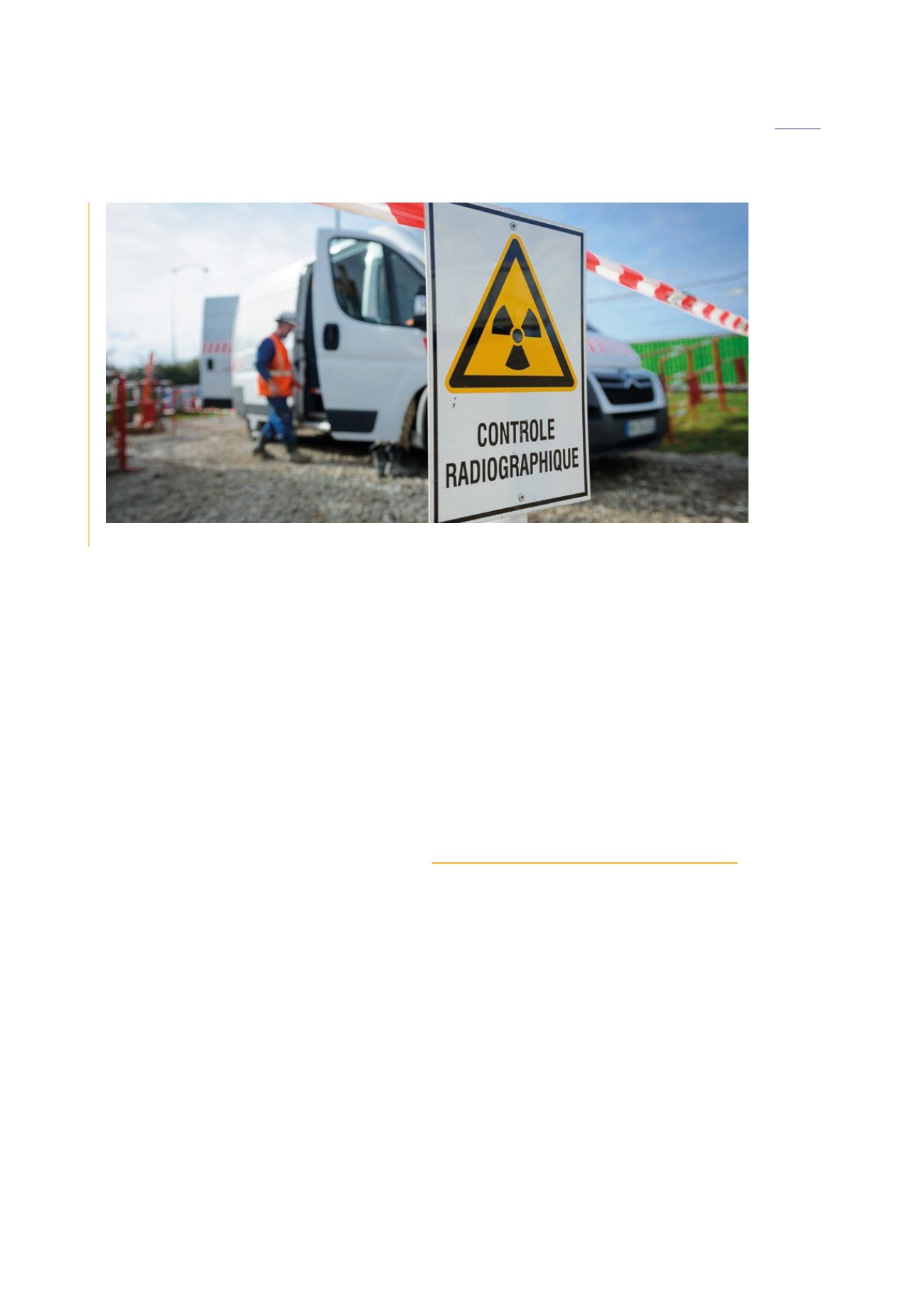
Natural gas pipeline construction site. Marking out for radiographic exposure.
329
CHAPTER 10:
INDUSTRIAL, RESEARCH AND VETERINARY USES AND SOURCE SECURITY
ASN report on the state of nuclear safety and radiation protection in France in 2015