


 330 / 536

The devices used in the veterinary sector are sometimes
derived fromthemedical sector. However, the profession
is increasingly adopting newdevices specially developed
to meet its own specific needs.
2.3 Particle accelerators
The PublicHealthCodedefines anaccelerator as adevice or
installation inwhich electrically chargedparticles undergo
acceleration, emitting ionising radiation at an energy level
in excess of 1 megaelectronvolt (MeV).
When they meet the characteristics specified in Article 3
of Decree 2007-830 of 11thMay 2007 concerning the list
of BNIs, these facilities are listed as BNIs.
Certain applications require the use of particle accelerators
which produce photon or electron beams, as applicable.
The inventory of particle accelerators in France, whether
linear (linacs) or circular (cyclotrons – see point 3 – and
synchrotrons), comprises about 60 identified installations
(excluding BNIs) which can be used in a wide variety of
fields:
•
research, which sometimes requires the coupling of
several machines (accelerator, implanter, etc.);
•
radiography (fixed or mobile accelerator);
•
radioscopy of lorries and containers during customs
checks (fixed-site or mobile accelerators);
•
modification of material properties;
•
sterilisation;
•
conservation of foodstuffs;
•
etc.
Inthefieldofresearch,twosynchrotronradiationproduction
facilities canbementioned inFrance: the ESRF (European
Synchrotron Radiation Facility) in Grenoble, and the
Soleil (Optimised source of energy light) synchrotron in
Gif-sur-Yvette.
Recently, particle accelerator imaging systems have been
used inFrance to combat fraudand large-scale international
trafficking. This technology,which is felt by the operators to
be effective,must however beusedunder certainconditions
in order to comply with the radiation protection rules
applicable to workers and the public, in particular:
•
a ban on activation of construction products, consumer
goods and foodstuffs as specified by Article R. 1333-2 of
the Public HealthCode, by ensuring that themaximum
energy of the particles emitted by the accelerators used
rules out any risk of activation of the materials being
verified;
•
a ban on the use of ionising radiation on the human
body for purposes other than medical. Thus, the use
of ionising technologies to seek out illegal immigrants
in transport vehicles is prohibited in France;
•
the setting up of procedures to ensure that the checks
conducted on the goods or transport vehicles do not lead
to accidental exposure of workers or other individuals.
During customs inspections of trucks using tomographic
techniques, for example, the driversmust be kept away
from the vehicle and other checks must be performed
prior to irradiation to detect the presence of any illegal
immigrants, in order to avoid unjustified exposure of
persons during the inspection.
2.4 Other electrical
devices emitting ionising radiation
This category covers all the electrical devices emitting
ionising radiationother than thosementionedabove andnot
excludedby the license andnotification exemption criteria
set out in Article R. 1333-18 of the Public Health Code.
This category notably includes devices generating
ionising radiation but not used for this property, such
as ion implanters, electron-beam welding equipment,
klystrons, certain lasers, certain electrical devices such
as high-voltage fuse tests.
0
500
1,000
1,500
2,000
2,500
3,000
3,500
2009 2010 2011 2012 2013 2014
2015
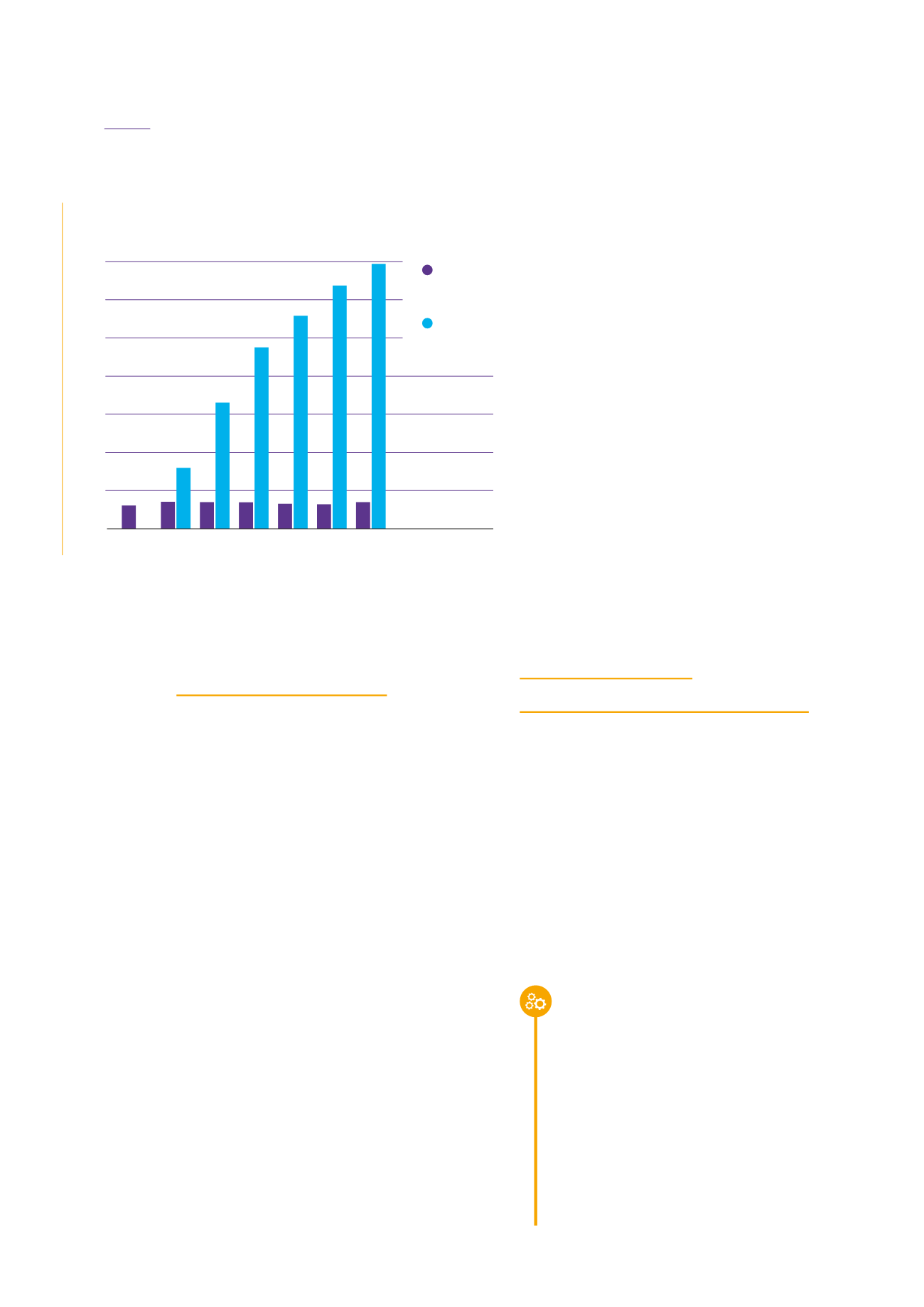
GRAPH 4:
Use of electrical devices generating ionising radiation for veterinary activities
Number
of veterinary
notifications
Number
of veterinary
authorisations
Synchrotrons
The synchrotron is a member of the same circular particle
accelerator family as the cyclotron (see point 3), but is far
larger, enabling energies of several gigaelectronvolts (GeV)
to be achieved by means of successive accelerators.
Owing to the low mass of the particles (generally electrons),
the acceleration created by the curvature of their trajectory
in a storage ring produces an electromagnetic wave when
the speeds achieved become relativistic: this is synchrotron
radiation. This radiation is collected at various locations called
beam lines and is used to conduct scientific experiments.
UNDERSTAND
330
CHAPTER 10:
INDUSTRIAL, RESEARCH AND VETERINARY USES AND SOURCE SECURITY
ASN report on the state of nuclear safety and radiation protection in France in 2015