


 472 / 536

notedduring an inspection conducted jointlywithASND
concerning a consignment of waste containers transported
between the nuclear power plant and the storage facility
of the Marcoule SBNI.
2.3 Areva installations
The situation of the UP2-400 complex is described in
chapter 13. This complex comprises the former spent fuel
reprocessing plant UP2-400 (BNI 33) and the associated
units, shut down since2004, namely theEffluent Treatment
Plant STE2A (BNI 38), the Oxide High Activity Facility
HAO (BNI 80), and the ELAN IIB installation (BNI 47),
which manufactured caesium-137 and strontium-90
sources until 1973.
2.3.1 The UP2-400 spent fuel reprocessing plant
and associated facilities
The HAO (High Activity Oxide) facility (BNI 80)
BNI 80 ensured the first stages of the reprocessing of spent
oxide nuclear fuels: reception, storage then shearing and
dissolution. The dissolution solutions produced inBNI 80
were then transferred to the UP2-400 industrial plant in
which the subsequent reprocessing operations tookplace.
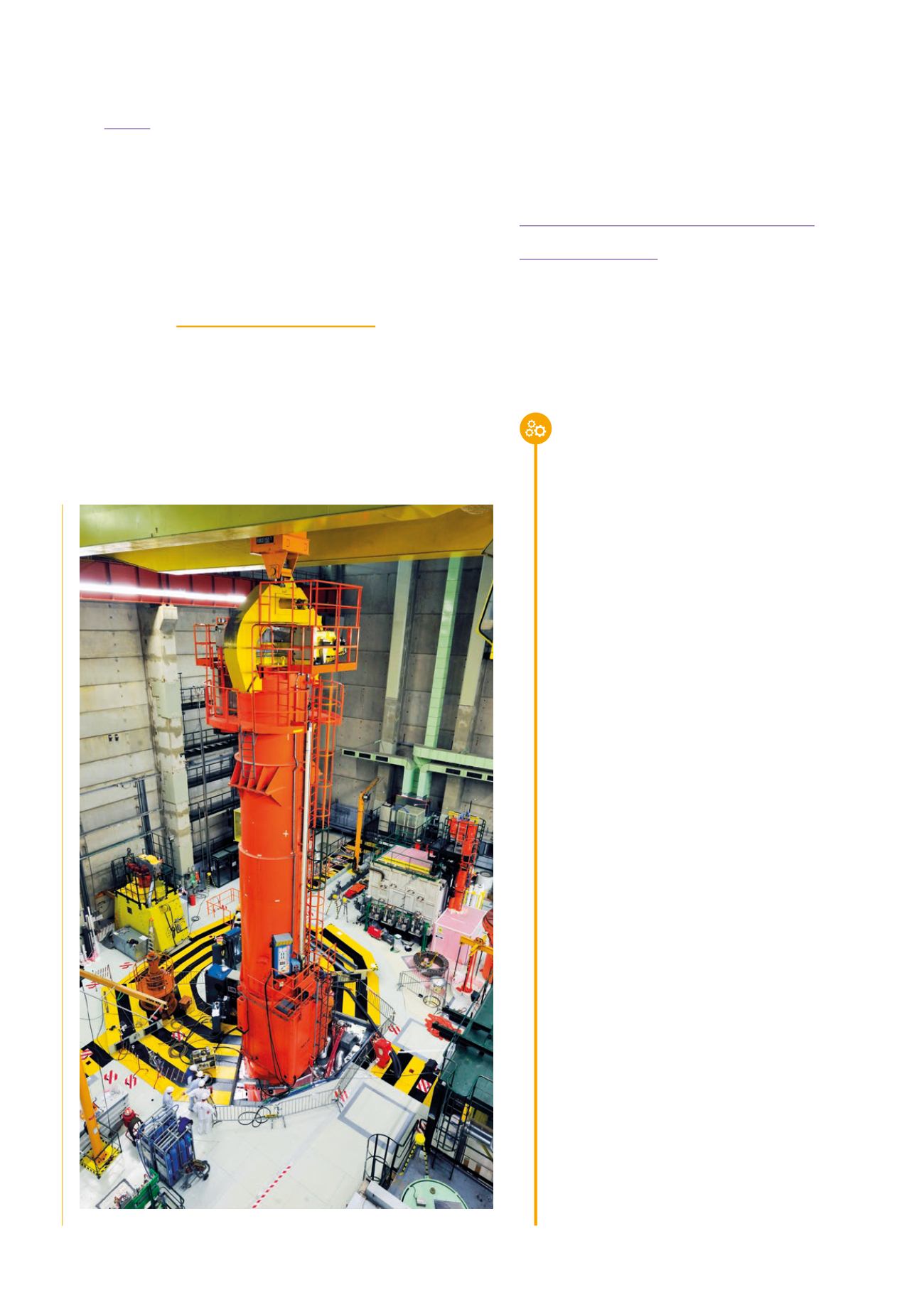
Extraction in fume cupboard of a primary component on the CEA Marcoule Phénix installation, April 2009.
Decommissioning of the Phénix NPP
CEA plans completing decommissioning of the Phénix NPP
by 2045 at the latest. These operations involve the following
stages:
• continuation of removal of the fuel elements and various
removable components from the reactor core, then transfer of
the fuels to the La Hague plant ;
• elimination of the sodium risks by treating the sodium and
objects having been in contact with this metal: this treatment
will necessitate the construction of new units and two new
buildings (NOAH and ELA) within the perimeter of BNI 71;
• dismantling of some of the reactor block structures (activated
structures present in the reactor vessel), of the reactor vessel
and the fuel storage tank, the shielded cells, etc.;
• dismantling of the workshops created for the decommissioning
of the NPP and dismantling of the NOAH and ELA buildings;
• cleaning out of the civil engineering structures that CEA wants to
keep once decommissioning is completed.
The availability of the NOAH and ELA infrastructures led CEA to also
request authorisation to treat - jointly with the sodium-containing
waste and the sodium from the Phénix NPP - sodium-containing
waste and batches of «legacy» sodium from other CEA facilities
(SURA facilities, an experimental loop of CABRI, Rapsodie, LECA,
and ICPEs situated at Cadarache).
The major safety issues identified in the decommissioning of the
Phénix NPP are:
• control of the criticality associated with the reactivity of
the fuel elements during the period when fissile material is
present in the installation and during the assembly handling
and treatment phases, in the irradiated elements cell for
example;
• the risks associated with sodium, as sodium reacts violently
with the oxygen in air and with water. The risk is therefore
present right through to the end of sodium treatment;
• management of the radioactive waste resulting from the
decommissioning and clean-out operations;
• control and limitation of gaseous and liquid effluent
discharges associated with the sodium treatment operations.
Safety functions enable these risks to be drastically reduced,
thanks in particular to control of the reactivity, to the
containment of the radioactive substances, and by maintaining
the primary sodium in the reactor vessel in the liquid phase.
Numerous commitments from the licensee should also help
minimise these risks.
UNDERSTAND
472
CHAPTER 15:
SAFE DECOMMISSIONING OF BASIC NUCLEAR INSTALLATIONS
ASN report on the state of nuclear safety and radiation protection in France in 2015