


 52 / 536

2.1.2 Radon
Some geological areas have a high radon exhalation
potential due to the geological characteristics of the
ground (granitic bedrock, for example). The concentration
measured inside homes also depends on the tightness
of the building (foundations) and the ventilation of the
rooms.
So-called “domestic” exposure to radon (radon indwellings)
was estimated by IRSN (French Institute for Radiation
Protection and Nuclear Safety) through measurement
campaigns followed by statistical interpretations (see
www.irsn.fr)
. The average radon activity valuemeasured
in France is 63 Bq/m
3
, with about half the results being
below 50 Bq/m
3
, 9% above 200 Bq/m
3
and 2.3% above
400 Bq/m
3
.
Thesemeasurements have allowed the French
départements
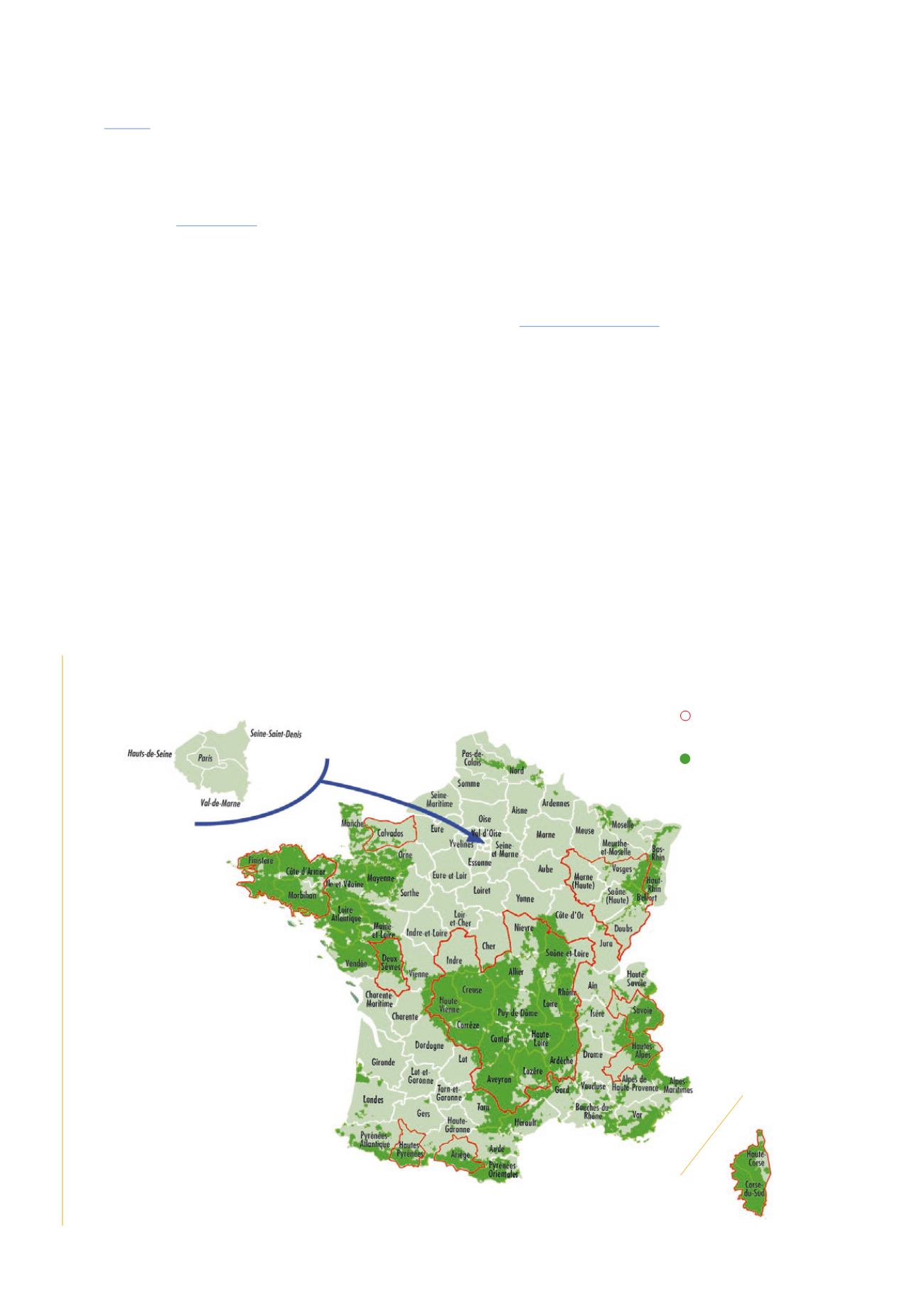
to be classified according to the radon exhalation potential
of the ground (see map below).
In 2011, IRSNpublished a newmap of France considering
the radon exhalation potential of the ground, based on
data from the French Geological and Mining Research
Office (BRGM).
2.1.3 Cosmic radiation
Les rayonnements cosmiques de composantes ionique The
cosmic radiation from ionic and neutronic components
is also accompanied by electromagnetic radiation. At sea
level, the dose rate resulting fromelectromagnetic radiation
is estimated at 32 nSv per hour and that resulting from
the neutronic component at 3.6 nSv per hour.
Considering the average time spent inside the home
(which itself attenuates the ionic component of the
cosmic radiation), the average individual effective dose
in a locality at sea level in France is 0.27 mSv per year,
whereas it could exceed 1.1mSv per year in a mountain
locality situated at an elevation of about 2.800 metres.
RADON
exhalation potential in metropolitan France (source: IRSN)
Radon exhalation potential zones
Limit of 31 priority
départements
for radon monitoring
52
CHAPTER 01:
NUCLEAR ACTIVITIES: IONISING RADIATION AND HEALTH AND ENVIRONMENTAL RISKS
ASN report on the state of nuclear safety and radiation protection in France in 2015