


 56 / 536

expressed in terms of effective dose, has been 20 mSv
for 12 consecutive months), obtained by adding the
dose due to external exposure to that resulting from any
internal contamination; other limits, called equivalent
dose limits, are defined for the external exposure of
certain parts of the body such as the hands and the
lens of the eye (see chapter 3).
The recorded data allow the identification of the
cumulative exposure dose for a given period (month or
quarter) for each worker in nuclear activities, including
workers fromoutside companies. The data are collected in
the Ionising Radiation Exposure Monitoring Information
System (SISERI) managed by IRSN and are published
annually. Themonitoring systemdoes not include worker
exposure to radon.
For each sector, tables 1 and 2 give the breakdown into
the populations monitored, the collective dose and
the number of times the annual limit of 20 mSv was
exceeded. They clearly show a significant disparity in
the breakdown of doses depending on the sector. For
example, the medical and veterinary activities sector,
which comprises a significant share of the population
monitored (nearly two thirds of the total), in fact only
accounts for about 28% of the collective dose. On the
other hand, this sector accounts for seven of the eight
reported exceedances of the 20 mSv annual dose limit,
of which one approached 96 mSv, one was between
20 and 25 mSv and five were between 30 and 50 mSv).
The latest statistics show a slight but regular increase in the
number of persons subject to dosimetricmonitoring since
2005 (see diagram 2); the mark of 350,000 individuals
was exceeded in 2012. This trend is largely due to
the increase in the number of persons monitored in
the fields of medical and veterinary activities. After a
slight drop in 2013, the first since 2001, the year 2014
again showed a slight increase in the number of people
monitored; it would thus seem that a plateau has been
reached, a trend which remains to be confirmed in the
coming years.
At the same time, the overall collective annual dose
has decreased (by about 50% since 1996, whereas the
number of people monitored has increased by about
50%). The collective dose did however display an upward
trend between 2006 and 2009, followed by a levelling
off over the 2009 -2013 period and then a drop in 2014
to reach 56.3 man-Sv.
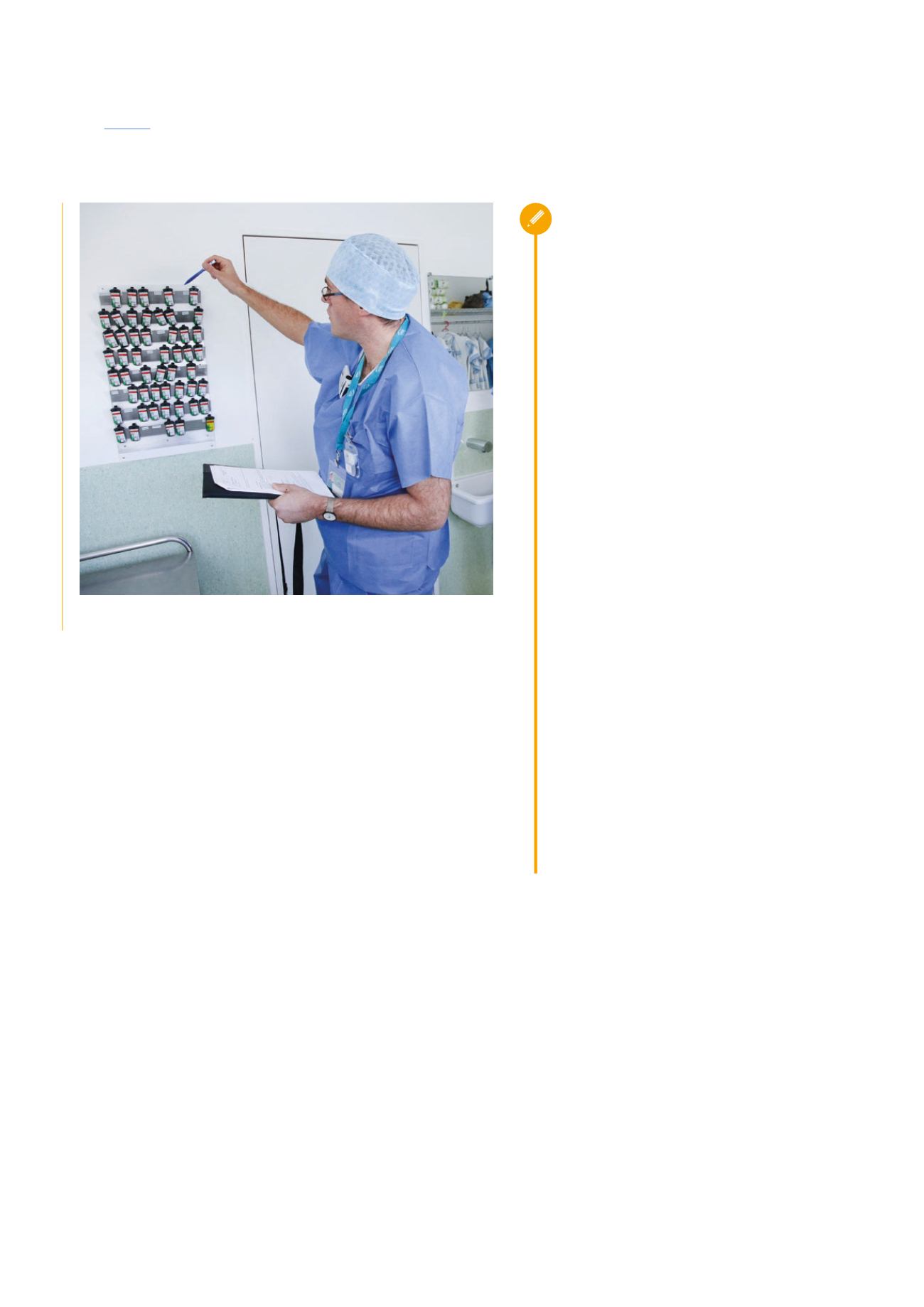
ASN inspectors inspect the dosimeters of the medical personnel at the Guingamp hospital
centre.
Results of dosimetry monitoring of worker
external exposure to ionising radiation in 2014
(source: Occupational exposure to ionising radiation in France -
2014 results, IRSN, July 2015)
• Total population monitored: 359,646 workers.
• Monitored population for whom the dose remained below
the detection threshold: 283,143 workers, or about 79%.
• Monitored population for whom the dose remained between
the detection threshold and 1 mSv: 63,431 workers,
or about 18%.
• Monitored population for whom the dose remained between
1 mSv and 20 mSv: 13,072 workers, or about 3.6%.
• Monitored population for whom the annual effective dose
of 20 mSv was exceeded: 9 including 1 above 50 mSv.
• Collective dose (sum of individual doses): 56.3 man-Sv.
• Annual average individual dose in the population which
recorded a dose higher than the detection threshold:
0.74 mSv.
Results of internal exposure monitoring in 2014
• Number of routine examinations carried out:
306,220 (of which fewer than 1% were considered
positive).
• Population for which dose estimation was made:
553 workers.
• Number of special monitoring examinations or verifications
performed: 5,524 (of which 16% were above the detection
threshold).
• Population having recorded a committed effective dose
exceeding 1mSv: 5 workers.
Results of cosmic radiation exposure monitoring
in 2014 (civil aviation)
• Collective dose for 18,110 flight crew members:
32.6 man-Sv.
• Annual average individual dose: 1.8 mSv.
TO BE NOTED
56
CHAPTER 01:
NUCLEAR ACTIVITIES: IONISING RADIATION AND HEALTH AND ENVIRONMENTAL RISKS
ASN report on the state of nuclear safety and radiation protection in France in 2015