


 451 / 536

ITER, risks and prevention system
The ITER project, devoted to research on thermonuclear fusion,
is based on a “tokamak” type machine.
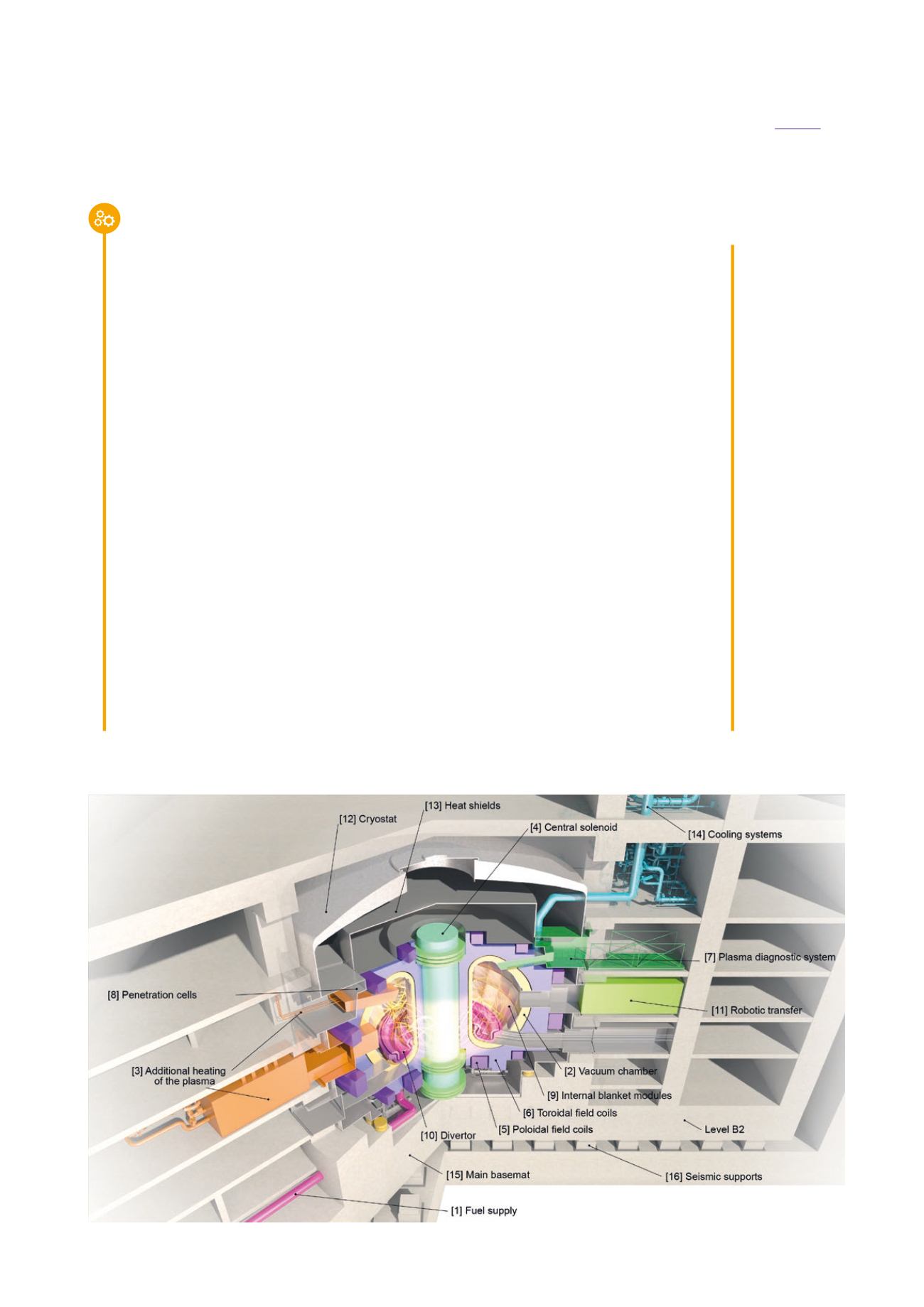
The principle consists in introducing gaseous fuel [1] into
a vacuum chamber [2] and then heating it to a temperature of
about 100 million degrees to obtain a deuterium-tritium plasma
which, through fusion, produces neutrons and particles. Heating
is mainly by means of an electric current created by the windings
of a central solenoid [4] and additional heating systems [3]
injecting electrically neutral, highly energetic particles.
The plasma is controlled and confined inside the vacuum chamber
by magnetic fields, about 200,000 times stronger than that
of the Earth, generated by superconducting coils [5 and 6] and
by the central solenoid [4]. There can be considerable mechanical
stresses in the event of a plasma malfunction, such as vertical
displacement or disruption. The plasma diagnostic system [7]
measures its behaviour and performance by means of devices
installed on the inner walls of the vacuum chamber and
in the penetration cells [8].
The vacuum chamber is protected from heat and from neutrons
by blanket modules [9] covered with beryllium, the toxicity
of which requires personnel protection and waste management
measures. Steps are taken to prevent the risks of internal
explosion in the vacuum chamber, which could disperse hydrogen
isotopes or dust. The divertor [10], placed at the base of the
vacuum chamber, is used to extract the impurities and residues
generated by fusion, along with some of the power produced.
UNDERSTAND
For maintenance, the highly Irradiating internal components of the
vacuum chamber are extracted and transferred to another building by
means of robotic equipment and casks [11].
The tokamak is enclosed in a cryostat [12] comprising heat shields
[13] enabling the coils, which are at very low temperature,
to be separated from the high-temperature components.
Heat is transferred outside by means of a water cooling system [14]
consisting of two loops leading to cooling towers.
The walls of the vacuum chamber and the buildings, plus the ventilation
system, allow containment of the tritium, an isotope of hydrogen
which gives off low levels of radioactivity but which is present in large
quantities in the ITER facility, preventing it from being released into
the environment. A detritiation system, Installed In the “tritium”
building next to the tokamak, extracts the tritium from the gases
and liquids so that it can be returned to the fuel cycle. It comprises
recombiners, molecular sieves and scrubbing columns (offering 99%
efficiency in a normal operating situation and 90% in the event of a
fire).
The complex of buildings housing the tokamak and the tritium building
is built on a main basemat [15] which itself rests on seismic pads [16],
themselves built on an isolating seismic lower basemat.
The main safety issues in the facility are thus the containment of
radioactive substances, tritium in particular, in normal and accident
situations, as well as radiation protection, more specifically during
maintenance of highly irradiating components.
451
CHAPTER 14:
NUCLEAR RESEARCH AND MISCELLANEOUS INDUSTRIAL FACILITIES
ASN report on the state of nuclear safety and radiation protection in France in 2015