


 448 / 536

In order to be able to produce exotic nuclei
1
, the Ganil
was authorised in 2012 to build phase 1 of the Spiral 2
project. ASN issued a partial commissioning license
for phase 1 of this project on 30th October 2014. ASN
examined the commissioning application for phase 1
of the Spiral 2 project and notes that the additional
information requested, more specifically concerning
the seismic resistance of the facility, was submitted late,
meaning that it was impossible to conduct a complete
examination in 2015.
ASN has completed the examination of the first
periodic safety review of the installation since it was
commissioned in 1983. This review was on the whole
satisfactory and led ASN to issue several prescriptions
on the conformity of the installation with its safety
baseline requirements and the regulations currently
in force, in order to allow continued operation.
1. The “exotic nuclei” are nuclei which do not exist naturally
on Earth. They are created artificially in the Ganil for nuclear
physics experiments on the origins and structure of matter.
Finally, ASN issued a resolution on 7th July 2015
concerning effluent discharges and transfers at the Ganil.
ASN considers that the licensee must improve how
it organises waste management and in particular its
monitoring of the outside contractor responsible for
packaging the Very Low Level Waste (VLLW) and the
Low-Level Waste (LLW) produced on the site. ASN
also regrets the absence of advance planning for the
removal of the waste stored since 2012.
2.2 The High Flux Reactor (RHF)
at the Laue-Langevin Institute
TheRHF(BNI67)inGrenoble,operatedbytheLaue-Langevin
Institute (ILL), provides neutrons used for experiments in
thefieldsofphysicsandbiology.Thisreactorwasauthorised
by the Decree of 19th June 1969, modified by the Decree
of 5thDecember 1994, andhas amaximumpower of 58.3
MWth,operatingcontinuouslyin50-daycycles.Thereactor
core is cooledbyheavywater contained ina reflective tank,
which is itself immersed in a light water pool.
ASN considers that those aspects of RHF safety identified
by ILL as priorities are managed both proactively and
reactively. In the light of the experience feedback from
the Fukushima Daiichi accident, the ILL thus rapidly
carried out major reinforcement work, which continued
satisfactorily in 2015. However, ASN did find that,
despite these improvements, the expected rigour in the
traceability of the activities and updating of the baseline
safety requirements was not always present. The planning
and quality of the files were not always sufficient. The
post-Fukushima work should continue in 2016 with
the same level of proactive commitment, but withmore
rigour in document transmissions and updates. ASNdoes
however consider that the licensee needs to improve its
organisation in order to comply with the requirements of
the regulations. It must in particular improve and clarify
the facility’s baseline safety requirements and then ensure
that the facility actually complies with these requirements.
The licensee must also make progress in the traceability
andmonitoring of its activities important for protection,
in particular works, maintenance and periodic checks and
tests. In 2015, ASN thus asked the ILL to significantly
improve its monitoring of the regulatory inspections
on electrical and lifting equipment and its lock-out if
the equipment is not up to date with these regulatory
inspections. ASN also requires ILL to analyse and make
greater use of operating experience feedback in order
to improve its own organisation, in particular on the
basis of notified significant events and the observations
and requests expressed by ASN further to inspections.
In 2015, in reply to several requests fromASN, the ILL
proposed implementing an integrated management
system meeting the requirements of the regulations,
along with a reorganisation of its safety system in order
to improve its independence.
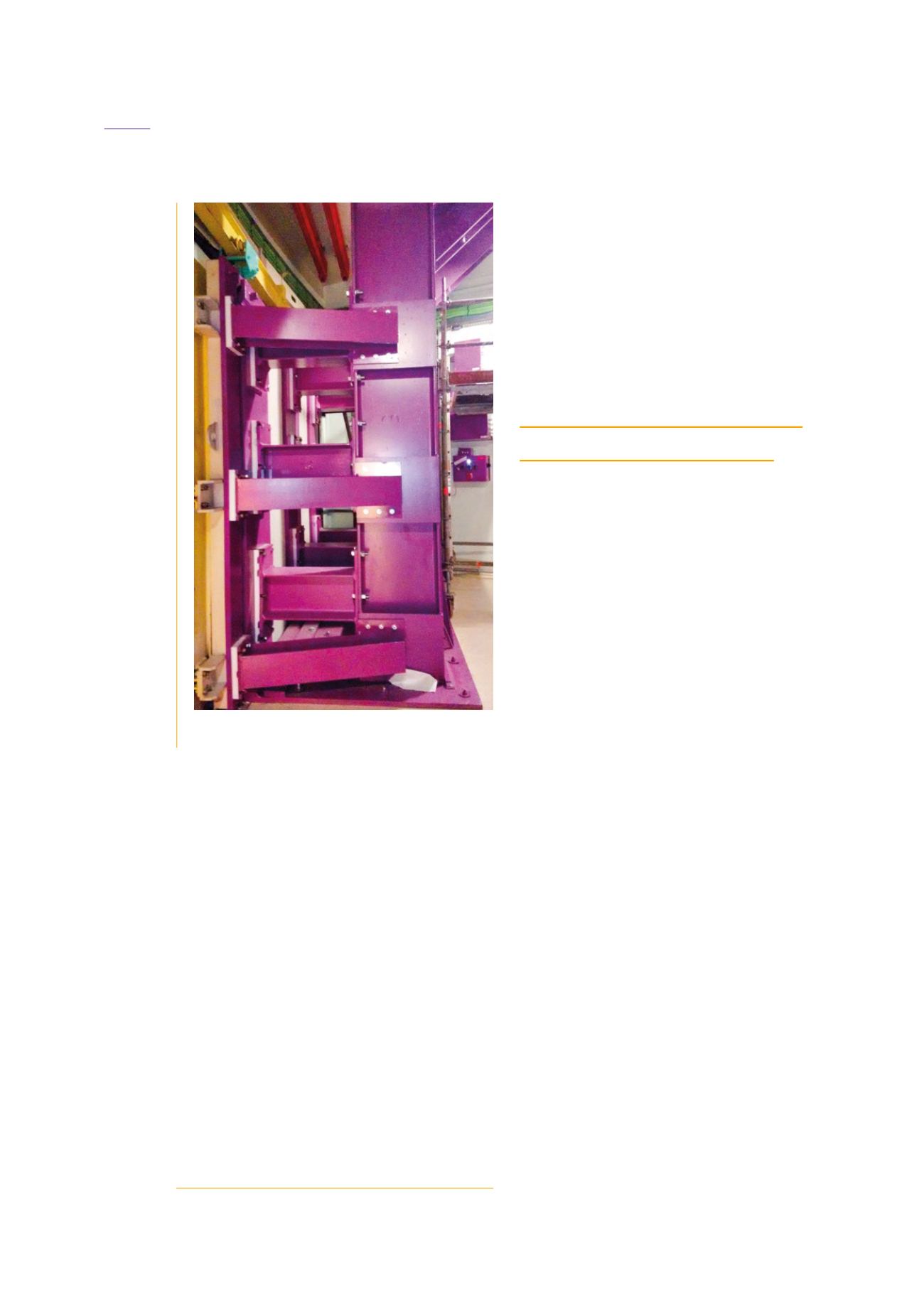
Elements of the RHF “hardened safety core”: reinforcement of a door
to withstand extreme flooding.
448
CHAPTER 14:
NUCLEAR RESEARCH AND MISCELLANEOUS INDUSTRIAL FACILITIES
ASN report on the state of nuclear safety and radiation protection in France in 2015