


 449 / 536

Implementation of these changes will be submitted
to ASN for approval.
In response to a formal notice service by ASN, the ILL
submitted applications for special conditions regarding
the implementation of Title III of the Decree of 13th
December 1999 concerning nuclear pressure equipment,
for the 21 equipment items non-compliant with the
regulations. Each of these files describes the measures
proposed to compensate for the verifications which
cannot be performed owing to the specific nature of
the RHF equipment. After analysing the proposals,
ASN defined these special conditions.
Finally, the ILL must be the subject of a periodic safety
review in 2017. ASN hopes that already in 2016 the
licensee will make a serious commitment to updating and
re-assessing the facility’s baseline safety requirements
from both the technical and documentary viewpoints.
2.3 European Organization
for Nuclear Research (CERN)
installations
The European Organization for Nuclear Research
(CERN) is an international organisation whose role is
to carry out purely scientific and fundamental research
programmes concerning high energy particles. A
tripartite agreement signed by France, Switzerland
and CERN came into effect on 16th September 2011.
The oversight of nuclear safety and radiation protection
was previously managed through bilateral agreements.
For the CERN, 2015 was marked by the extension
of a lengthy outage, to allow higher power operation
by the LHC accelerator, which was restarted in 2015.
In 2014, ASN and the Swiss Federal Office for Public
Health (OFSP) approved the site’s nuclear waste
management study and the safety file for a new linear
accelerator, built in the CERN and called Linac 4.
This accelerator was inspected jointly with the Swiss
Authorities in 2015.
The CERN notified the Swiss, French and German
authorities of its first significant event in 2015, which
is positive in terms of transparency.
2.4 The ITER project
ITER (BNI 174) is an experimental installation,
the purpose of which is scientific and technical
demonstration of controlled thermonuclear fusion
energy obtained with magnetic confinement of a
deuterium-tritium plasma, during long-duration
experiments with a significant power level (500 MWe
for 400 s). This international project enjoys financial
support fromChina, South Korea, India, Japan, Russia,
the European Union and the United States, who make
in-kind contributions by providing equipment for the
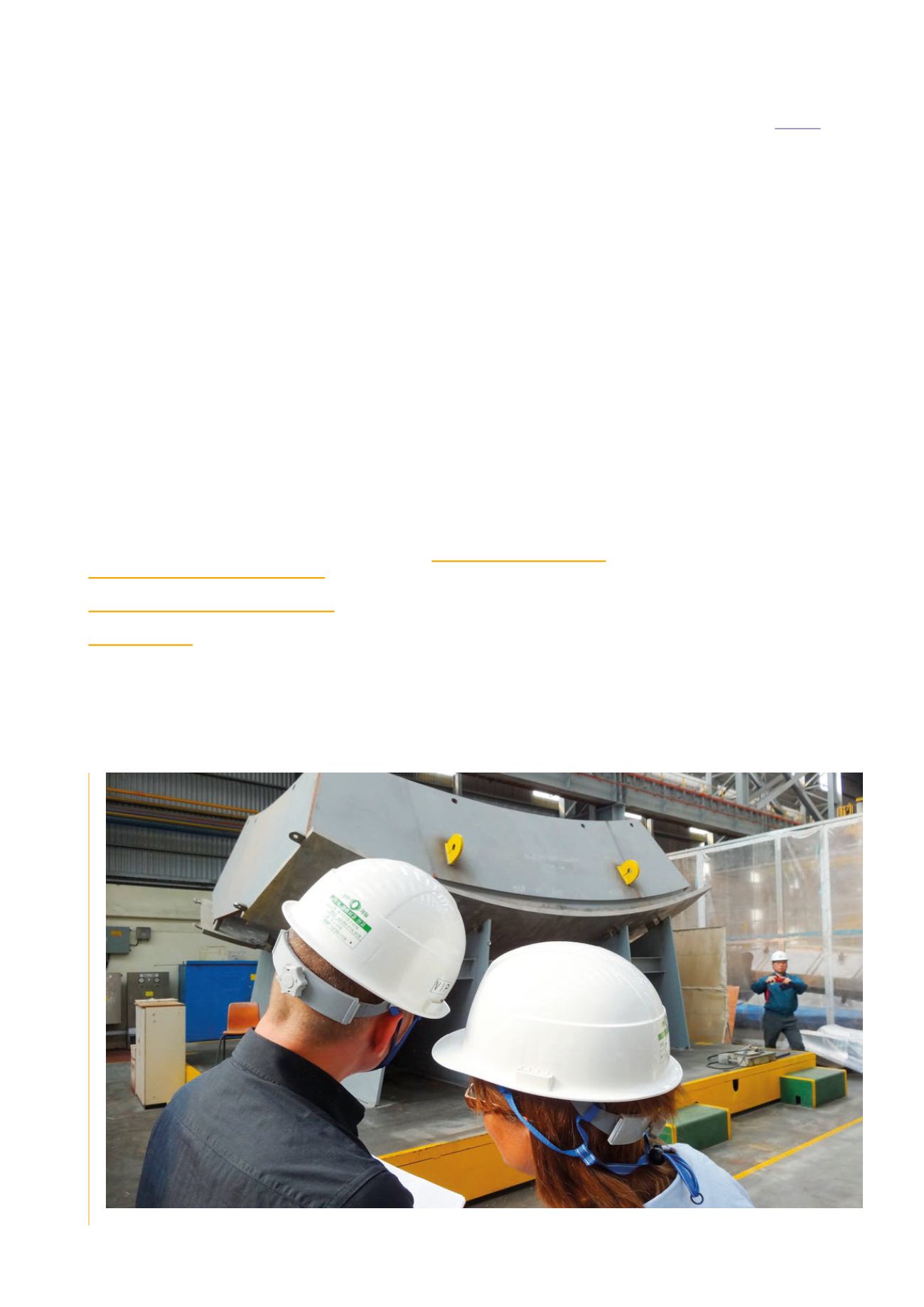
ASN inspection of monitoring of the outside contractors in charge of manufacturing ITER vacuum chamber sectors in South Korea, April 2015.
449
CHAPTER 14:
NUCLEAR RESEARCH AND MISCELLANEOUS INDUSTRIAL FACILITIES
ASN report on the state of nuclear safety and radiation protection in France in 2015