


 444 / 536

In addition, even though ASN notes that a large share of
the undertakings made for the periodic safety review of
the facility in 2009 have beenmet, a number of particular
technical justifications have yet to be produced.
In the follow-up to the Fukushima Daiichi accident, the
ASN resolution of 8th January 2015 set the requirements
for the facility’s “hardened safety core”, which is the only
one of the CEA batch 2 facilities for which the need to
deploy such a hardened safety core was identified by
the licensee.
Test reactors
Cabri reactor (Cadarache)
The Cabri reactor (BNI 24), created on 27th May 1964,
is used for experimental programmes aimed at better
understanding nuclear fuel behaviour in the event of
a reactivity accident. The reactor is operated by CEA.
Modifications to the facility were authorised in a Decree
of 20th March 2006, in order to run new research
programmes. The reactor’s sodium loop was replaced
by a water loop in order to study the behaviour of high
burn-up fraction fuels in accident situations representative
of those that could be encountered in a pressurisedwater
reactor.
2015 was marked by the first criticality of the modified
reactor, authorised for start-up tests by ASN on
13thOctober 2015. In order to authorise this criticality,
ASN in particular examined:
•
the implementation of the prescriptions of the ASN
resolutionof 8th January 2015 concerning integrationof
the lessons learned fromtheFukushimaDaiichi accident;
•
the completion of CEA’s 2004 commitments prior to
criticality, as part of the facility’s safety reassessment and
the modification project authorised in 2006;
•
the completion of CEA’s 2008 and 2009 commitments
for refuelling of the driver core;
•
updating of the facility’s baseline requirements, in
particular the safety analysis reports and the general
operating rules transmitted in February 2015;
•
implementation of compensatory measures following
the significant event of 15thDecember 2014 concerning
a fault in the core system.
The three inspections carried out by ASN in 2015,
devoted to the start-up tests and the periodic checks
and tests, did not reveal any significant deviation with
respect to the facility’s baseline safety requirements. CEA
will be required to conduct a more detailed analysis of
the numerous events which occurred at first criticality.
On 13th October 2015, ASN also prescribed the
transmission of additional files, including a report
summarising the commissioning tests prior to the first
experimental test. In it, ASN also notifies the deadline
for the next periodic safety review of the facility in 2017.
Phébus reactor (Cadarache)
The Phébus reactor (BNI 92), the creation of which was
authorised by the Decree of 5th July 1977, enabled tests to
be performed concerning the severe accidents that could
affect pressurisedwater reactors. It was finally shut down
in 2010 following the “fission products” experimentation
programme which started in 1988. CEA informed ASN
in 2013 that it intended to shut down this BNI once and
for all and in 2014 transmitted an updated file presenting
the decommissioning preparation operations and the
decommissioning plan. In 2015, CEAwas authorised to
begin the first operations to prepare for decommissioning,
in this case the disassembly of cooling equipment outside
the reactor building. CEA undertook to submit the
decommissioning file for the facility no later than 2017.
It will also submit the facility’s periodic safety review file.
ASNaskedCEA to supplement its decommissioning plan
and its safety review orientations file with respect to the
management of radioactive substances.
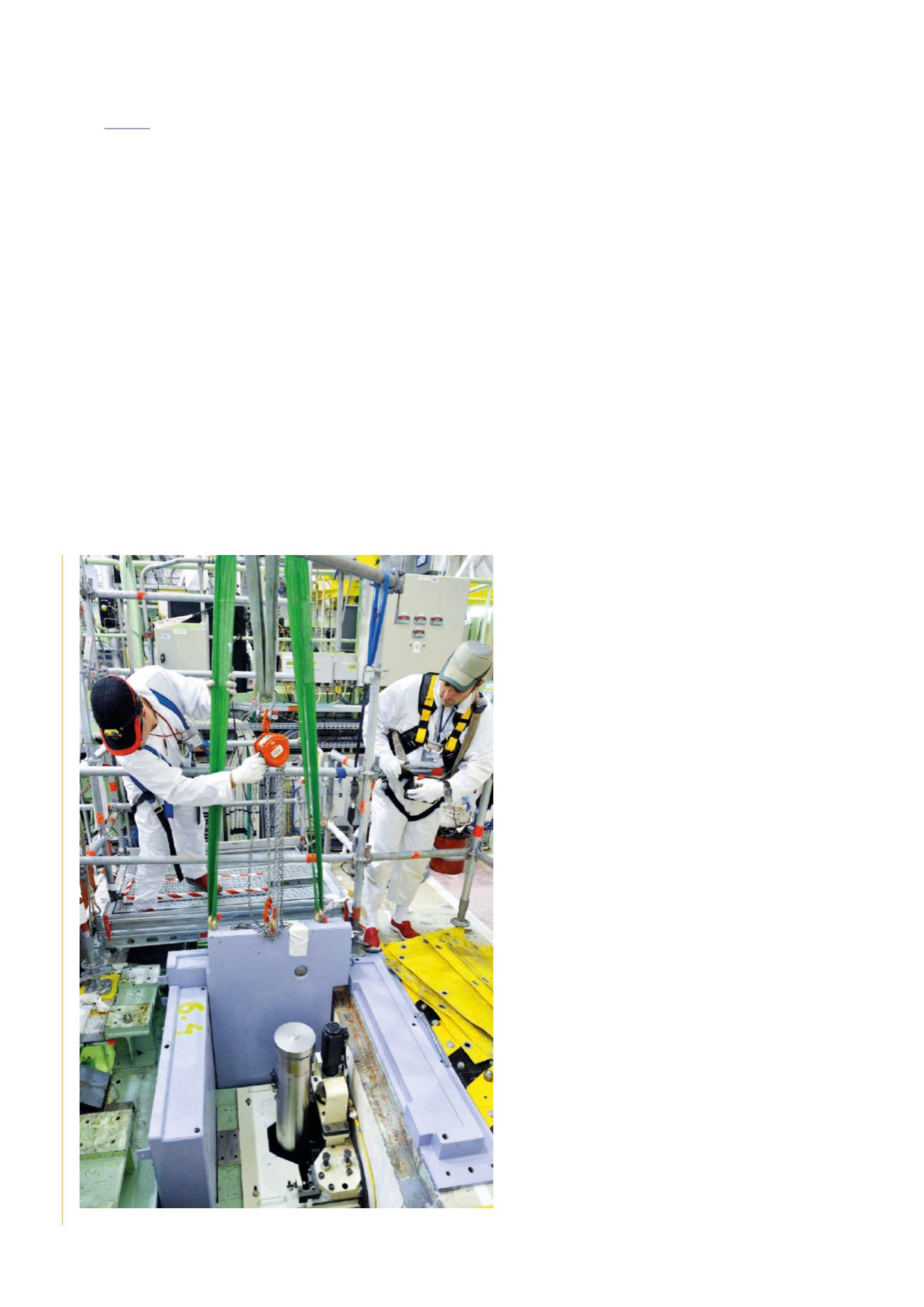
Installation of biological shielding in the Cabri research reactor containment, 2012.
444
CHAPTER 14:
NUCLEAR RESEARCH AND MISCELLANEOUS INDUSTRIAL FACILITIES
ASN report on the state of nuclear safety and radiation protection in France in 2015