


 441 / 536

buildingdesigned tomeet reference earthquake standards)
was once againdelayedbyCEA: the substantialmodification
application file is now being announced by CEA for the
first quarter of 2016. Even if the organisation currently in
place in the facility for monitoring outside contractors is
satisfactory, it will need to be significantly strengthened
in the light of the renovation operations.
Despite the delays in the facility’s renovationproject, CEA
submitted its periodic safety review file inApril 2015. ASN
considered it to be unsatisfactory and requested that it be
supplemented, inparticularwith regard to the conformity
of the equipment necessary in the short term in the light
of the requirements defined by CEA.
ÉOLE and Minerve reactors (Cadarache)
The ÉOLE and Minerve critical mock-ups are very low
power reactors (less than 1 kW) used for neutron studies,
inparticular toqualify calculation systems, evaluate gamma
or neutron attenuation in materials and acquire basic
nuclear data.
The ÉOLE reactor (BNI 42), whose construction was
authorised by the Decree of 23rd June 1965, is intended
for neutron studies of light water reactor cores. It is able
to reproduce a neutron flux representative of that of the
power reactor cores, on a very small scale. The Minerve
reactor (BNI 95), whose transfer from the Fontenay-aux-
Roses research centre to the Cadarache research centre
was authorised by the Decree of 21st September 1977, is
situated in the same hall as the ÉOLE reactor. It is primarily
devoted to effective cross-section measurements.
In 2015, ÉOLE and Minerve continued their teaching
and research activities, inparticularwith the “FLUOLE 2”
programme, for which ÉOLE was authorised to operate
at 1 kW.
The examination of the second periodic safety review led
ASN to issue its resolution of 30thOctober 2014, making
continuedoperation conditional on the removal ofmost of
the nuclearmaterials fromstorage in the near future, along
with a limited improvement in its seismic resistance, no
later than the end of 2017 and then its compliance with
current seismic resistance requirements before the end
of 2019. In 2015, CEA thus transferred a significant part
of the radioactive substances stored in the facility to the
Magenta installation on the Cadarache site, nine months
ahead of the schedule set by ASN, thus achieving a 95%
reduction in the radiological impact of a possible accident.
With regard to the limited seismic resistance reinforcements,
the studies have reached the detailed design stage and
will enable CEA to clarify how it will be carrying out the
reinforcement work before the end of 2017.
Given the cost of the reinforcements to the buildings
that would be needed in order to meet current seismic
resistance requirements, CEA will shut down the facility
at the end of 2019 to comply with the ASN resolution of
30th October 2014.
Irradiation reactors
The Osiris reactor and its ISIS critical mock-up (Saclay)
The Osiris pool-type reactor (BNI 40) has an authorised
power of 70 megawatts thermal (MWth). It is primarily
intended for technological irradiationof structuralmaterials
and fuels for various power reactor technologies. It is also
used for a few industrial applications, in particular the
production of radionuclides for medical uses, including
molybdenum-99 (99Mo). Its critical mock-up, the ISIS
reactor, with a power of 700 kWth, is essentially used for
trainingpurposes today. These two reactorswere authorised
by a Decree dated 8th June 1965.
Owing to the significant design differences between this
older facility and the best techniques currently available for
protection against external hazards and the containment
of materials in the event of an accident, 2015 was the last
year of operation for the Osiris reactor. The ISIS reactor
will be able to continue to operate until 2019.
The various inspections showed that the facility is operated
in satisfactory conditions. Application of the regulatory
provisions concerning nuclear pressure equipment was
improved.
The main cause of most of the significant events in 2014
was hardware failures, in particular in instrumentation
and control. They had nomajor safety impact. A number
of residual studies from the 2009 periodic safety review
underwent complementary analyses, in particular with
regard to the handling conditions for the Orphée spent
fuel stored in the facility. The handling conditions for these
fuels weremademore robust in order to improve control
of the criticality risk.
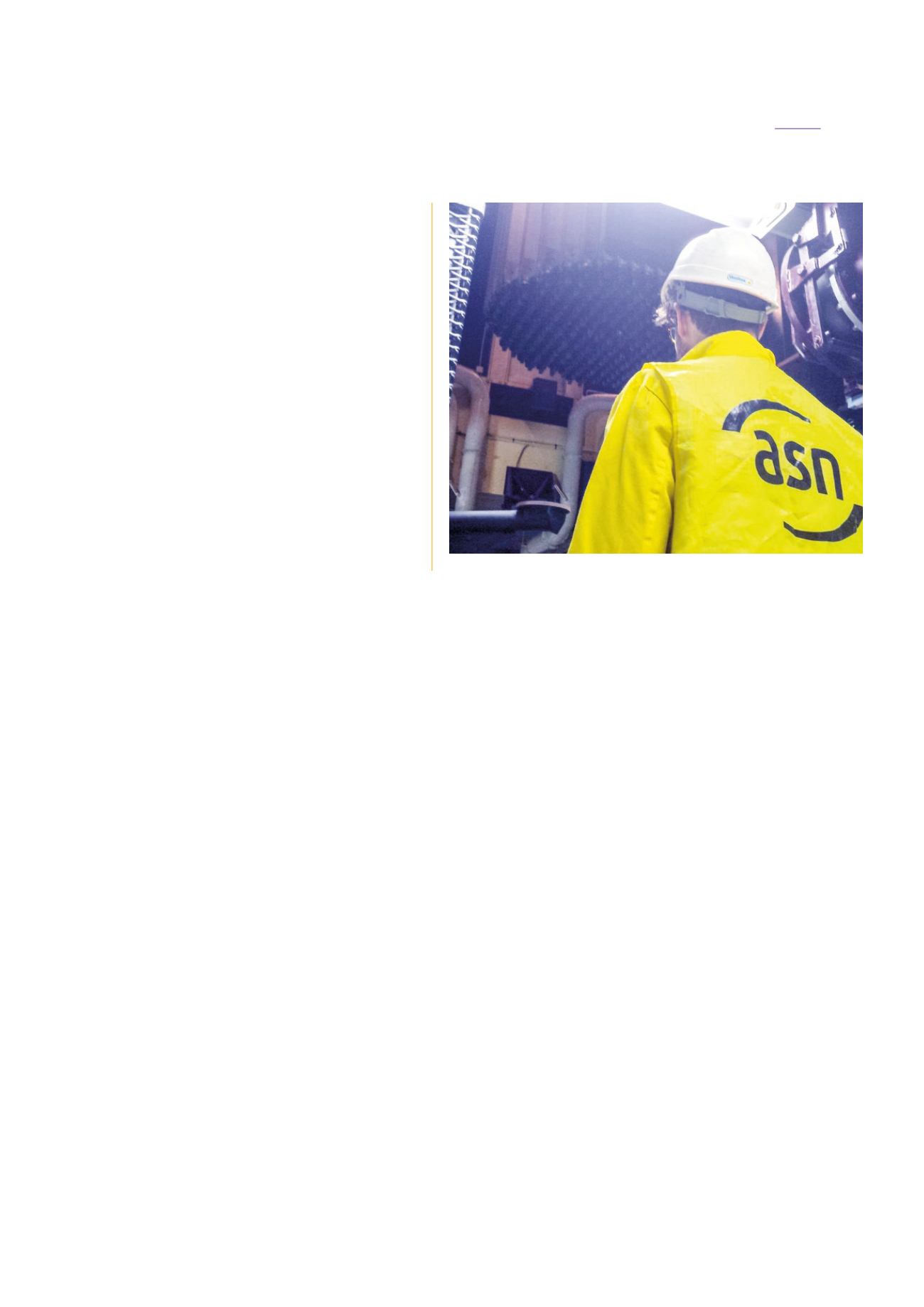
ASN inspection in the core of the shutdown Masurca reactor, April 2015.
441
CHAPTER 14:
NUCLEAR RESEARCH AND MISCELLANEOUS INDUSTRIAL FACILITIES
ASN report on the state of nuclear safety and radiation protection in France in 2015