


 443 / 536

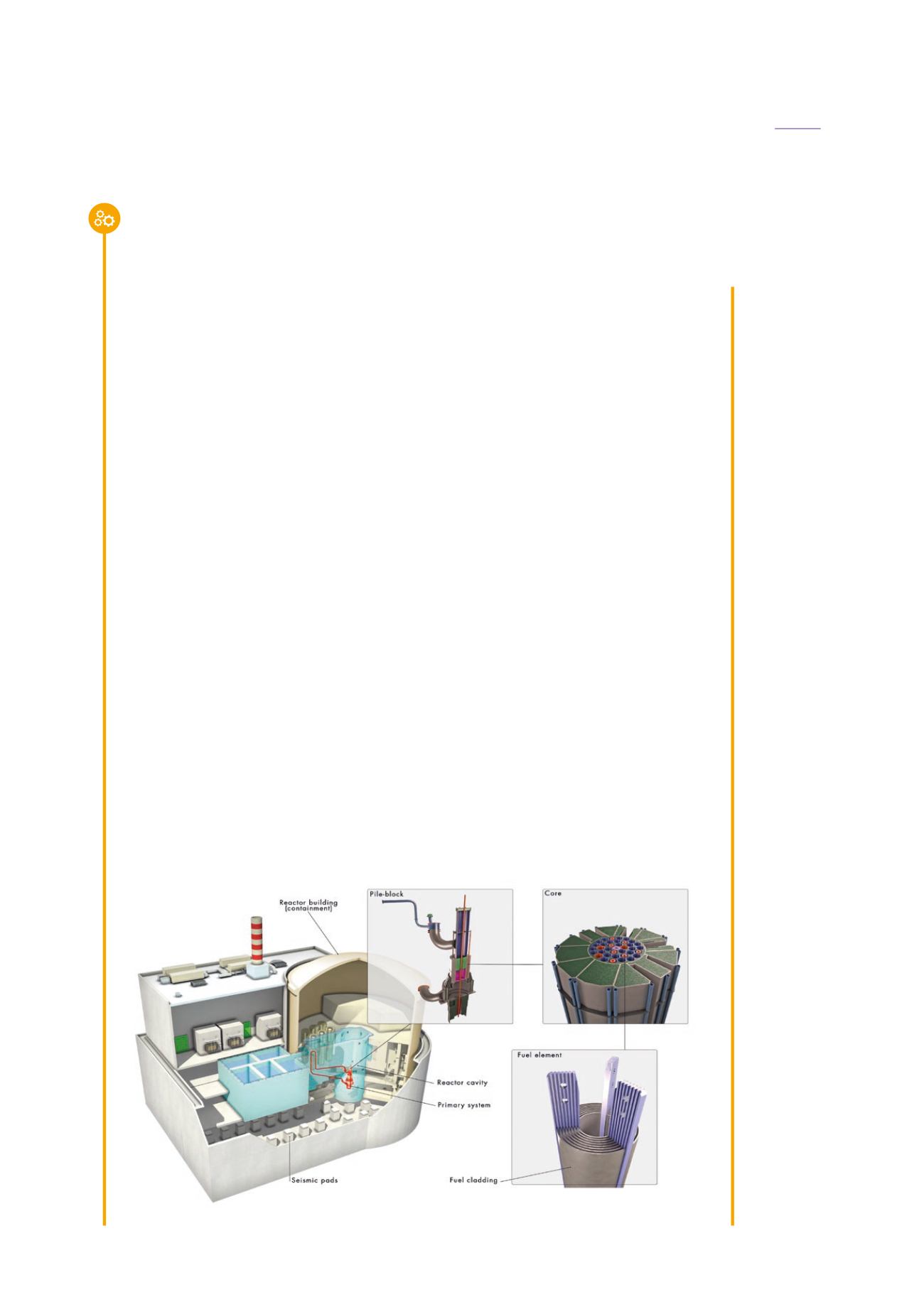
Jules Horowitz Reactor.
Jules Horowitz Reactor, risks and
prevention systems
Just like all reactors, the RJH presents four main risks:
• Core melt:
resulting from overheating of the irradiated
fuel. To prevent this, the core is cooled by a closed circuit
of circulating water (primary system), itself cooled by a
secondary system. Finally, the water from the Provence
canal, which is then directed to the EDF canal, cools this latter
(tertiary system). At the same time, the reactor (the core and
part of the primary system) is immersed in the water-filled
reactor cavity.
• Criticality:
runaway fission reaction of the uranium atoms
contained in the reactor core (fuel). To prevent this, a specific
fuel elements geometry must be maintained. To do this,
and over and above the numerous retaining systems in the
reactor, protection is provided by the “reactor building”
(pre-stressed concrete).
• Dispersal of radioactivity:
in an accident situation,
radioactivity can be dispersed in liquid, gaseous or dust form.
Three barriers are designed to prevent this:
-- 1st barrier: the fuel cladding: which will prevent the fuel
from coming into contact with the water in the primary
system;
-- 2nd barrier: the primary system: if the 1st barrier fails, the
primary system will contain the radioactivity dispersed into
the water;
-- 3rd barrier: the containment: if the 2nd barrier fails,
the pre-stressed concrete reactor building acts as the
containment for the radioactive substances.
• Irradiation:
emission of particles that are harmful
to the organism. To prevent this, screens can be installed,
or materials such as water, concrete, etc. can be used.
The water in the reactor cavity for example also acts
a protective shield. Steps are also presented to deal with
UNDERSTAND
hazards that can stem from the installation itself or even from its
environment: extreme climatic conditions, flooding, earthquake,
airplane crash, internal fire or explosion, projectile or falling load
inside the installation. Seismic pads are for instance present
underneath the installation
In addition, the assessments carried out following the Fukushima
Daiichi accident led CEA to identify a «hardened safety core» of
equipment, the operation of which must be guaranteed in extreme
situations.
This equipment must enable the following to take place:
• cooling of the core to prevent an accident: equipment designed to
maintain convection in the primary system and pool make-up system
from outside the facility;
• in the event of an accident, limit discharges into the environment:
equipment designed to isolate and depressurise the containment,
radiological activity and pressure sensors;
• in the event of an accident, monitor the facility and manage the
emergency: in the fall-back centre, indicators of the temperature
and water level in the reactor cavity and of maintained convection in
the primary system, with installation of mobile resources (portable
lighting, radiation protection monitors, communication devices, etc.).
In order to obtain commissioning authorisation for the RJH, CEA shall
demonstrate that the steps it has taken can guarantee the operational
safety of the reactor and meet the ASN demands and prescriptions
issued at the time of the creation of the facility.
443
CHAPTER 14:
NUCLEAR RESEARCH AND MISCELLANEOUS INDUSTRIAL FACILITIES
ASN report on the state of nuclear safety and radiation protection in France in 2015